







Question: General Instructions For Problems #1 and #2: on engineering paper or printed out using a computer. Follow the formal presentation format discussed in class. .
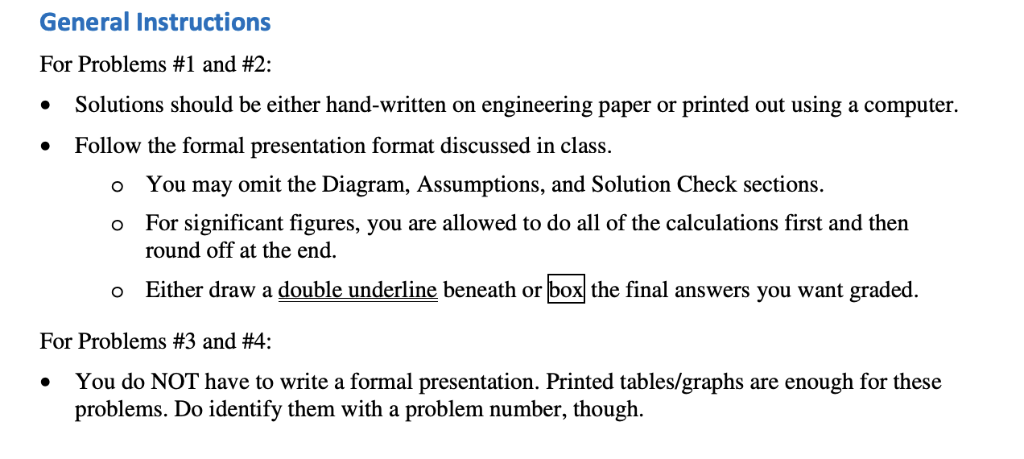
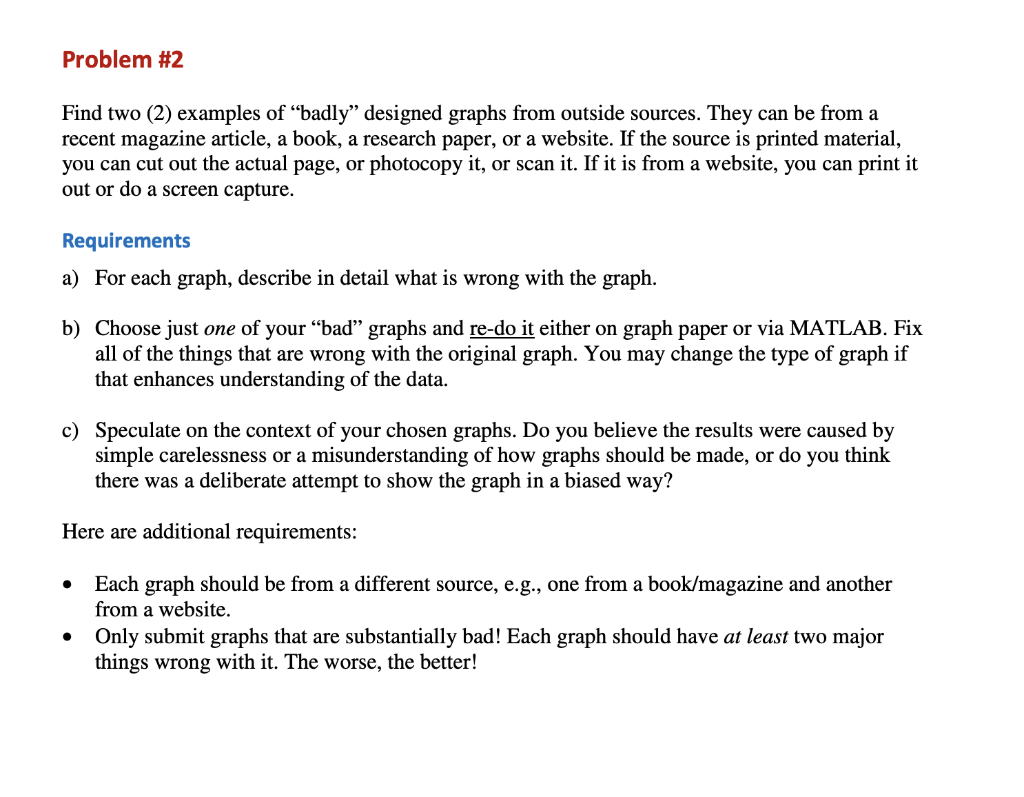
General Instructions For Problems #1 and #2: on engineering paper or printed out using a computer. Follow the formal presentation format discussed in class. . o You may omit the Diagram, Assumptions, and Solution Check sections For significant figures, you are allowed to do all of the calculations first and then round off at the end. o o Either draw a double underline beneath or b the final answers you want graded. For Problems #3 and #4: You do NOT have to write a formal presentation. Printed tables/graphs are enough for these problems. Do identify them with a problem number, though. Problem #2 Find two (2) examples of "badly" designed graphs from outside sources. They can be from a recent magazine article, a book, a research paper, or a website. If the source is printed material, you can cut out the actual page, or photocopy it, or scan it. If it is from a website, you can print it out or do a screen capture Requirements a) For each graph, describe in detail what is wrong with the graph. b) Choose just one of your "bad" graphs and re-do it either on graph paper or via MATLAB. Fix all of the things that are wrong with the original graph. You may change the type of graph if that enhances understanding of the data. Speculate on the context of your chosen graphs. Do you believe the results were caused by simple carelessness or a misunderstanding of how graphs should be made, or do you think there was a deliberate attempt to show the graph in a biased way? c) Here are additional requirements Each graph should be from a different source, e.g. one from a book/magazine and another from a website. Only submit graphs that are substantially bad! Each graph should have at least two major things wrong with it. The worse, the better! General Instructions For Problems #1 and #2: on engineering paper or printed out using a computer. Follow the formal presentation format discussed in class. . o You may omit the Diagram, Assumptions, and Solution Check sections For significant figures, you are allowed to do all of the calculations first and then round off at the end. o o Either draw a double underline beneath or b the final answers you want graded. For Problems #3 and #4: You do NOT have to write a formal presentation. Printed tables/graphs are enough for these problems. Do identify them with a problem number, though. Problem #2 Find two (2) examples of "badly" designed graphs from outside sources. They can be from a recent magazine article, a book, a research paper, or a website. If the source is printed material, you can cut out the actual page, or photocopy it, or scan it. If it is from a website, you can print it out or do a screen capture Requirements a) For each graph, describe in detail what is wrong with the graph. b) Choose just one of your "bad" graphs and re-do it either on graph paper or via MATLAB. Fix all of the things that are wrong with the original graph. You may change the type of graph if that enhances understanding of the data. Speculate on the context of your chosen graphs. Do you believe the results were caused by simple carelessness or a misunderstanding of how graphs should be made, or do you think there was a deliberate attempt to show the graph in a biased way? c) Here are additional requirements Each graph should be from a different source, e.g. one from a book/magazine and another from a website. Only submit graphs that are substantially bad! Each graph should have at least two major things wrong with it. The worse, the better
Step by Step Solution
There are 3 Steps involved in it

Get step-by-step solutions from verified subject matter experts
 Study Help