







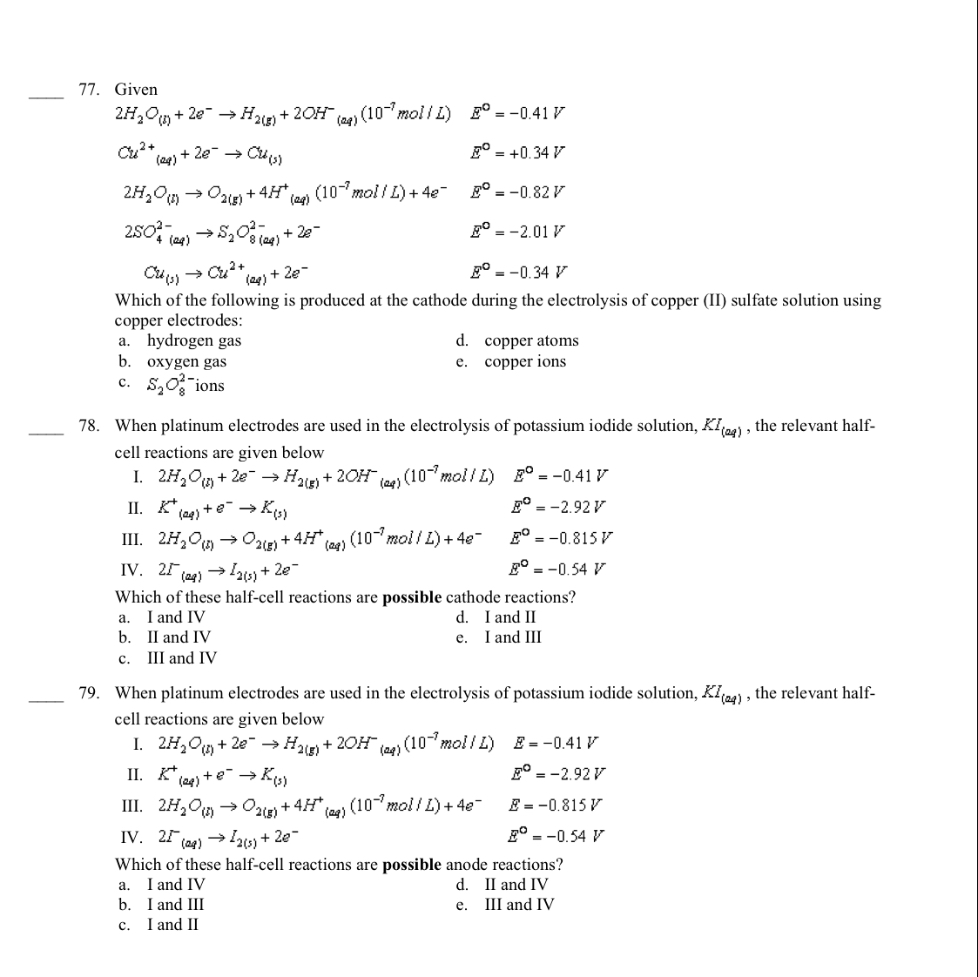
Question: Given 2 H 2 O ( b ) + 2 e - H 2 ( g ) + 2 O H ( a q )
Given
Which of the following is produced at the cathode during the electrolysis of copper II sulfate solution using
copper electrodes:
a hydrogen gas
d copper atoms
b oxygen gas
e copper ions
c ions
When platinum electrodes are used in the electrolysis of potassium iodide solution, the relevant half
cell reactions are given below
I.
II
III.
IV
Which of these halfcell reactions are possible cathode reactions?
a I and IV
d I and II
b II and IV
e I and III
c III and IV
When platinum electrodes are used in the electrolysis of potassium iodide solution, the relevant half
cell reactions are given below
I.
II
III.
IV
Which of these halfcell reactions are possible anode reactions?
a I and IV
d II and IV
b I and III
e III and IV
c I and II
Step by Step Solution
There are 3 Steps involved in it
1 Expert Approved Answer
Step: 1 Unlock

Question Has Been Solved by an Expert!
Get step-by-step solutions from verified subject matter experts
Step: 2 Unlock
Step: 3 Unlock
 Study Help