



Question: Given languages L, and L2 we define delete(L1, L2) to be the language {uw | Uvw L2,ve L} to be the set of strings obtained
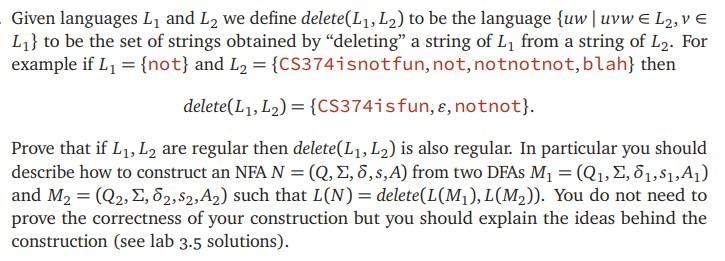
Given languages L, and L2 we define delete(L1, L2) to be the language {uw | Uvw L2,ve L} to be the set of strings obtained by "deleting" a string of L from a string of L2. For example if L1 = {not} and L2 = {CS374isnotfun, not, notnotnot, blah} then delete(L1, L2) = {CS374isfun, e, notnot}. Prove that if L1,L2 are regular then delete(L1, L2) is also regular. In particular you should describe how to construct an NFA N =(Q, 2, 8, s, A) from two DFAs My = (Q1, 2, 81,$1,A1) and M2 = (Q2, 2, 62,92,A2) such that L(N) = delete(L(M), L(M.)). You do not need to prove the correctness of your construction but you should explain the ideas behind the construction (see lab 3.5 solutions)
Step by Step Solution
There are 3 Steps involved in it

Get step-by-step solutions from verified subject matter experts