







Question: Given regular languages L1 and L2, we know that L(M) L(M2) is regular also. The proof in class used the fact that every regular language
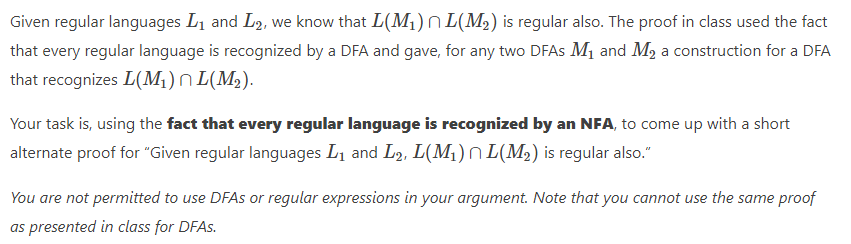
Given regular languages L1 and L2, we know that L(M) L(M2) is regular also. The proof in class used the fact that every regular language is recognized by a DFA and gave, for any two DFAs M and M, a construction for a DFA that recognizes L(M) L(M2). Your task is, using the fact that every regular language is recognized by an NFA, to come up with a short alternate proof for "Given regular languages L1 and L2, L(M) n L(M2) is regular also." You are not permitted to use DFAs or regular expressions in your argument. Note that you cannot use the same proof as presented in class for DFAs
Step by Step Solution
There are 3 Steps involved in it
1 Expert Approved Answer
Step: 1 Unlock

Question Has Been Solved by an Expert!
Get step-by-step solutions from verified subject matter experts
Step: 2 Unlock
Step: 3 Unlock
 Study Help