







Question: Given the function g(z ) = 4x - 12x - 180z, find the first derivative, g (I). g (z) Notice that g'(@) - 0 when
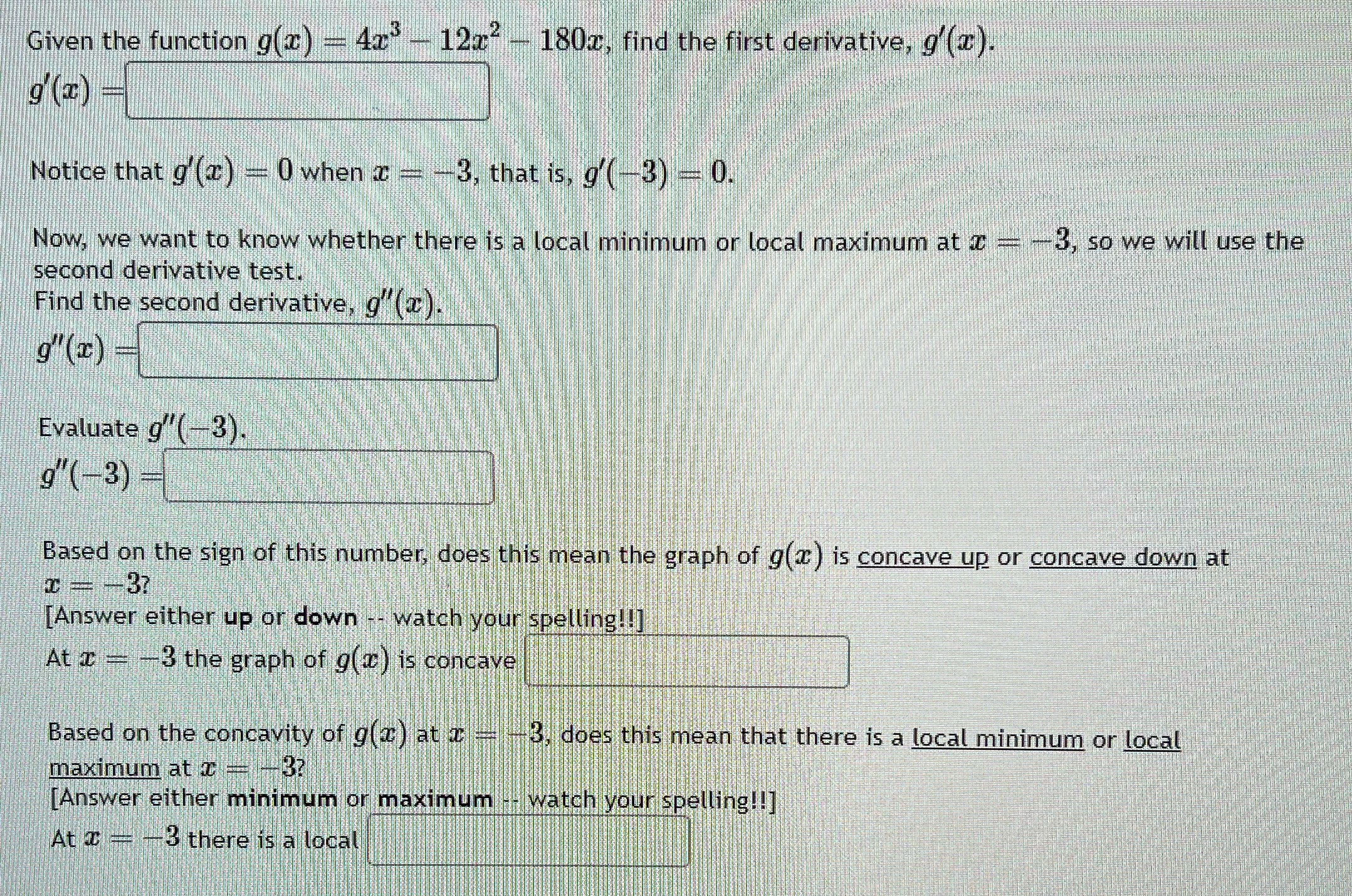
Given the function g(z ) = 4x - 12x - 180z, find the first derivative, g (I). g (z) Notice that g'(@) - 0 when c - - 3, that is, g'( 3) - 0. Now, we want to know whether there is a local minimum or local maximum at @ - -3, so we will use the second derivative test. Find the second derivative, g"(x). g"(z) Evaluate g"(-3). 9"(-3) Based on the sign of this number, does this mean the graph of g( ) is concave up or concave down at C = -37 [Answer either up or down -- watch your spelling!!] At I = -3 the graph of g(2 ) is concave Based on the concavity of g(a ) at z - -3, does this mean that there is a local minimum or local maximum at c - - 3? [Answer either minimum or maximum - - watch your spelling! !] At D = -3 there is a local
Step by Step Solution
There are 3 Steps involved in it

Get step-by-step solutions from verified subject matter experts
 Study Help