







Question: Given we have a cipher that first flips (i.e. convert 1 to 0 and 0 to 1) and then right shifts two bits (circular shift).
Given we have a cipher that first flips (i.e. convert 1 to 0 and 0 to 1) and then right shifts two bits (circular shift). If we use this cipher in encryption, then the decryption process would be left shift two bits and do a flip. We use this cipher with CBC mode. Assume we have a plaintext as following: 10101100 01110001 11000101, block size is 8. So the plaintext can be divided into three blocks. IV is 01000111. The basic CBC diagram is shown as following:
Find ciphertext based on part (a) of the diagram.
Generate the recovered plaintext based on part (b) of the diagram. Show your steps. The recovered plaintext should be same as the original plaintext
Assuming No. 7 bit in the plaintext got bit error (i.e. flipped by accident), the plaintext becomes: 10101110 01110001 11000101. For this plaintext, find the ciphertext and the recovered plaintext again.
Compare the results of the ciphertext and the recovered plaintext from b and c. How does one-bit difference in the first plaintext block affect the ciphertext result and recovered plaintext result?
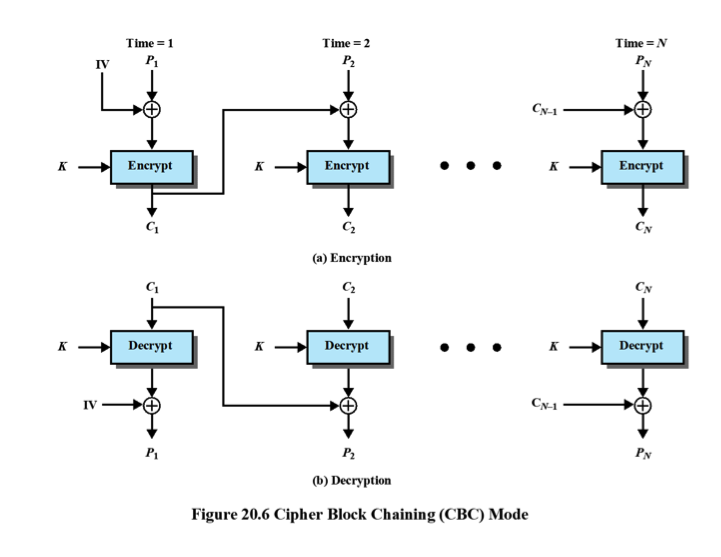
Time= 1 Time = 2 Time = N IV K Encrypt K Encrypt K Encrypt C2 (a) Encryption C2 C1 Decrypt K Decrypt K Decrypt N-1 P2 Pv (b) Decryption Figure 20.6 Cipher Block Chaining (CBC) Mode
Step by Step Solution
There are 3 Steps involved in it

Get step-by-step solutions from verified subject matter experts
 Study Help