







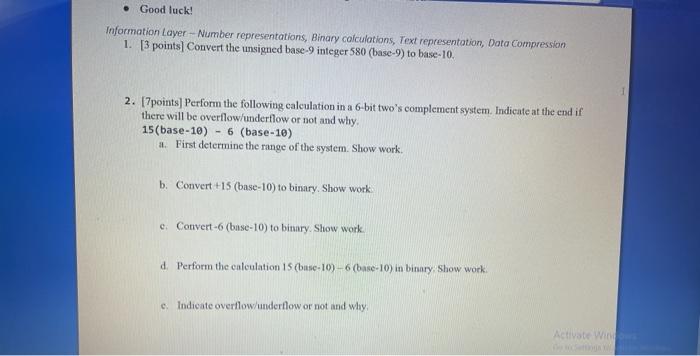
Question: Good luck! Information Layer -- Number representations, Binary calculations, Text representation, Data Compression 1. [3 points] Convert the unsigned base-9 integer 580 (base-9) to base-10.
![Data Compression 1. [3 points] Convert the unsigned base-9 integer 580 (base-9)](https://dsd5zvtm8ll6.cloudfront.net/si.experts.images/questions/2024/09/66f454eedc507_55866f454eeb2a58.jpg)
Good luck! Information Layer -- Number representations, Binary calculations, Text representation, Data Compression 1. [3 points] Convert the unsigned base-9 integer 580 (base-9) to base-10. 2. [7points) Perform the following calculation in a 6-bit two's complement system. Indicate at the end if there will be overflow/underflow or not and why. 15(base-10) - 6 (base-10) a. First determine the range of the system. Show work. b. Convert +15 (base-10) to binary. Show work e Convert-6 (base-10) to binary. Show work. d. Perform the calculation 1 (base-10) - 6 (base-10) in binary Show work e Indicate overflow/underflow or not and why Activate Wine 3. [2 points) What is the signed base-10 value of 11011 which is in 5-bit sign-magnitude system. Show work 4. [3 points] Suppose that some text contains 10 characters and uncompressed text is being represented using ASCII encoding. We apply Run-length compression algorithm to the text and see that the compressed text size is 7 Bytes. We then apply Huffman compression algorithm to the text (original text) and see that the compressed text size is 64 bits. Which of the two compression algorithms will be your final choice and why? Give reasoning by calculating and comparing compression ratios. Activate Wing
Step by Step Solution
There are 3 Steps involved in it

Get step-by-step solutions from verified subject matter experts
 Study Help