







Question: Graph Input Tool Daily Demand for Pollution Rights table [ [ Price , ] , [ ( Dollars per ton ) , ] ,
Graph Input Tool
Daily Demand for Pollution Rights
tablePriceDollars per tonQuantityDemandedMillions of tons
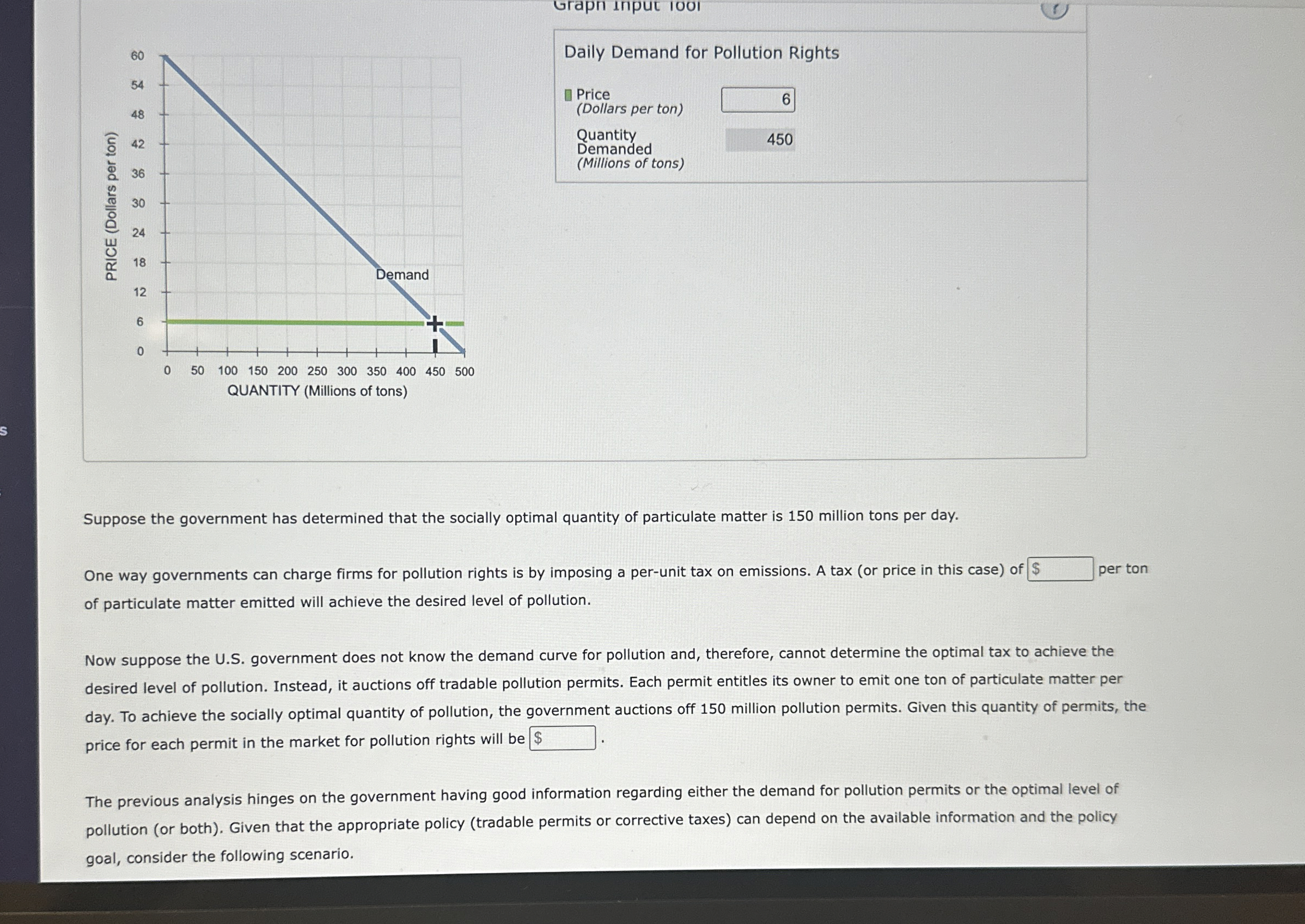
Suppose the government has determined that the socially optimal quancty of particulate matter is million tons per day.
One way governments can charge firms for pollution rights is by imposing a perunit tax on emissions. A tax or price in this case of per ton of particulate matter emitted will achieve the desired level of pollution.
Now suppose the US government does not know the demand curve for pollution and, therefore, cannot determine the optimal tax to achieve the desired level of pollution. Instead, it auctions off tradable pollution permits. Each permit entitles its owner to emit one ton of particulate matter per day. To achieve the socially optimal quantity of pollution, the government auctions off million pollution permits. Given this quantity of permits, the price for each permit in the market for pollution rights will be
The previous analysis hinges on the government having good information regarding either the demand for pollution permits or the optimal level of pollution or both Given that the appropriate policy tradable permits or corrective taxes can depend on the available information and the policy goal, consider the following scenario.
Suppose the government has determined that the socially optimal quantity of particulate matter is million tons per day.
One way governments can charge firms for pollution rights is by imposing a perunit tax on emissions. A tax or price in this case of per ton of particulate matter emitted will achieve the desired level of pollution.
Now suppose the US government does not know the demand curve for pollution and, therefore, cannot determine the optimal tax to achieve the desired level of pollution. Instead, it auctions off tradable pollution permits. Each permit entitles its owner to emit one ton of particulate matter per day. To achieve the socially optimal quantity of pollution, the government auctions off million pollution permits. Given this quantity of permits, the price for each permit in the market for pollution rights will be
The previous analysis hinges on the government having good information regarding either the demand for pollution permits or the optimal level of pollution or both Given that the appropriate policy tradable permits or corrective taxes can depend on the available information and the policy goal, consider the following scenario.
Suppose the government knows the optimal quantity of pollution as well as how much it costs a particular polluting firm to reduce pollution at each quantity.
If this is all the information the government has, which solution to reduce pollution is appropriate? Check all that apply.
Tradable permits
Corrective taxes
Grapn input looi
Daily Demand for Pollution Rights
tablePriceDollars per tonQuantityDemandedMillions of tons
Suppose the government has determined that the socially optimal quantity of particulate matter is million tons per day.
One way governments can charge firms for pollution rights is by imposing a perunit tax on emissions. A tax or price in this case of per ton of particulate matter emitted will achieve the desired level of pollution.
Now suppose the US government does not know the demand curve for pollution and, therefore, cannot determine the optimal tax to achieve the desired level of pollution. Instead, it auctions off tradable pollution permits. Each permit entitles its owner to emit one ton of particulate matter per day. To achieve the socially optimal quantity of pollution, the government auctions off million pollution permits. Given this quantity of permits, the price for each permit in the market for pollution rights will be
The previous analysis hinges on the government having good information regarding either the demand for pollution permits or the optimal level of pollution or both Given that the appropriate policy tradable permits or corrective taxes can depend on the available information and the policy goal, consider the following scenario.
Step by Step Solution
There are 3 Steps involved in it
1 Expert Approved Answer
Step: 1 Unlock

Question Has Been Solved by an Expert!
Get step-by-step solutions from verified subject matter experts
Step: 2 Unlock
Step: 3 Unlock
 Study Help