



Question: Guarantee thumbs up if good!!!!! Read this below: Once you have read this please answer these questions!!: 1. Come up with a Vision Statement for
Guarantee thumbs up if good!!!!!
Read this below:
Once you have read this please answer these questions!!:
1. Come up with a Vision Statement for this company:
2. Come up with a Mission Statement for this company:
You must answer these two questions above ^^ for full credit and answer them just right, not to long BUT NOT TO SHORT, Just right! Also maybe be prepared to be able to communicate with me in comments for concerns. Thank you! If it is well I will 100% leave a thumbs up!
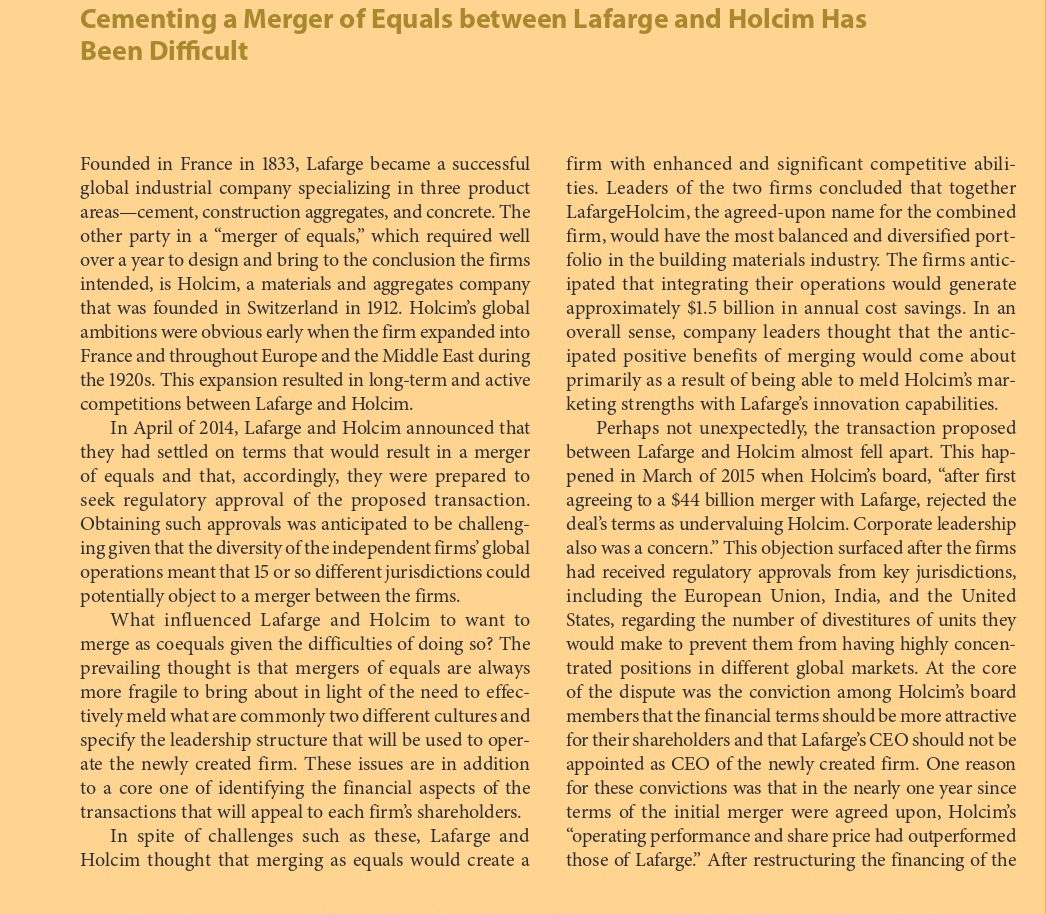
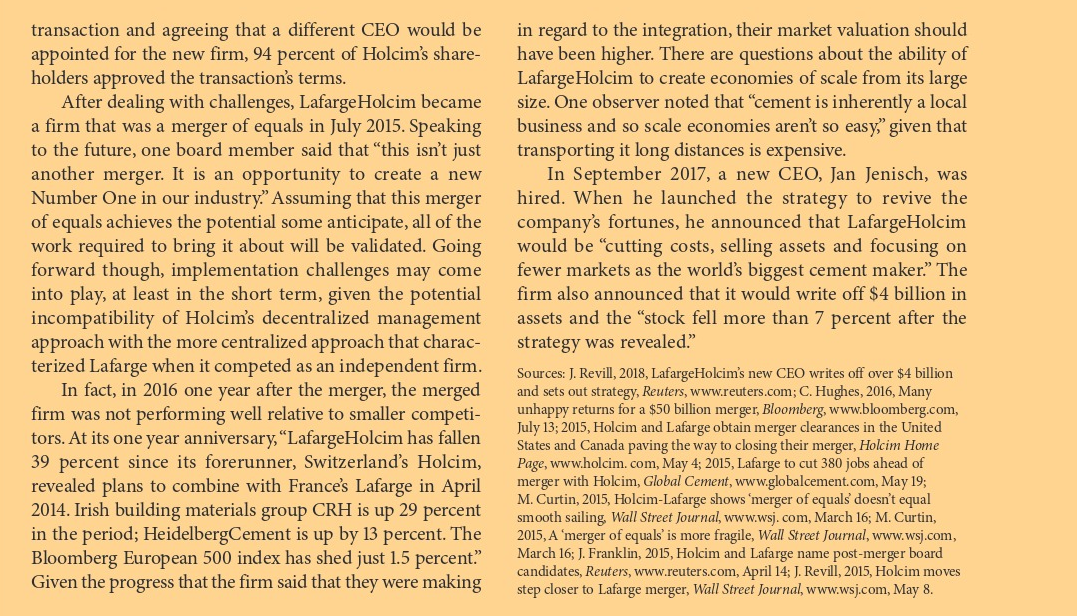
Cementing a Merger of Equals between Lafarge and Holcim Has Been Difficult Founded in France in 1833, Lafarge became a successful global industrial company specializing in three product areascement, construction aggregates, and concrete. The other party in a merger of equals, which required well over a year to design and bring to the conclusion the firms intended, is Holcim, a materials and aggregates company that was founded in Switzerland in 1912. Holcim's global ambitions were obvious early when the firm expanded into France and throughout Europe and the Middle East during the 1920s. This expansion resulted in long-term and active competitions between Lafarge and Holcim. In April of 2014, Lafarge and Holcim announced that they had settled on terms that would result in a merger of equals and that, accordingly, they were prepared to seek regulatory approval of the proposed transaction. Obtaining such approvals was anticipated to be challeng- ing given that the diversity of the independent firms global operations meant that 15 or so different jurisdictions could potentially object to a merger between the firms. What influenced Lafarge and Holcim to want to merge as coequals given the difficulties of doing so? The prevailing thought is that mergers of equals are always more fragile to bring about in light of the need to effec- tively meld what are commonly two different cultures and specify the leadership structure that will be used to oper- ate the newly created firm. These issues are in addition to a core one of identifying the financial aspects of the transactions that will appeal to each firm's shareholders. In spite of challenges such as these, Lafarge and Holcim thought that merging as equals would create a firm with enhanced and significant competitive abili- ties. Leaders of the two firms concluded that together LafargeHolcim, the agreed-upon name for the combined firm, would have the most balanced and diversified port- folio in the building materials industry. The firms antic- ipated that integrating their operations would generate approximately $1.5 billion in annual cost savings. In an overall sense, company leaders thought that the antic- ipated positive benefits of merging would come about primarily as a result of being able to meld Holcim's mar- keting strengths with Lafarge's innovation capabilities. Perhaps not unexpectedly, the transaction proposed between Lafarge and Holcim almost fell apart. This hap- pened in March of 2015 when Holcim's board, after first agreeing to a $44 billion merger with Lafarge, rejected the deal's terms as undervaluing Holcim. Corporate leadership also was a concern. This objection surfaced after the firms had received regulatory approvals from key jurisdictions, including the European Union, India, and the United States, regarding the number of divestitures of units they would make to prevent them from having highly concen- trated positions in different global markets. At the core of the dispute was the conviction among Holcim's board members that the financial terms should be more attractive for their shareholders and that Lafarge's CEO should not be appointed as CEO of the newly created firm. One reason for these convictions was that in the nearly one year since terms of the initial merger were agreed upon, Holcim's operating performance and share price had outperformed those of Lafarge After restructuring the financing of the transaction and agreeing that a different CEO would be appointed for the new firm, 94 percent of Holcim's share- holders approved the transaction's terms. After dealing with challenges, Lafarge Holcim became a firm that was a merger of equals in July 2015. Speaking to the future, one board member said that this isn't just another merger. It is an opportunity to create a new Number One in our industry. Assuming that this merger of equals achieves the potential some anticipate, all of the work required to bring it about will be validated. Going forward though, implementation challenges may come into play, at least in the short term, given the potential incompatibility of Holcim's decentralized management approach with the more centralized approach that charac- terized Lafarge when it competed as an independent firm. In fact, in 2016 one year after the merger, the merged firm was not performing well relative to smaller competi- tors. At its one year anniversary, Lafarge Holcim has fallen 39 percent since its forerunner, Switzerland's Holcim, revealed plans to combine with France's Lafarge in April 2014. Irish building materials group CRH is up 29 percent in the period; HeidelbergCement is up by 13 percent. The Bloomberg European 500 index has shed just 1.5 percent Given the progress that the firm said that they were making in regard to the integration, their market valuation should have been higher. There are questions about the ability of Lafarge Holcim to create economies of scale from its large size. One observer noted that "cement is inherently a local business and so scale economies aren't so easy, given that transporting it long distances is expensive. In September 2017, a new CEO, Jan Jenisch, was hired. When he launched the strategy to revive the company's fortunes, he announced that LafargeHolcim would be "cutting costs, selling assets and focusing on fewer markets as the world's biggest cement maker. The firm also announced that it would write off $4 billion in assets and the "stock fell more than 7 percent after the strategy was revealed. Sources: J. Revill, 2018, Lafarge Holcim's new CEO writes off over $4 billion and sets out strategy, Reuters, www.reuters.com; C. Hughes, 2016, Many unhappy returns for a $50 billion merger, Bloomberg, www.bloomberg.com, July 13, 2015, Holcim and Lafarge obtain merger clearances in the United States and Canada paving the way to closing their merger, Holcim Home Page, www.h .com, May 4; 2015, Lafarge to cut 380 jobs ahead of merger with Holcim, Global Cement, www.globalcement.com, May 19; M. Curtin, 2015, Holcim-Lafarge shows merger of equals' doesn't equal smooth sailing, Wall Street Journal, www.wsj.com, March 16; M. Curtin, 2015, A 'merger of equals' is more fragile, Wall Street Journal, www.wsj.com, March 16; J. Franklin, 2015, Holcim and Lafarge name post-merger board candidates, Reuters, www.reuters.com, April 14; J. Revill, 2015, Holcim moves step closer to Lafarge merger, Wall Street Journal, www.wsj.com, May 8Step by Step Solution
There are 3 Steps involved in it
1 Expert Approved Answer
Step: 1 Unlock

Question Has Been Solved by an Expert!
Get step-by-step solutions from verified subject matter experts
Step: 2 Unlock
Step: 3 Unlock