







Question: having troubles with part (c). need it programmed in Python 3.9 Exercise 2.11: Binomial coefficients The binomial coefficient () is an integer equal to n!
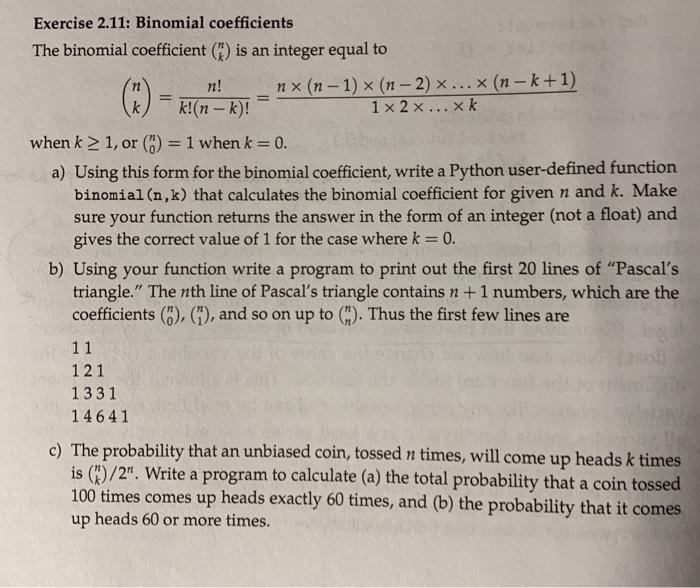
Exercise 2.11: Binomial coefficients The binomial coefficient () is an integer equal to n! nx (n-1) x (n - 2) ...x (n-k+1) k!(n - k)! 1x 2 x... xk when k > 1, or (%) = 1 when k = 0. a) Using this form for the binomial coefficient, write a Python user-defined function binomial(n,k) that calculates the binomial coefficient for given n and k. Make sure your function returns the answer in the form of an integer (not a float) and gives the correct value of 1 for the case where k = 0. b) Using your function write a program to print out the first 20 lines of "Pascal's triangle." The nth line of Pascal's triangle contains n +1 numbers, which are the coefficients (). (), and so on up to (). Thus the first few lines are 11 121 1331 14641 c) The probability that an unbiased coin, tossed n times, will come up heads k times is (*)/2". Write a program to calculate (a) the total probability that a coin tossed 100 times comes up heads exactly 60 times, and (b) the probability that it comes up heads 60 or more times
Step by Step Solution
There are 3 Steps involved in it

Get step-by-step solutions from verified subject matter experts
 Study Help