







Question: Heat transfer + Two parallel conducting plates exhibit a large voltage difference (4%), and are held by a bundle of circular section rods with length
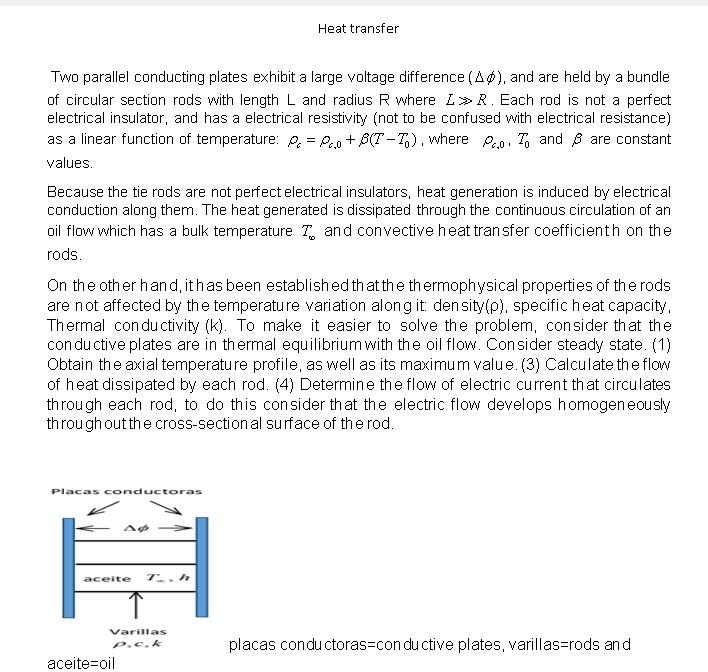
Heat transfer + Two parallel conducting plates exhibit a large voltage difference (4%), and are held by a bundle of circular section rods with length L and radius R where LR. Each rod is not a perfect electrical insulator, and has a electrical resistivity (not to be confused with electrical resistance) as a linear function of temperature: 0. = 26.0 +8(7-7), where P0. To and 8 are constant values. Because the tie rods are not perfect electrical insulators, heat generation is induced by electrical conduction along them. The heat generated is dissipated through the continuous circulation of an oil flow which has a bulk temperature 7. and convective heat transfer coefficienth on the rods. On the other hand, ithas been established that the thermophysical properties of the rods are not affected by the temperature variation alongit: density(p), specific heat capacity. Thermal conductivity (k). To make it easier to solve the problem, consider th at the conductive plates are in thermal equilibrium with the oil flow. Consider steady state (1) Obtain the axial temperature profile, as well as its maximum value. (3) Calculate the flow of heat dissipated by each rod. (4) Determine the flow of electric current that circulates through each rod, to do this consider that the electric flow develops homogeneously throughout the cross-section al surface of the rod. Placas conductoras aceite Varillas A.C. placas conductoras-conductive plates, varillas=rods and aceite=oil Heat transfer + Two parallel conducting plates exhibit a large voltage difference (4%), and are held by a bundle of circular section rods with length L and radius R where LR. Each rod is not a perfect electrical insulator, and has a electrical resistivity (not to be confused with electrical resistance) as a linear function of temperature: 0. = 26.0 +8(7-7), where P0. To and 8 are constant values. Because the tie rods are not perfect electrical insulators, heat generation is induced by electrical conduction along them. The heat generated is dissipated through the continuous circulation of an oil flow which has a bulk temperature 7. and convective heat transfer coefficienth on the rods. On the other hand, ithas been established that the thermophysical properties of the rods are not affected by the temperature variation alongit: density(p), specific heat capacity. Thermal conductivity (k). To make it easier to solve the problem, consider th at the conductive plates are in thermal equilibrium with the oil flow. Consider steady state (1) Obtain the axial temperature profile, as well as its maximum value. (3) Calculate the flow of heat dissipated by each rod. (4) Determine the flow of electric current that circulates through each rod, to do this consider that the electric flow develops homogeneously throughout the cross-section al surface of the rod. Placas conductoras aceite Varillas A.C. placas conductoras-conductive plates, varillas=rods and aceite=oil
Step by Step Solution
There are 3 Steps involved in it

Get step-by-step solutions from verified subject matter experts
 Study Help