



Question: Heating Graph of Water When a substance cools down or warms up, a specific pattern of temperature changes occurs. During a change of state, the
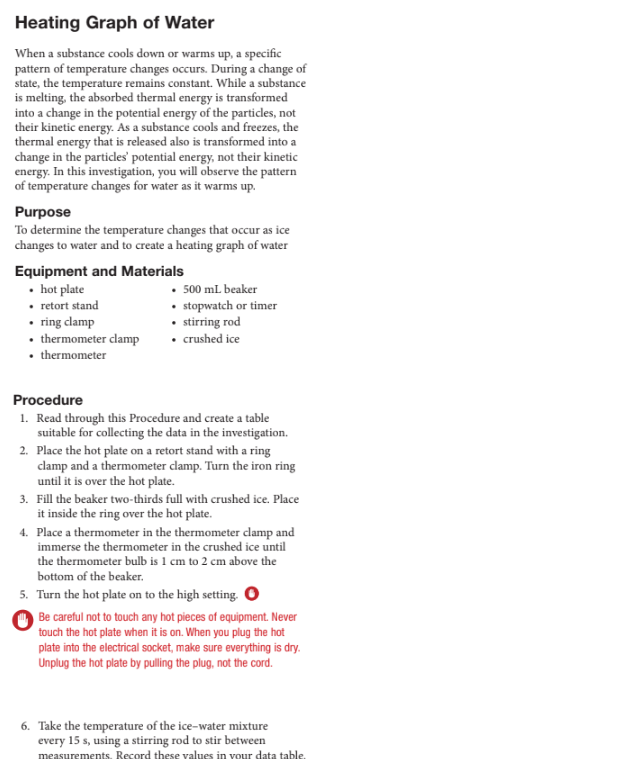
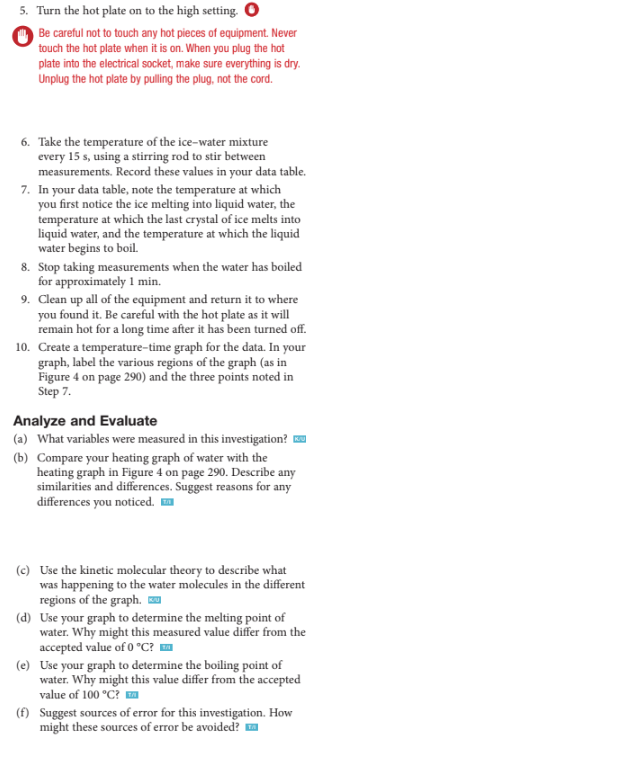
Heating Graph of Water When a substance cools down or warms up, a specific pattern of temperature changes occurs. During a change of state, the temperature remains constant. While a substance is melting, the absorbed thermal energy is transformed into a change in the potential energy of the particles, not their kinetic energy. As a substance cools and freezes, the thermal energy that is released also is transformed into a change in the particles' potential energy, not their kinetic energy. In this investigation, you will observe the pattern of temperature changes for water as it warms up. Purpose To determine the temperature changes that occur as ice changes to water and to create a heating graph of water Equipment and Materials . hot plate . 500 mL beaker . retort stand . stopwatch or timer . ring clamp . stirring rod . thermometer clamp . crushed ice . thermometer Procedure 1. Read through this Procedure and create a table suitable for collecting the data in the investigation. 2. Place the hot plate on a retort stand with a ring clamp and a thermometer clamp. Turn the iron ring until it is over the hot plate. 3. Fill the beaker two-thirds full with crushed ice. Place it inside the ring over the hot plate. 4. Place a thermometer in the thermometer clamp and immerse the thermometer in the crushed ice until the thermometer bulb is 1 cm to 2 cm above the bottom of the beaker. 5. Turn the hot plate on to the high setting O O Be careful not to touch any hot pieces of equipment. Never ouch the hot plate when it is on. When you plug the hot plate into the electrical socket, make sure everything is dry. Unplug the hot plate by pulling the plug, not the cord. 6. Take the temperature of the ice-water mixture every 15 s, using a stirring rod to stir between5. Turn the hot plate on to the high setting. O O Be careful not to touch any hot pieces of equipment. Never touch the hot plate when it is on. When you plug the hot plate into the electrical socket, make sure everything is dry. Unplug the hot plate by pulling the plug, not the cord. 6. Take the temperature of the ice-water mixture every 15 s, using a stirring rod to stir between measurements. Record these values in your data table. 7. In your data table, note the temperature at which you first notice the ice melting into liquid water, the temperature at which the last crystal of ice melts into liquid water, and the temperature at which the liquid water begins to boil. 8. Stop taking measurements when the water has boiled for approximately 1 min. 9. Clean up all of the equipment and return it to where you found it. Be careful with the hot plate as it will remain hot for a long time after it has been turned off. 10. Create a temperature-time graph for the data. In your graph, label the various regions of the graph (as in Figure 4 on page 290) and the three points noted in Step 7. Analyze and Evaluate (a) What variables were measured in this investigation? Ru (b) Compare your heating graph of water with the heating graph in Figure 4 on page 290. Describe any similarities and differences. Suggest reasons for any differences you noticed. im (c) Use the kinetic molecular theory to describe what was happening to the water molecules in the different regions of the graph. au (d) Use your graph to determine the melting point of water. Why might this measured value differ from the accepted value of 0 "C? (e) Use your graph to determine the boiling point of water. Why might this value differ from the accepted value of 100 "C? mm (f) Suggest sources of error for this investigation. How might these sources of error be avoided? im
Step by Step Solution
There are 3 Steps involved in it

Get step-by-step solutions from verified subject matter experts