







Question: please help answer these questions. Phase Changes Each individuat chemical (whilie in its llquid state) has what is caled a freexing and a bolling point.
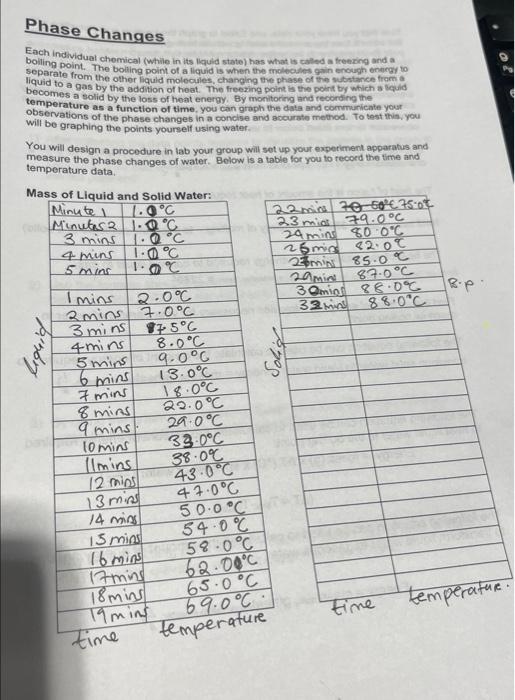
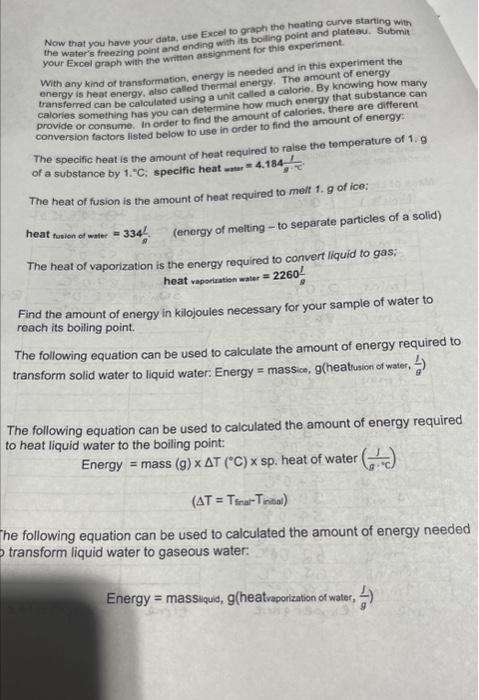
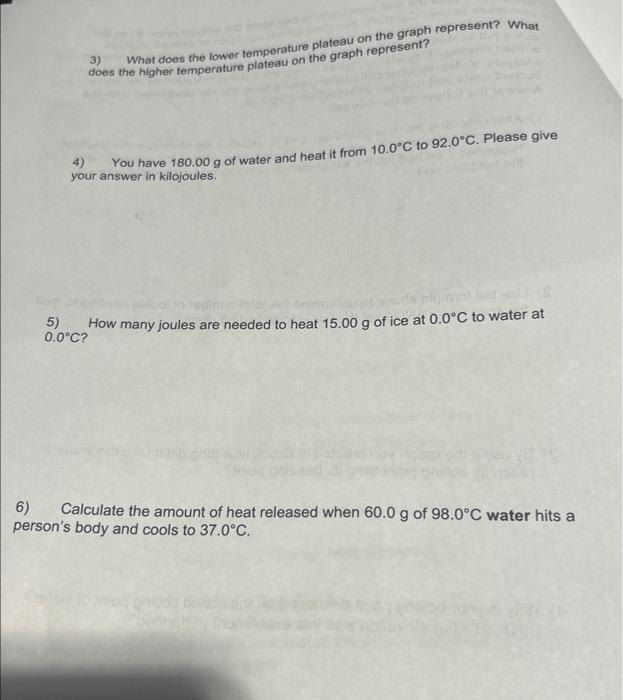
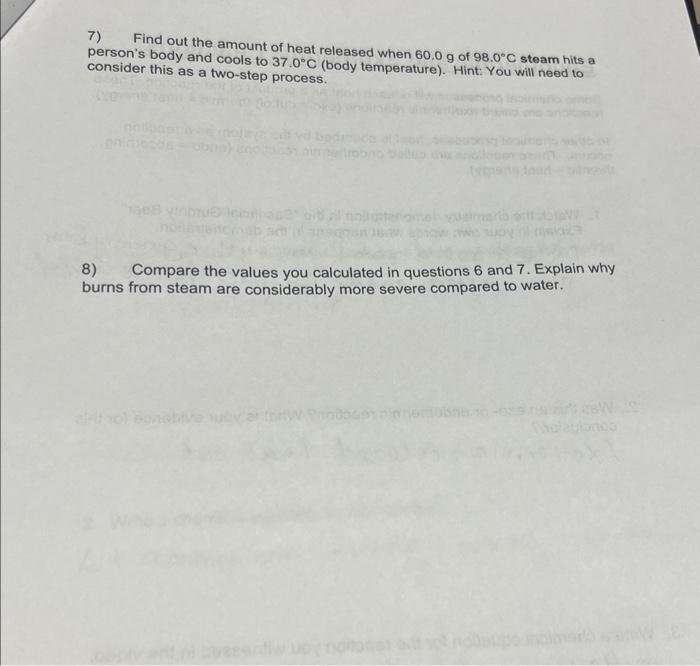
Phase Changes Each individuat chemical (whilie in its llquid state) has what is caled a freexing and a bolling point. The bolling point of a llquid is when the molecules gain enough endrgy to separate from the other pquint molecules, changing the phase of the substance fram a becomes a solid by the loss of heat energy. By monitoring and recording the temperature as a function of time, you can graph the data and commuricate yout observations of the phase changes in a conclse and accurate method. To test this, you will be graphing the points yourself using water. You will design a procedure in lab your group will set up your experiment apparatus and measure the phase changes of water. Below is a table for you to record the time and temperature data, Now that you have your data, use Excel to graph the heating curve starting wht the waters treezing point and ending with its bolling point and plateaU. Submit your Excel graph with the witton assignment for this experiment. With any kind of transformation, energy is needed and in this experiment the energy is heat energy, atso callod thermal energy. The amount of energy transferred can be calculated using a unit called a calorie. By knowing how many calories something has you can detemine how much energy there are different provide or consume. In order to find the amount of calord the amount of energy: conversion factors listed below to use in order to find theat is the amount of heat required to raise the temperature of 1.9 of a substance by 1.C; specific heat war =4.184gl. The heat of fusion is the amount of heat required to melt 1. g of ice: heat fusion of water =334NL. (energy of melting - to separate particles of a solid) The heat of vaporization is the energy required to convert liquid to gas: heatvaporiationwaser=2260gL Find the amount of energy in kilojoules necessary for your sample of water to reach its boiling point. The following equation can be used to calculate the amount of energy required to transform solid water to liquid water. Energy = massice, g( heatusice of water, g4) The following equation can be used to calculated the amount of energy required to heat liquid water to the boiling point: Energy=mass(g)T(C)sp.heatofwater(gC1) (T=TfralTinsial) he following equation can be used to calculated the amount of energy needed transform liquid water to gaseous water: Energy = massilquid, g( heatvaporization of water, g) 3) What does the lower temperature plateau on the graph represent? What does the higher temperature plateau on the graph represent? 4) You have 180.00g of water and heat it from 10.0C to 92.0C. Please give your answer in kilojoules. 5) How many joules are needed to heat 15.00g of ice at 0.0C to water at 0.0C? 6) Calculate the amount of heat released when 60.0g of 98.0C water hits a person's body and cools to 37.0C. 7) Find out the amount of heat released when 60.0g of 98.0C steam hits a person's body and cools to 37.0C (body temperature). Hint: You will need to consider this as a two-step process. 8) Compare the values you calculated in questions 6 and 7. Explain why burns from steam are considerably more severe compared to water
Step by Step Solution
There are 3 Steps involved in it

Get step-by-step solutions from verified subject matter experts
 Study Help