







Question: Hello all, I have few concerns and specificity that needs to be followed in the below mentioned question, those are as follows 1. Java Programming
Hello all,
I have few concerns and specificity that needs to be followed in the below mentioned question, those are as follows
1. Java Programming is preferred,
2. If you help us with the entire sub questions and answers it might be helpful to learn and execute the same,
3. And for sub questions C, D and E, Kindly provide with the timing instance graph,
Waiting fingers crossed :)
Thank You in advance
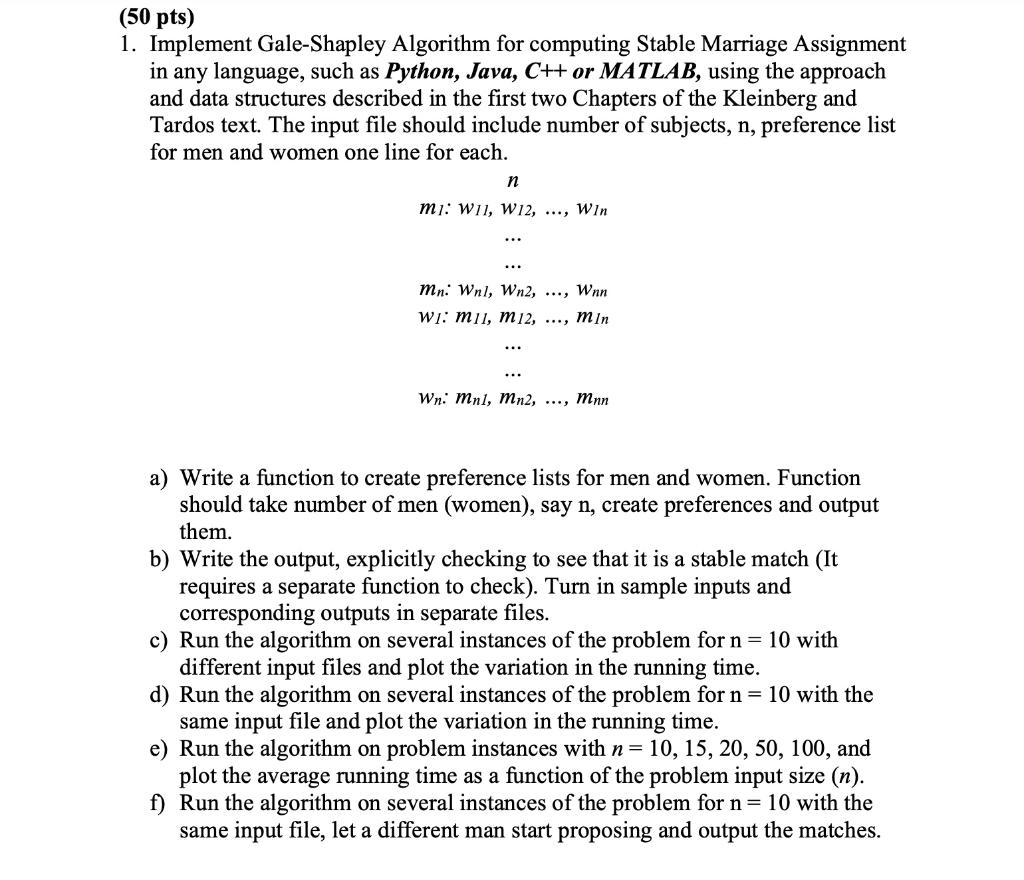
(50 pts) 1. Implement Gale-Shapley Algorithm for computing Stable Marriage Assignment in any language, such as Python, Java, C++ or MATLAB, using the approach and data structures described in the first two Chapters of the Kleinberg and Tardos text. The input file should include number of subjects, n, preference list for men and women one line for each. n mi: WII, W12, ..., Win ... mn. Wnl, Wn2, ..., Wnn WI: mil, mi2, ..., min ... Wn: mnl, mn2, ..., mnn a) Write a function to create preference lists for men and women. Function should take number of men (women), say n, create preferences and output them. b) Write the output, explicitly checking to see that it is a stable match (It requires a separate function to check). Turn in sample inputs and corresponding outputs in separate files. c) Run the algorithm on several instances of the problem for n= 10 with different input files and plot the variation in the running time. d) Run the algorithm on several instances of the problem for n = 10 with the same input file and plot the variation in the running time. e) Run the algorithm on problem instances with n= 10, 15, 20, 50, 100, and plot the average running time as a function of the problem input size (n). f) Run the algorithm on several instances of the problem for n= 10 with the same input file, let a different man start proposing and output the matches. (50 pts) 1. Implement Gale-Shapley Algorithm for computing Stable Marriage Assignment in any language, such as Python, Java, C++ or MATLAB, using the approach and data structures described in the first two Chapters of the Kleinberg and Tardos text. The input file should include number of subjects, n, preference list for men and women one line for each. n mi: WII, W12, ..., Win ... mn. Wnl, Wn2, ..., Wnn WI: mil, mi2, ..., min ... Wn: mnl, mn2, ..., mnn a) Write a function to create preference lists for men and women. Function should take number of men (women), say n, create preferences and output them. b) Write the output, explicitly checking to see that it is a stable match (It requires a separate function to check). Turn in sample inputs and corresponding outputs in separate files. c) Run the algorithm on several instances of the problem for n= 10 with different input files and plot the variation in the running time. d) Run the algorithm on several instances of the problem for n = 10 with the same input file and plot the variation in the running time. e) Run the algorithm on problem instances with n= 10, 15, 20, 50, 100, and plot the average running time as a function of the problem input size (n). f) Run the algorithm on several instances of the problem for n= 10 with the same input file, let a different man start proposing and output the matches
Step by Step Solution
There are 3 Steps involved in it

Get step-by-step solutions from verified subject matter experts
 Study Help