Question: HELLO. I have a DCSN 200 (OM) case study i desperately need help with. Im having trouble with little's law and balanced system i'd really
 HELLO. I have a DCSN 200 (OM) case study i desperately need help with. Im having trouble with little's law and balanced system i'd really appreciate help. Thanks in advance my problem is in xtm bike corporation an exercice in process analysis
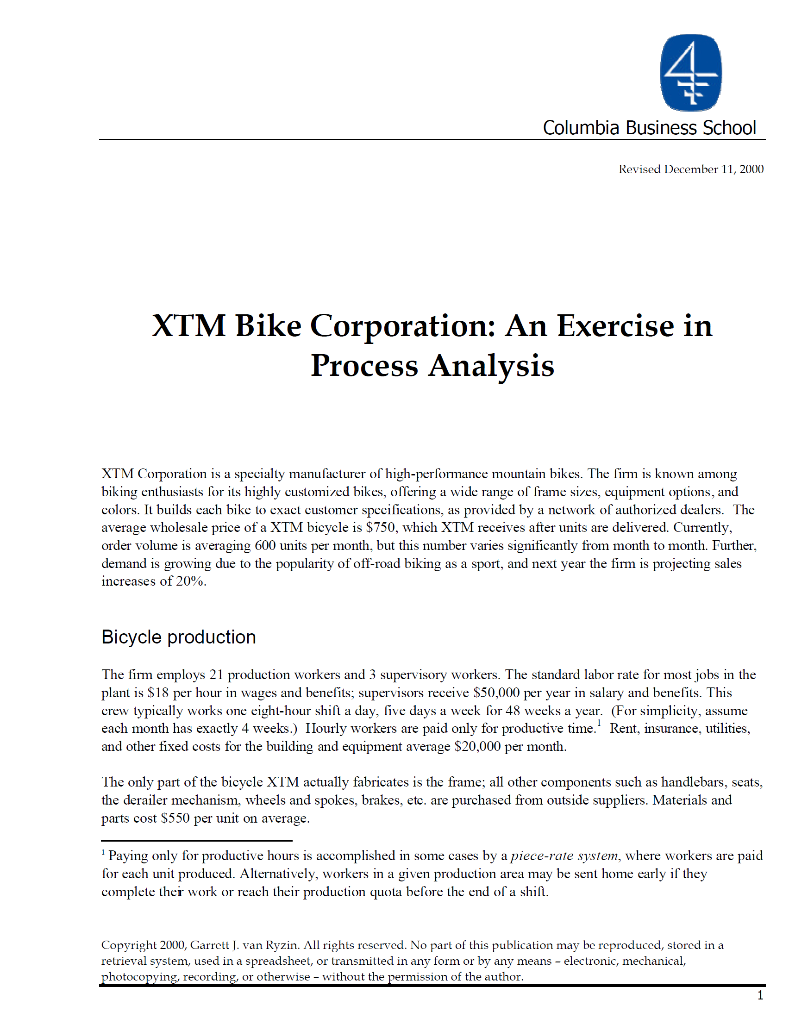
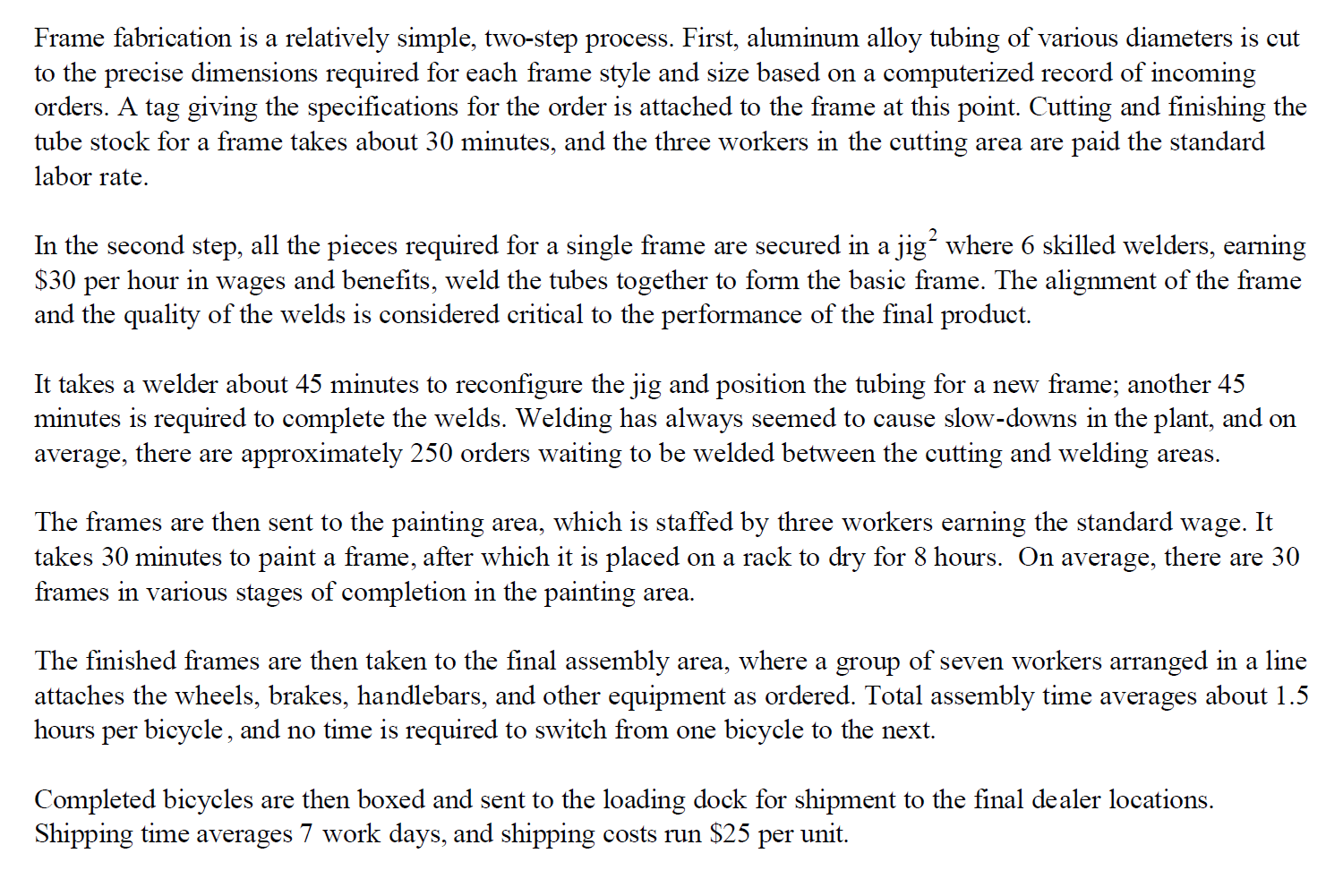
Columbia Business School Revised December 11, 2000 XTM Bike Corporation: An Exercise in Process Analysis XTM Corporation is a specialty manufacturer of high-performance mountain bikes. The linn is known among hiking enthusiasts for its highly customized bikes, offering a wide range of frame sizes, equipment options, and colors. It builds cach bike to exact customer specifications, as provided by a network of authorized dealers. The average wholesale price of a XTM bicycle is $750, which XTM receives after units are delivered. Currently, order volume is averaging 600 units per month, but this number varies significantly from month to month. Further, demand is growing due to the popularity of off-road biking as a sport, and next year the firm is projecting sales increases of 20%. Bicycle production The firm employs 21 production workers and 3 supervisory workers. The standard labor rate for most jobs in the plant is $18 per hour in wages and benefits; supervisors receive $50,000 per year in salary and benefits. This crew typically works one eight-hour shift a day, live days a week for 48 weeks a year. (For simplicity, assume each month has exactly 4 weeks.) Ilourly workers are paid only for productive time.' Rent, insurance, utilities, and other fixed costs for the building and equipment average $20,000 per month The only part of the bicycle XTM actually fabricates is the frame; all other components such as handlebars, seats, the derailer mechanism, wheels and spokes, brakes, etc. are purchased from outside suppliers. Materials and parts cost $550 per unit on average Paying only for productive hours is accomplished in some cases by a piece-rate system, where workers are paid for each unit produced. Alternatively, workers in a given production area may be sent home carly if they complete their work or reach their production quota before the end of a shil. Copyright 2000, Garrett J. van Ryzin. All rights reserved. No part of this publication may be reproduced, stored in a retrieval system, used in a spreadsheet, or transmitted in any form or by any means - electronic, mechanical, photocopying, recording, or otherwise - without the permission of the author. Frame fabrication is a relatively simple, two-step process. First, aluminum alloy tubing of various diameters is cut to the precise dimensions required for each frame style and size based on a computerized record of incoming orders. A tag giving the specifications for the order is attached to the frame at this point. Cutting and finishing the tube stock for a frame takes about 30 minutes, and the three workers in the cutting area are paid the standard labor rate. In the second step, all the pieces required for a single frame are secured in a jig? where 6 skilled welders, earning $30 per hour in wages and benefits, weld the tubes together to form the basic frame. The alignment of the frame and the quality of the welds is considered critical to the performance of the final product. It takes a welder about 45 minutes to reconfigure the jig and position the tubing for a new frame; another 45 minutes is required to complete the welds. Welding has always seemed to cause slow-downs in the plant, and on average, there are approximately 250 orders waiting to be welded between the cutting and welding areas. The frames are then sent to the painting area, which is staffed by three workers earning the standard wage. It takes 30 minutes to paint a frame, after which it is placed on a rack to dry for 8 hours. On average, there are 30 frames in various stages of completion in the painting area. The finished frames are then taken to the final assembly area, where a group of seven workers arranged in a line attaches the wheels, brakes, handlebars, and other equipment as ordered. Total assembly time averages about 1.5 hours per bicycle, and no time is required to switch from one bicycle to the next. Completed bicycles are then boxed and sent to the loading dock for shipment to the final dealer locations. Shipping time averages 7 work days, and shipping costs run $25 per unit. Columbia Business School Revised December 11, 2000 XTM Bike Corporation: An Exercise in Process Analysis XTM Corporation is a specialty manufacturer of high-performance mountain bikes. The linn is known among hiking enthusiasts for its highly customized bikes, offering a wide range of frame sizes, equipment options, and colors. It builds cach bike to exact customer specifications, as provided by a network of authorized dealers. The average wholesale price of a XTM bicycle is $750, which XTM receives after units are delivered. Currently, order volume is averaging 600 units per month, but this number varies significantly from month to month. Further, demand is growing due to the popularity of off-road biking as a sport, and next year the firm is projecting sales increases of 20%. Bicycle production The firm employs 21 production workers and 3 supervisory workers. The standard labor rate for most jobs in the plant is $18 per hour in wages and benefits; supervisors receive $50,000 per year in salary and benefits. This crew typically works one eight-hour shift a day, live days a week for 48 weeks a year. (For simplicity, assume each month has exactly 4 weeks.) Ilourly workers are paid only for productive time.' Rent, insurance, utilities, and other fixed costs for the building and equipment average $20,000 per month The only part of the bicycle XTM actually fabricates is the frame; all other components such as handlebars, seats, the derailer mechanism, wheels and spokes, brakes, etc. are purchased from outside suppliers. Materials and parts cost $550 per unit on average Paying only for productive hours is accomplished in some cases by a piece-rate system, where workers are paid for each unit produced. Alternatively, workers in a given production area may be sent home carly if they complete their work or reach their production quota before the end of a shil. Copyright 2000, Garrett J. van Ryzin. All rights reserved. No part of this publication may be reproduced, stored in a retrieval system, used in a spreadsheet, or transmitted in any form or by any means - electronic, mechanical, photocopying, recording, or otherwise - without the permission of the author. Frame fabrication is a relatively simple, two-step process. First, aluminum alloy tubing of various diameters is cut to the precise dimensions required for each frame style and size based on a computerized record of incoming orders. A tag giving the specifications for the order is attached to the frame at this point. Cutting and finishing the tube stock for a frame takes about 30 minutes, and the three workers in the cutting area are paid the standard labor rate. In the second step, all the pieces required for a single frame are secured in a jig? where 6 skilled welders, earning $30 per hour in wages and benefits, weld the tubes together to form the basic frame. The alignment of the frame and the quality of the welds is considered critical to the performance of the final product. It takes a welder about 45 minutes to reconfigure the jig and position the tubing for a new frame; another 45 minutes is required to complete the welds. Welding has always seemed to cause slow-downs in the plant, and on average, there are approximately 250 orders waiting to be welded between the cutting and welding areas. The frames are then sent to the painting area, which is staffed by three workers earning the standard wage. It takes 30 minutes to paint a frame, after which it is placed on a rack to dry for 8 hours. On average, there are 30 frames in various stages of completion in the painting area. The finished frames are then taken to the final assembly area, where a group of seven workers arranged in a line attaches the wheels, brakes, handlebars, and other equipment as ordered. Total assembly time averages about 1.5 hours per bicycle, and no time is required to switch from one bicycle to the next. Completed bicycles are then boxed and sent to the loading dock for shipment to the final dealer locations. Shipping time averages 7 work days, and shipping costs run $25 per unit









 Study Help