







Question: Hello, May you please help me answer this question 2a and b, in Finance. I would truly appreciate it. thank you 2. The section. Do
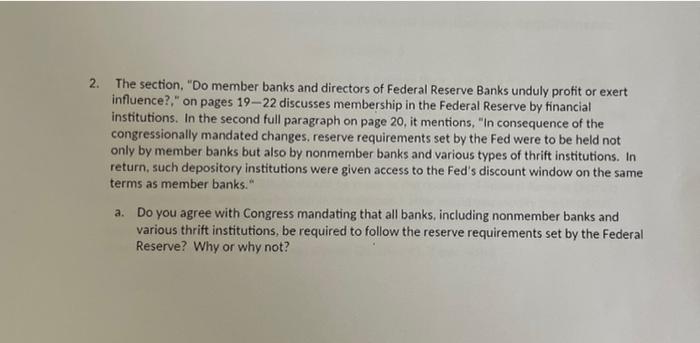

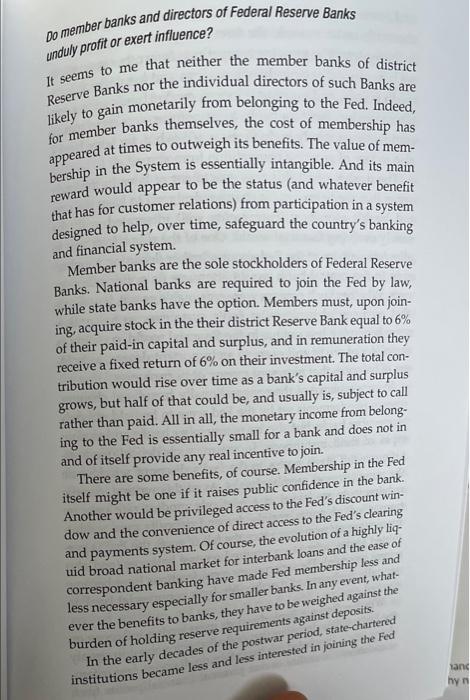
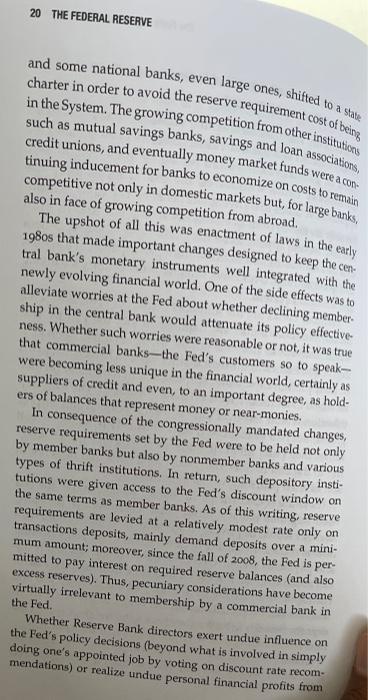
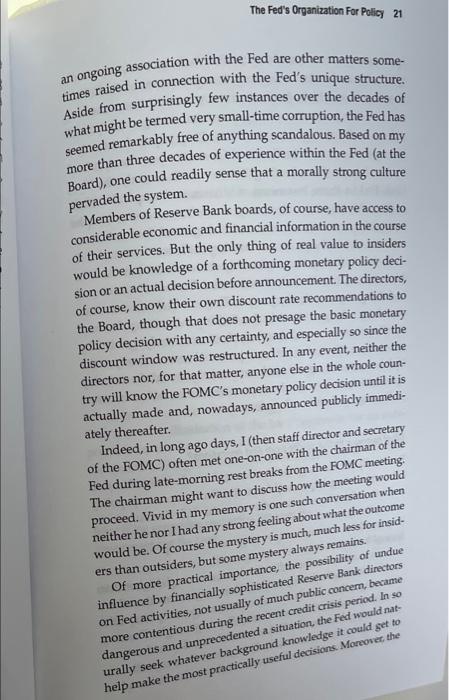
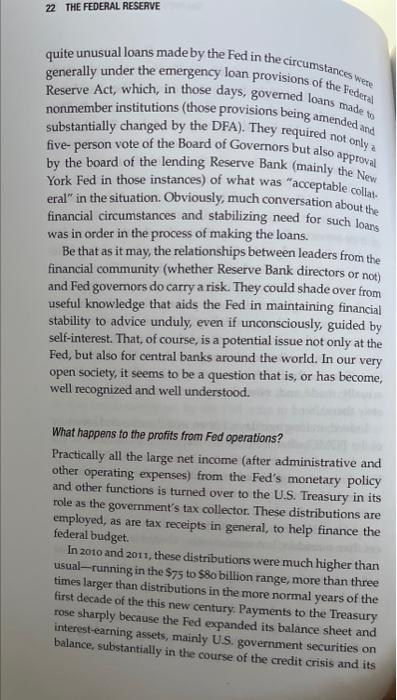
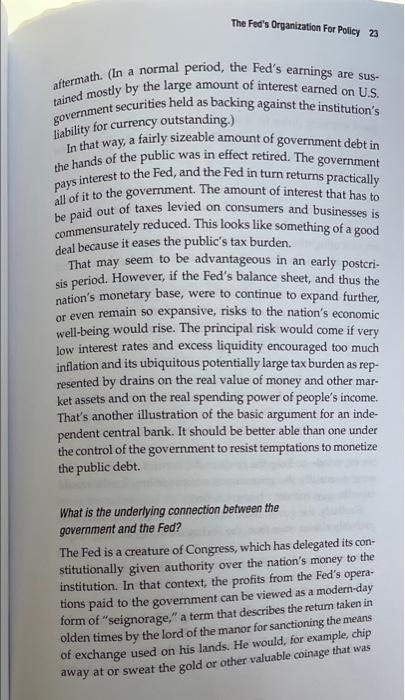
2. The section. "Do member banks and directors of Federal Reserve Banks unduly profit or exert influence?," on pages 19-22 discusses membership in the Federal Reserve by financial institutions. In the second full paragraph on page 20, it mentions, "In consequence of the congressionally mandated changes. reserve requirements set by the Fed were to be held not only by member banks but also by nonmember banks and various types of thrift institutions. In return, such depository institutions were given access to the Fed's discount window on the same terms as member banks." a. Do you agree with Congress mandating that all banks, including nonmember banks and various thrift institutions, be required to follow the reserve requirements set by the Federal Reserve? Why or why not? b. After reading through this section, so you believe that all commercial banks and financial institutions should be required to be members of the Federal Reserve? Why or why not? Do member banks and directors of Federal Reserve Banks unduly profit or exert influence? Reserve Banks nor the individual directors of such Banks are It seems to me that neither the member banks of district likely to gain monetarily from belonging to the Fed. Indeed, for member banks themselves, the cost of membership has appeared at times to outweigh its benefits. The value of mem- bership in the System is essentially intangible. And its main reward would appear to be the status and whatever benefit that has for customer relations) from participation in a system designed to help, over time, safeguard the country's banking and financial system Member banks are the sole stockholders of Federal Reserve Banks. National banks are required to join the Fed by law, while state banks have the option. Members must, upon join- ing, acquire stock in the their district Reserve Bank equal to 6% of their paid-in capital and surplus, and in remuneration they receive a fixed return of 6% on their investment. The total con- tribution would rise over time as a bank's capital and surplus grows, but half of that could be, and usually is, subject to call rather than paid. All in all the monetary income from belong- ing to the Fed is essentially small for a bank and does not in and of itself provide any real incentive to join. There are some benefits, of course. Membership in the Fed itself might be one if it raises public confidence in the bank. Another would be privileged access to the Fed's discount win- dow and the convenience of direct access to the Fed's clearing a and payments system. Of course, the evolution of a highly liq- uid broad national market for interbank loans and the ease of correspondent banking have made Fed membership less and less necessary especially for smaller banks. In any event, what- ever the benefits to banks, they have to be weighed against the burden of holding reserve requirements against deposits. In the early decades of the postwar period, state-chartered institutions became less and less interested in joining the Fed Yang hyn 20 THE FEDERAL RESERVE and some national banks, even large ones, shifted to a state charter in order to avoid the reserve requirement cost of being in the System. The growing competition from other institutions such as mutual savings banks, savings and loan associations, credit unions, and eventually money market funds were a con tinuing inducement for banks to economize on costs to remain competitive not only in domestic markets but, for large barks, also in face of growing competition from abroad. The upshot of all this was enactment of laws in the early 1980s that made important changes designed to keep the cen tral bank's monetary instruments well integrated with the newly evolving financial world. One of the side effects was to alleviate worries at the Fed about whether declining member ship in the central bank would attenuate its policy effective ness. Whether such worries were reasonable or not, it was true that commercial banks--the Fed's customers so to speak- were becoming less unique in the financial world, certainly as suppliers of credit and even to an important degree, as hold- ers of balances that represent money or near-monies. In consequence of the congressionally mandated changes, reserve requirements set by the Fed were to be held not only by member banks but also by nonmember banks and various types of thrift institutions. In return, such depository insti- tutions were given access to the Fed's discount window on the same terms as member banks. As of this writing, reserve requirements are levied at a relatively modest rate only on transactions deposits, mainly demand deposits over a mini- mum amount; moreover, since the fall of 2008, the Fed is per mitted to pay interest on required reserve balances and also excess reserves). Thus, pecuniary considerations have become virtually irrelevant to membership by a commercial bank in the Fed. Whether Reserve Bank directors exert undue influence on the Fed's policy decisions (beyond what is involved in simply doing one's appointed job by voting on discount rate recom- mendations) or realize undue personal financial profits from The Fed's Organization For Policy 21 an ongoing association with the Fed are other matters some- times raised in connection with the Fed's unique structure. Aside from surprisingly few instances over the decades of what might be termed very small-time corruption, the Fed has seemed remarkably free of anything scandalous. Based on my more than three decades of experience within the Fed (at the Board), one could readily sense that a morally strong culture pervaded the system Members of Reserve Bank boards, of course, have access to considerable economic and financial information in the course of their services. But the only thing of real value to insiders would be knowledge of a forthcoming monetary policy deci- sion or an actual decision before announcement. The directors, of course, know their own discount rate recommendations to the Board, though that does not presage the basic monetary policy decision with any certainty, and especially so since the discount window was restructured. In any event, neither the directors nor, for that matter, anyone else in the whole coun- try will know the FOMC's monetary policy decision until it is actually made and, nowadays, announced publicly immedi- ately thereafter. Indeed, in long ago days, I (then staff director and secretary of the FOMC) often met one-on-one with the chairman of the Fed during late-morning rest breaks from the FOMC meeting. The chairman might want to discuss how the meeting would proceed. Vivid in my memory is one such conversation when neither he nor I had any strong feeling about what the outcome would be. Of course the mystery is much, much less for insid- ers than outsiders, but some mystery always remains. Of more practical importance, the possibility of undue influence by financially sophisticated Reserve Bank directors on Fed activities, not usually of much public concem, became more contentious during the recent credit crisis period. In so dangerous and unprecedented a situation, the Fed would nat- urally seek whatever background knowledge it could get to help make the most practically useful decisions. Moreover, the 22 THE FEDERAL RESERVE quite unusual loans made by the Fed in the circumstances were generally under the emergency loan provisions of the Federal Reserve Act, which, in those days, governed loans made to nonmember institutions (those provisions being amended and substantially changed by the DFA). They required not only a five-person vote of the Board of Governors but also approval by the board of the lending Reserve Bank (mainly the New "acceptable collat York Fed in those instances) of what was eral" in the situation. Obviously, much conversation about the financial circumstances and stabilizing need for such loans was in order in the process of making the loans. Be that as it may, the relationships between leaders from the financial community (whether Reserve Bank directors or not) and Fed governors do carry a risk. They could shade over from useful knowledge that aids the Fed in maintaining financial stability to advice unduly, even if unconsciously, guided by self-interest. That, of course, is a potential issue not only at the Fed, but also for central banks around the world. In our very open society, it seems to be a question that is, or has become, well recognized and well understood. What happens to the profits from Fed operations? Practically all the large net income (after administrative and other operating expenses) from the Fed's monetary policy and other functions is turned over to the U.S. Treasury in its role as the government's tax collector. These distributions are employed, as are tax receipts in general, to help finance the federal budget. In 2010 and 2011, these distributions were much higher than usual-running in the $75 to $80 billion range, more than three times larger than distributions in the more normal years of the first decade of the this new century. Payments to the Treasury rose sharply because the Fed expanded its balance sheet and interest-earning assets, mainly U.S. government securities on balance, substantially in the course of the credit crisis and its The Fed's Organization For Policy 23 liability for currency outstanding.) aftermath. (In a normal period, the Fed's earnings are sus- tained mostly by the large amount of interest earned on U.S. government securities held as backing against the institution's In that way, a fairly sizeable amount of government debt in the hands of the public was in effect retired. The g government pays interest to the Fed, and the Fed in turn returns practically all of it to the government. The amount of interest that has to commensurately reduced. This looks like something of a good be paid out of taxes levied on consumers and businesses is deal because it eases the public's tax burden. That may seem to be advantageous in an early postcri- sis period. However, if the Fed's balance sheet, and thus the nation's monetary base, were to continue to expand further, or even remain so expansive, risks to the nation's economic well-being would rise. The principal risk would come if very low interest rates and excess liquidity encouraged too much inflation and its ubiquitous potentially large tax burden as rep- resented by drains on the real value of money and other mar- ket assets and on the real spending power of people's income. That's another illustration of the basic argument for an inde- pendent central bank. It should be better able than one under the control of the government to resist temptations to monetize the public debt. What is the underlying connection between the government and the Fed? The Fed is a creature of Congress, which has delegated its con- stitutionally given authority over the nation's money to the institution. In that context, the profits from the Fed's opera- tions paid to the government can be viewed as a modern-day form of "seignorage," a term that describes the retum taken in olden times by the lord of the manor for sanctioning the means of exchange used on his lands. He would, for example, chip away at or sweat the gold or other valuable coinage that was
Step by Step Solution
There are 3 Steps involved in it

Get step-by-step solutions from verified subject matter experts
 Study Help