







Question: 3.) Orbital maneuvers: Consider a satellite in a circular orbit around the Earth with radius ao. The satellite fires its thrusters, giving an impulse
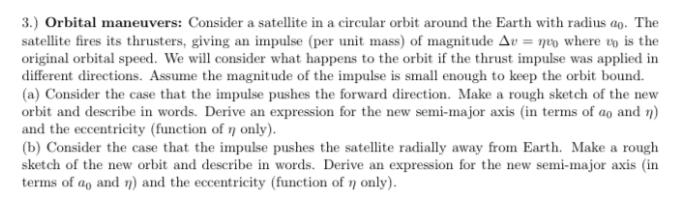
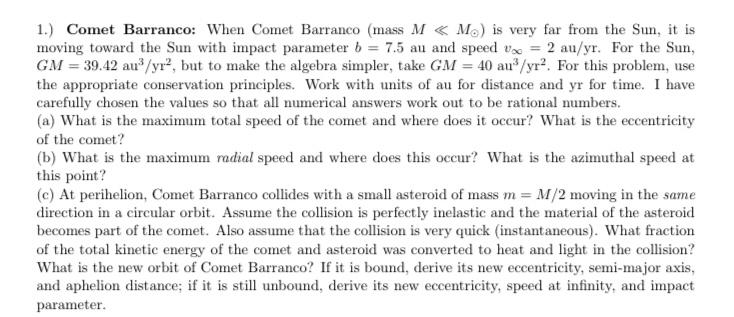
3.) Orbital maneuvers: Consider a satellite in a circular orbit around the Earth with radius ao. The satellite fires its thrusters, giving an impulse (per unit mass) of magnitude Ar = no where to is the original orbital speed. We will consider what happens to the orbit if the thrust impulse was applied in different directions. Assume the magnitude of the impulse is small enough to keep the orbit bound. (a) Consider the case that the impulse pushes the forward direction. Make a rough sketch of the new orbit and describe in words. Derive an expression for the new semi-major axis (in terms of ao and n) and the eccentricity (function of n only). (b) Consider the case that the impulse pushes the satellite radially away from Earth. Make a rough sketch of the new orbit and describe in words. Derive an expression for the new semi-major axis (in terms of ag and n) and the eccentricity (function of n only). 1.) Comet Barranco: When Comet Barranco (mass MM) is very far from the Sun, it is moving toward the Sun with impact parameter b = 7.5 au and speed = 2 au/yr. For the Sun, GM = 39.42 au/yr, but to make the algebra simpler, take GM = 40 au/yr. For this problem, use the appropriate conservation principles. Work with units of au for distance and yr for time. I have carefully chosen the values so that all numerical answers work out to be rational numbers. (a) What is the maximum total speed of the comet and where does it occur? What is the eccentricity of the comet? (b) What is the maximum radial speed and where does this occur? What is the azimuthal speed at this point? (c) At perihelion, Comet Barranco collides with a small asteroid of mass m = M/2 moving in the same direction in a circular orbit. Assume the collision is perfectly inelastic and the material of the asteroid becomes part of the comet. Also assume that the collision is very quick (instantaneous). What fraction of the total kinetic energy of the comet and asteroid was converted to heat and light in the collision? What is the new orbit of Comet Barranco? If it is bound, derive its new eccentricity, semi-major axis, and aphelion distance; if it is still unbound, derive its new eccentricity, speed at infinity, and impact parameter.
Step by Step Solution
3.48 Rating (174 Votes )
There are 3 Steps involved in it
a The maximum total speed of the comet is 244 auyr and it occurs at the aphelion The eccentricity of the comet is 0625 b The maximum radial speed of the comet is 156 auyr and it occurs at the periheli... View full answer

Get step-by-step solutions from verified subject matter experts
 Study Help