Question: help Born at the Wrong Time? Julio Ramirez sat forward at his desk and pondered the latest contract he had taken in his HR consultancy.
help
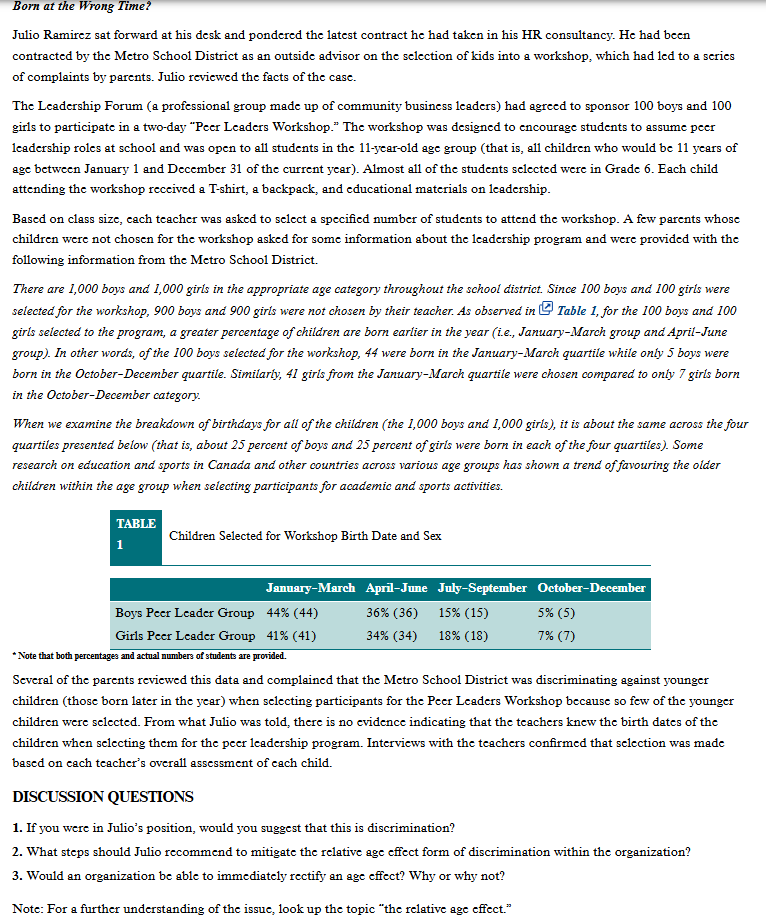
Born at the Wrong Time? Julio Ramirez sat forward at his desk and pondered the latest contract he had taken in his HR consultancy. He had been contracted by the Metro School District as an outside advisor on the selection of kids into a workshop, which had led to a series of complaints by parents. Julio reviewed the facts of the case. The Leadership Forum (a professional group made up of community business leaders) had agreed to sponsor 100 boys and 100 girls to participate in a two-day "Peer Leaders Workshop." The workshop was designed to encourage students to assume peer leadership roles at school and was open to all students in the 11-year-old age group (that is, all children who would be 11 years of age between January 1 and December 31 of the current year). Almost all of the students selected were in Grade 6. Each child attending the workshop received a T-shirt, a backpack, and educational materials on leadership. Based on class size, cach teacher was asked to select a specified number of students to attend the workshop. A few parents whose children were not chosen for the workshop asked for some information about the leadership program and were provided with the following information from the Metro School District. There are 1,000 boys and 1,000 girls in the appropriate age category throughout the school district. Since 100 boys and 100 girls were selected for the workshop, 900 boys and 900 girls were not chosen by their teacher. As observed in Table 1, for the 100 boys and 100 girls selected to the program, a greater percentage of children are born earlier in the year (i.e., January-March group and April-June group). In other words, of the 100 boys selected for the workshop, 44 were born in the January-March quartile while only 5 boys were born in the October-December quartile. Similarly, 41 girls from the January-March quartile were chosen compared to only 7 girls born in the October-December category. When we examine the breakdown of birthdays for all of the children (the 1,000 boys and 1,000 girls), it is about the same across the four quartiles presented below (that is, about 25 percent of boys and 25 percent of girls were born in each of the four quartiles). Some research on education and sports in Canada and other countries across various age groups has shown a trend of favouring the older children within the age group when selecting participants for academic and sports activities. TABLE Children Selected for Workshop Birth Date and Sex January-March April-June July-September October-December Boys Peer Leader Group 44% (44) 36% (36) 15% (15) 5% (5) Girls Peer Leader Group 41% (41) 34% (34) 18% (18) 7% (7) *Note that both percentages and actual numbers of students are provided Several of the parents reviewed this data and complained that the Metro School District was discriminating against younger children (those born later in the year) when selecting participants for the Peer Leaders Workshop because so few of the younger children were selected. From what Julio was told, there is no evidence indicating that the teachers knew the birth dates of the children when selecting them for the peer leadership program. Interviews with the teachers confirmed that selection was made based on each teacher's overall assessment of each child. DISCUSSION QUESTIONS 1. If you were in Julio's position, would you suggest that this is discrimination? 2. What steps should Julio recommend to mitigate the relative age effect form of discrimination within the organization? 3. Would an organization be able to immediately rectify an age effect? Why or why not? Note: For a further understanding of the issue, look up the topic "the relative age effect."









 Study Help