







Question: help me out Exercise 30 (Section 3.3) gave the pmf of Y, the number of traffic citations for a randomly selected individual insured by a
help me out
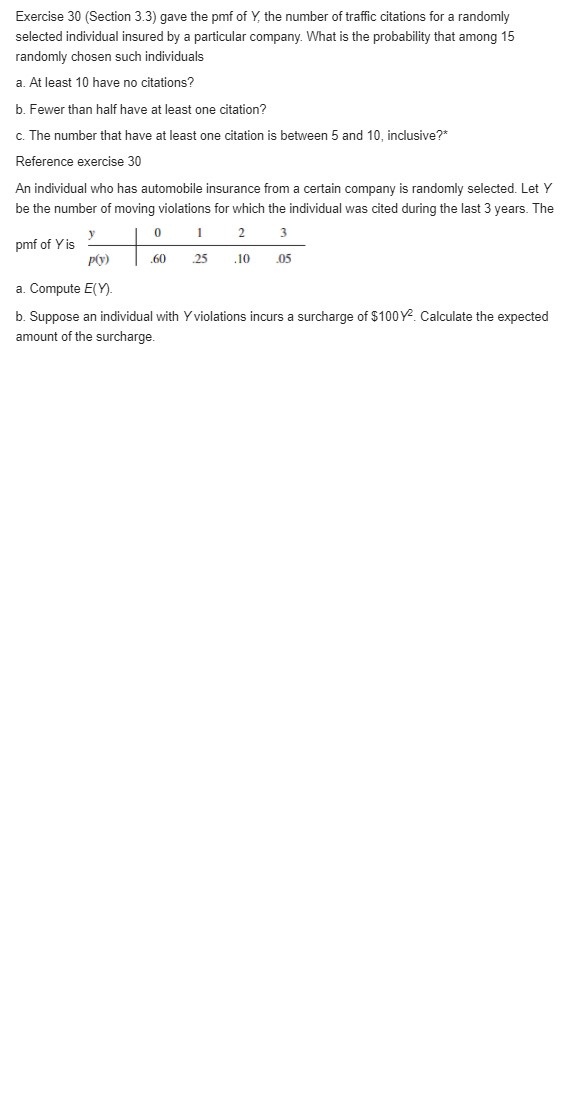
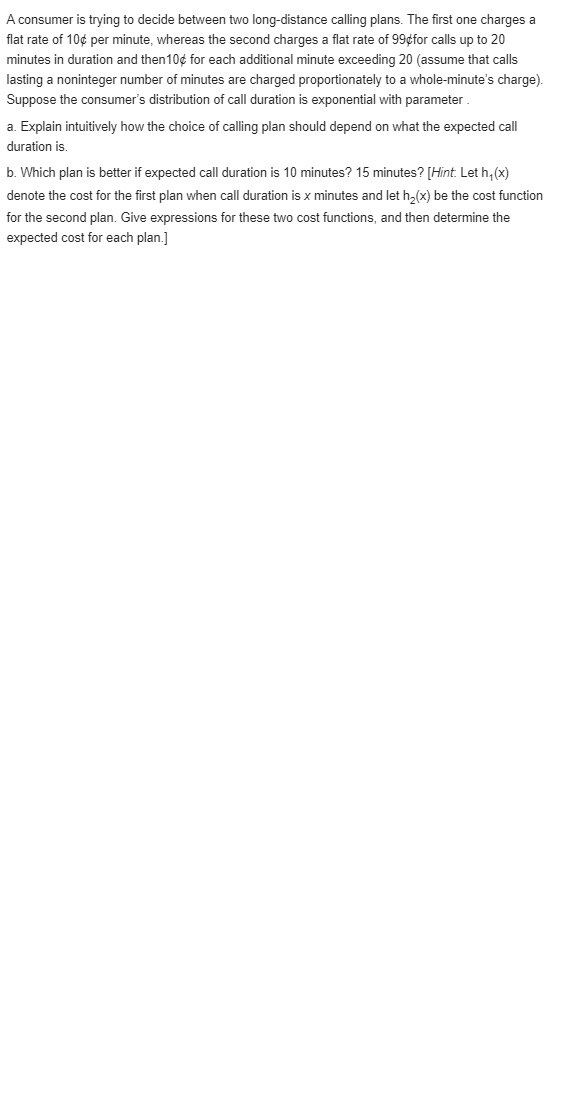
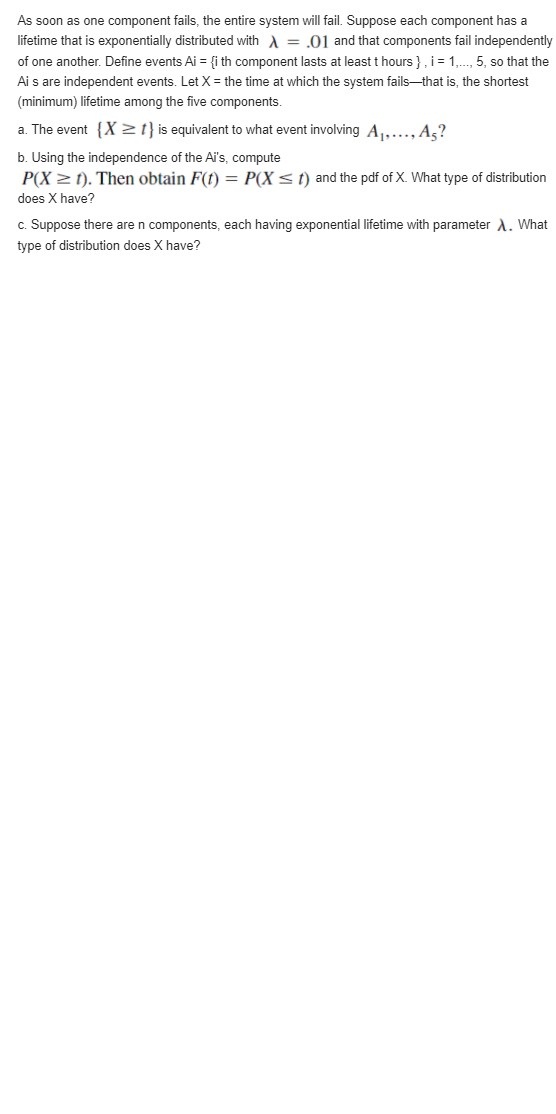
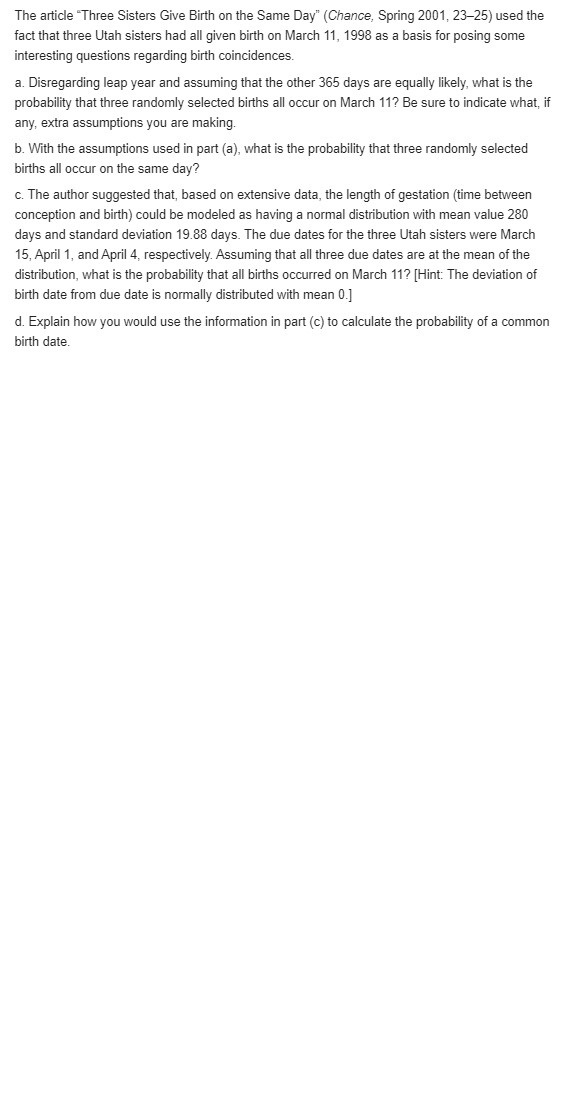
Exercise 30 (Section 3.3) gave the pmf of Y, the number of traffic citations for a randomly selected individual insured by a particular company. What is the probability that among 15 randomly chosen such individuals a. At least 10 have no citations? b. Fewer than half have at least one citation? c. The number that have at least one citation is between 5 and 10, inclusive?* Reference exercise 30 An individual who has automobile insurance from a certain company is randomly selected. Let Y be the number of moving violations for which the individual was cited during the last 3 years. The 0 1 2 3 pmf of Y is P(y) .60 .25 .10 .05 a. Compute E(Y). b. Suppose an individual with Y violations incurs a surcharge of $100. Calculate the expected amount of the surcharge.A consumer is trying to decide between two long-distance calling plans. The first one charges a flat rate of 104 per minute, whereas the second charges a flat rate of 994for calls up to 20 minutes in duration and then104 for each additional minute exceeding 20 (assume that calls lasting a noninteger number of minutes are charged proportionately to a whole-minute's charge). Suppose the consumer's distribution of call duration is exponential with parameter a. Explain intuitively how the choice of calling plan should depend on what the expected call duration is. b. Which plan is better if expected call duration is 10 minutes? 15 minutes? [Hint. Let h, (x) denote the cost for the first plan when call duration is x minutes and let h,(x) be the cost function for the second plan. Give expressions for these two cost functions, and then determine the expected cost for each plan.]As soon as one component fails, the entire system will fail. Suppose each component has a lifetime that is exponentially distributed with > = .()] and that components fail independently of one another. Define events Ai = {i th component lasts at least t hours } , i = 1,..., 5, so that the Ai s are independent events. Let X = the time at which the system fails-that is, the shortest (minimum) lifetime among the five components. a. The event { X > ( ) is equivalent to what event involving A,,..., As? b. Using the independence of the Ai's, compute P(X > (). Then obtain F(t) = P(X
Step by Step Solution
There are 3 Steps involved in it

Get step-by-step solutions from verified subject matter experts
 Study Help