



Question: Help me please :) In about 1-2 pages (double-spaced), provide your answers to the three questions at the end of the case, and submit the
Help me please :)
In about 1-2 pages (double-spaced), provide your answers to the three questions at the end of the case, and submit the Word document here.
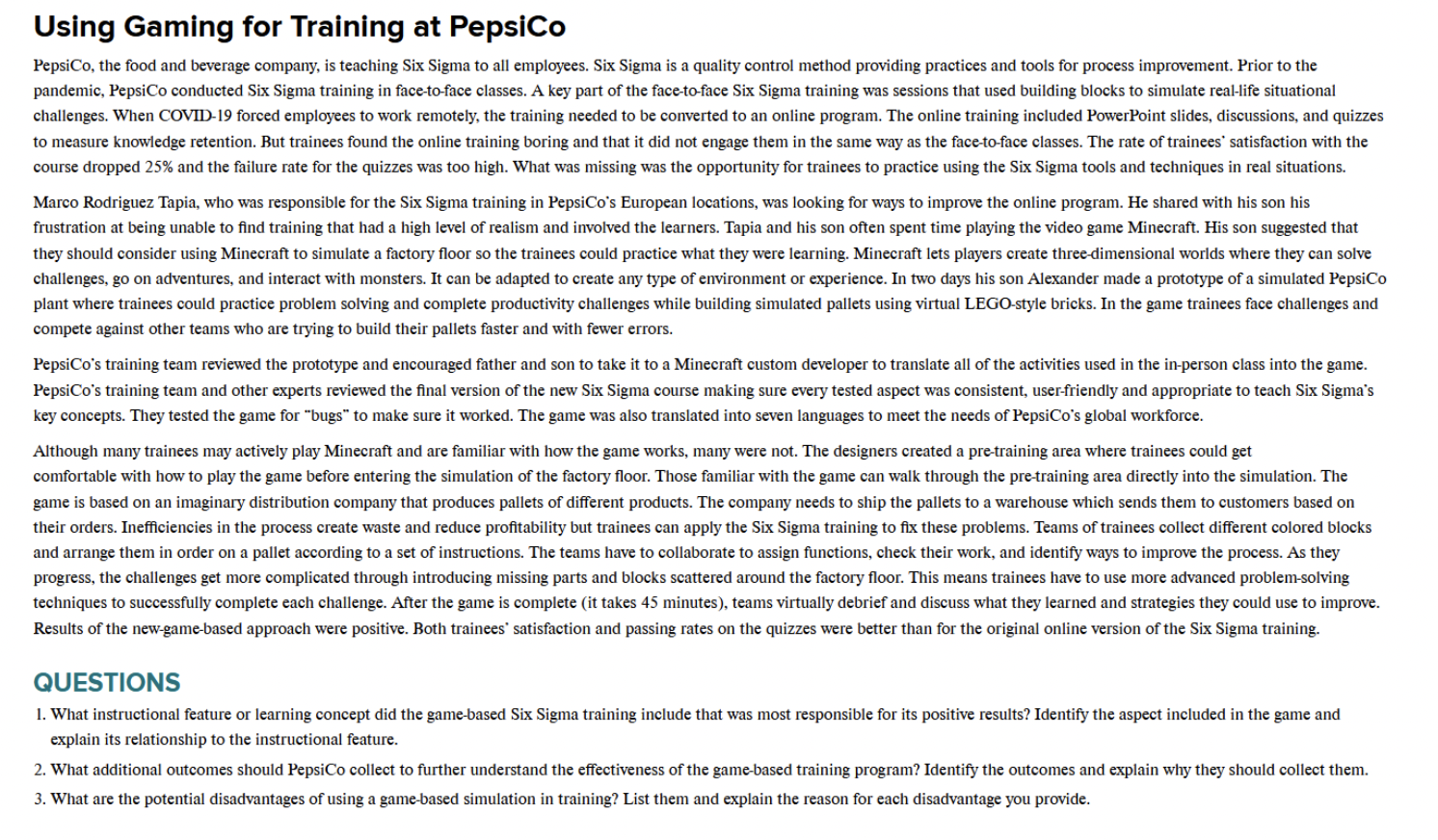
Using Gaming for Training at PepsiCo PepsiCo, the food and beverage company, is teaching Six Sigma to all employees. Six Sigma is a quality control method providing practices and tools for process improvement. Prior to the pandemic, PepsiCo conducted Six Sigma training in face-to-face classes. A key part of the face-to-face Six Sigma training was sessions that used building blocks to simulate real-life situational challenges. When COVID-19 forced employees to work remotely, the training needed to be converted to an online program. The online training included PowerPoint slides, discussions, and quizzes to measure knowledge retention. But trainees found the online training boring and that it did not engage them in the same way as the face-to-face classes. The rate of trainees' satisfaction with the course dropped 25% and the failure rate for the quizzes was too high. What was missing was the opportunity for trainees to practice using the Six Sigma tools and techniques in real situations. Marco Rodriguez Tapia, who was responsible for the Six Sigma training in PepsiCo's European locations, was looking for ways to improve the online program. He shared with his son his frustration at being unable to find training that had a high level of realism and involved the learners. Tapia and his son often spent time playing the video game Minecraft. His son suggested that they should consider using Minecraft to simulate a factory floor so the trainees could practice what they were learning. Minecraft lets players create three-dimensional worlds where they can solve challenges, go on adventures, and interact with monsters. It can be adapted to create any type of environment or experience. In two days his son Alexander made a prototype of a simulated PepsiCo plant where trainees could practice problem solving and complete productivity challenges while building simulated pallets using virtual LEGO-style bricks. In the game trainees face challenges and compete against other teams who are trying to build their pallets faster and with fewer errors. PepsiCo's training team reviewed the prototype and encouraged father and son to take it to a Minecraft custom developer to translate all of the activities used in the in-person class into the game. PepsiCo's training team and other experts reviewed the final version of the new Six Sigma course making sure every tested aspect was consistent, user-friendly and appropriate to teach Six Sigma's key concepts. They tested the game for "bugs" to make sure it worked. The game was also translated into seven languages to meet the needs of PepsiCo's global workforce. Although many trainees may actively play Minecraft and are familiar with how the game works, many were not. The designers created a pre-training area where trainees could get comfortable with how to play the game before entering the simulation of the factory floor. Those familiar with the game can walk through the pre-training area directly into the simulation. The game is based on an imaginary distribution company that produces pallets of different products. The company needs to ship the pallets to a warehouse which sends them to customers based on their orders. Inefficiencies in the process create waste and reduce profitability but trainees can apply the Six Sigma training to fix these problems. Teams of trainees collect different colored blocks and arrange them in order on a pallet according to a set of instructions. The teams have to collaborate to assign functions, check their work, and identify ways to improve the process. As they progress, the challenges get more complicated through introducing missing parts and blocks scattered around the factory floor. This means trainees have to use more advanced problem-solving techniques to successfully complete each challenge. After the game is complete (it takes 45 minutes), teams virtually debrief and discuss what they learned and strategies they could use to improve. Results of the new-game-based approach were positive. Both trainees' satisfaction and passing rates on the quizzes were better than for the original online version of the Six Sigma training. QUESTIONS 1. What instructional feature or learning concept did the game-based Six Sigma training include that was most responsible for its positive results? Identify the aspect included in the game and explain its relationship to the instructional feature. 2. What additional outcomes should PepsiCo collect to further understand the effectiveness of the game-based training program? Identify the outcomes and explain why they should collect them. 3. What are the potential disadvantages of using a game-based simulation in training? List them and explain the reason for each disadvantage you provide
Step by Step Solution
There are 3 Steps involved in it

Get step-by-step solutions from verified subject matter experts