







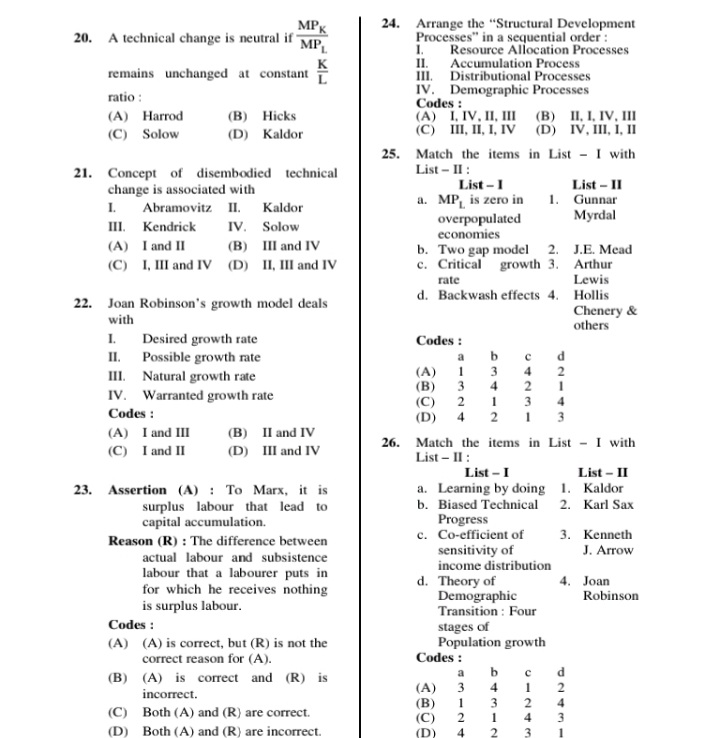
Question: help please MPK 24. Arrange the Structural Development 20. A technical change is neutral if MP Processes in a sequential order : I. Resource Allocation
help please
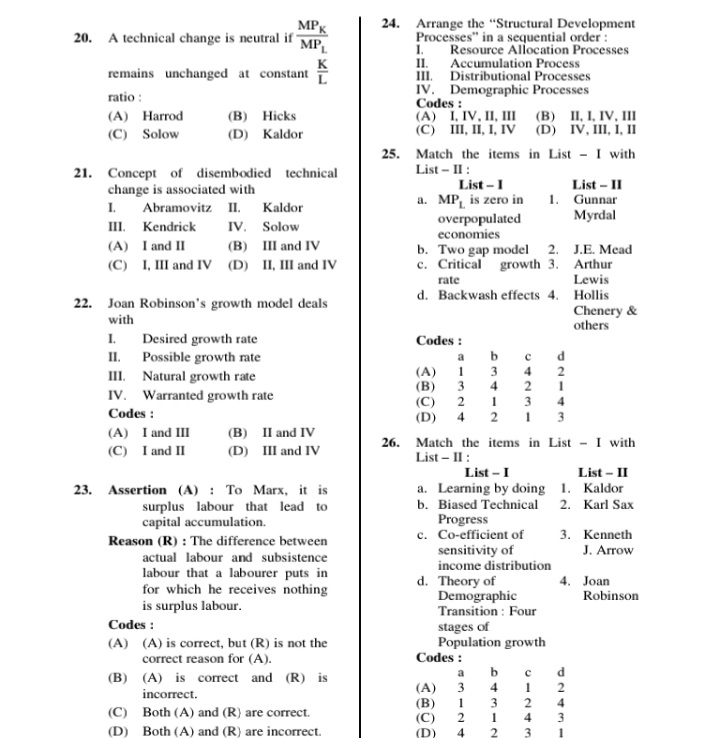
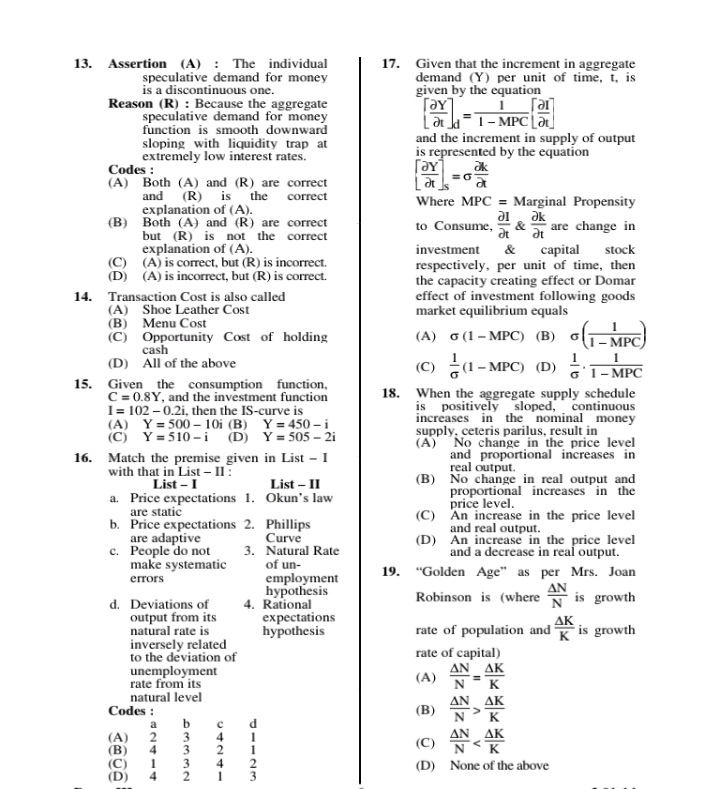
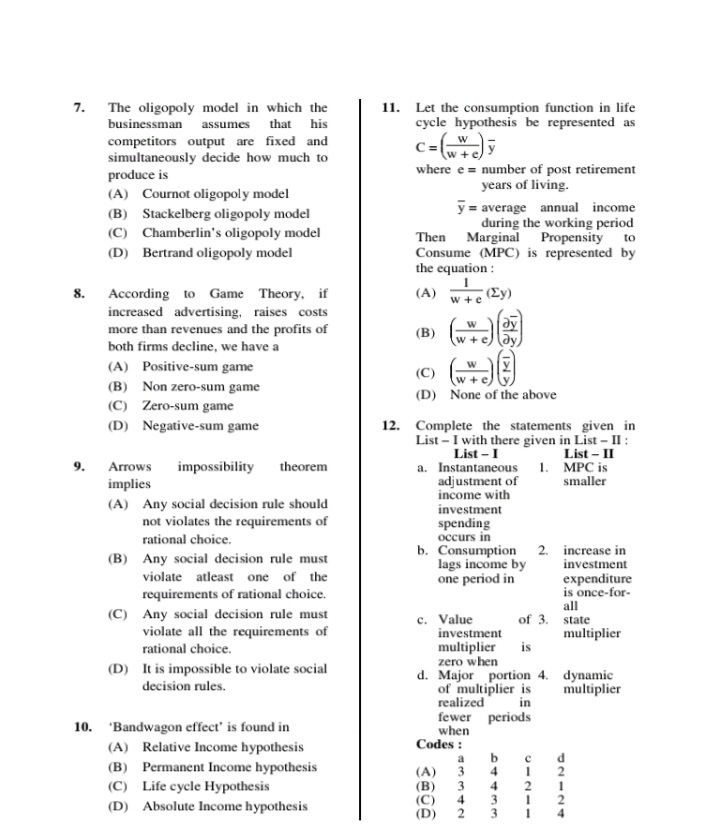
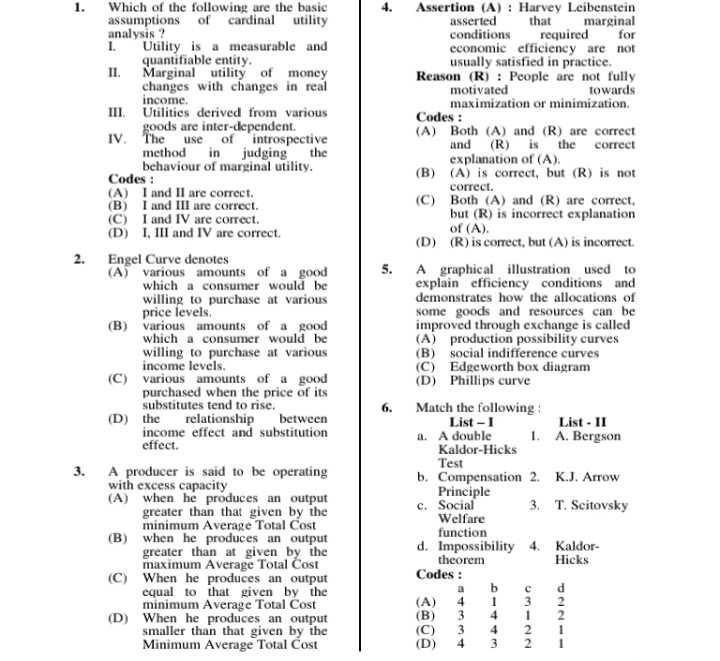
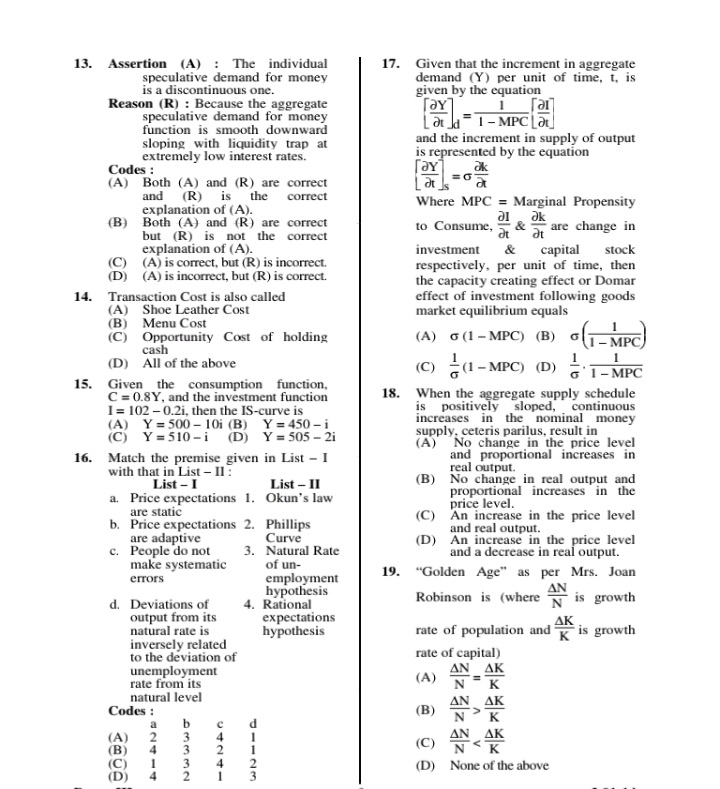
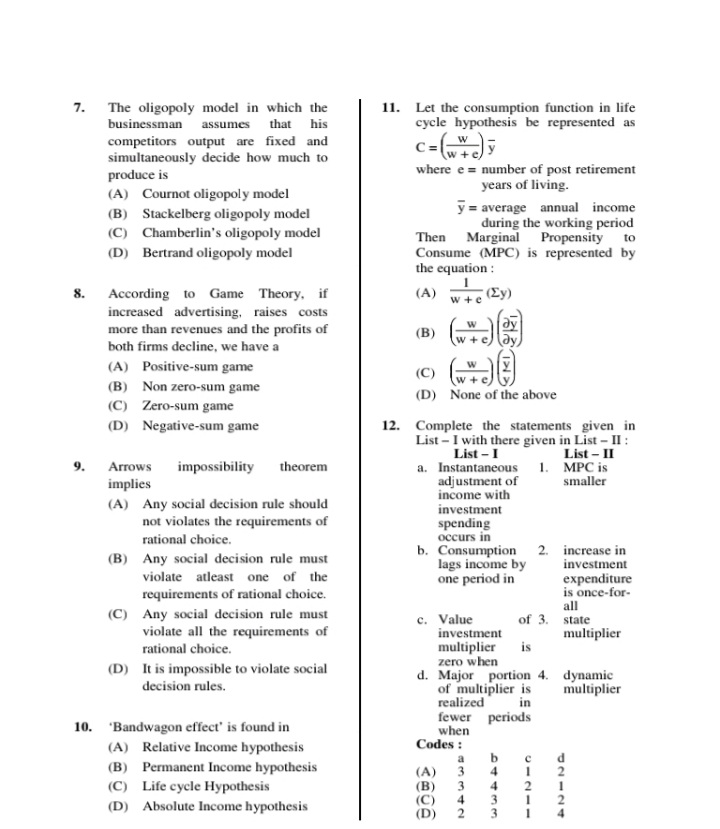
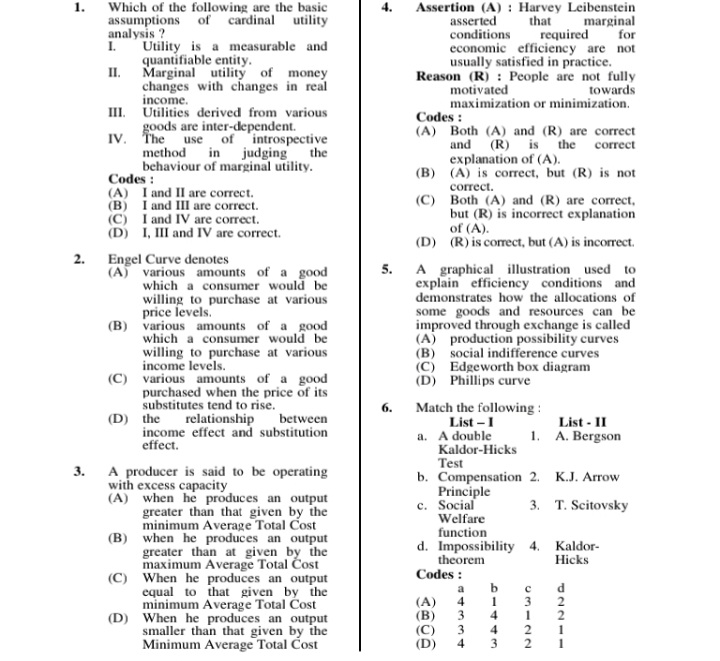
MPK 24. Arrange the "Structural Development 20. A technical change is neutral if MP Processes" in a sequential order : I. Resource Allocation Processes II. Accumulation Process remains unchanged at constant III, Distributional Processes IV. Demographic Processes ratio : Codes : (A) Harrod (B) Hicks (A) I, IV. II, III (B) II. I. IV. III (C) Solow (D) Kaldor (C) III, II, I, IV (D) IV, III, I, II 25. Match the items in List - I with 21. Concept of disembodied technical List - II : change is associated with List - 1 List - II Abramovitz II. Kaldor a. MP, is zero in Gunnar I. overpopulated Myrdal III. Kendrick IV. Solow economies (A) I and II (B) III and IV b. Two gap model 2. J.E. Mead (C) I, III and IV (D) II, III and IV C. Critical growth 3. Arthur rate Lewis d. Backwash effects 4. Hollis 22. Joan Robinson's growth model deals Chenery & with others I. Desired growth rate Codes : II. Possible growth rate III. Natural growth rate (A) IV. Warranted growth rate (B) Codes : N (A) I and III (B) II and IV 26. (C) I and II (D) III and IV Match the items in List - I with List - II : List - I List - II 23. Assertion (A) : To Marx, it is a. Learning by doing 1. Kaldor surplus labour that lead to b. Biased Technical 2. Karl Sax capital accumulation. Progress Reason (R) : The difference between c. Co-efficient of Kenneth actual labour and subsistence sensitivity of J. Arrow labour that a labourer puts in income distribution d. Theory of Joan for which he receives nothing Demographic Robinson is surplus labour. Transition : Four Codes : stages of ) (A) is correct, but (R) is not the Population growth correct reason for (A). Codes : (B) (A) is correct and (R) is incorrect. (A) (B) (C) Both (A) and (R) are correct. (C) (D) Both (A) and (R) are incorrect. (D)13. Assertion (A) : The individual 17. Given that the increment in aggregate speculative demand for money demand (Y) per unit of time, t, is is a discontinuous one. given by the equation Reason (R) : Because the aggregate 1 ran speculative demand for money Lat Ja = 1-MPC at function is smooth downward sloping with liquidity trap at and the increment in supply of output extremely low interest rates. is represented by the equation Codes : aY dk (A) Both (A) and (R) are correct and (R) is the correct explanation of (A). Where MPC = Marginal Propensity (B) Both (A) and (R) are correct to Consume, at di & ok at are change in but (R) is not the correct explanation of (A). investment & capital stock (C) (A) is correct, but (R) is incorrect. (D respectively, per unit of time, then (A) is incorrect, but (R) is correct. the capacity creating effect or Domar 14. Transaction Cost is also called effect of investment following goods (A) Shoe Leather Cost market equilibrium equals (B) Menu Cost (C) Opportunity Cost of holding (A) 6 (1 -MPC) (B) (1-MPC cash (D) All of the above (C) - (1 -MPC) (D) .1-MPC 1 . 15. Given the consumption function, C =0.8Y, and the investment function 18. When the aggregate supply schedule 1 = 102 -0.2i, then the IS-curve is is positively sloped, continuous (A) Y = 500 - 101 (B) Y = 450- i increases in the nominal money (c) Y =510-i Y = 505 - 2 supply, ceteris parilus, result in (A) No change in the price level 16. Match the premise given in List - I and proportional increases in with that in List - II : real output. List - I List - II (B) No change in real output and a. Price expectations 1. Okun's law proportional increases in the price level. are static (C) An increase in the price level b. Price expectations 2. Phillips and real output. are adaptive Curve (D) An increase in the price level C. People do not 3. Natural Rate and a decrease in real output. make systematic of un- employment 19. errors "Golden Age" as per Mrs. Joan hypothesis AN d. Deviations of 4. Rational Robinson is (where N is growth output from its expectations natural rate is hypothesis rate of population and AK K is growth inversely related to the deviation of rate of capital) unemployment AK rate from its (A) N K natural level AK Codes : (B) N K AN AK (C) -ANAn N *K None of the above NU7. The oligopoly model in which the 11. Let the consumption function in life businessman assumes that his cycle hypothesis be represented as competitors output are fixed and simultaneously decide how much to C= W + produce is where e = number of post retirement (A) Cournot oligopoly model years of living. (B) Stackelberg oligopoly model y = average annual income during the working period (C) Chamberlin's oligopoly model Then Marginal Propensity to (D) Bertrand oligopoly model Consume (MPC) is represented by the equation : 8. According to Game Theory, if (A) wte ( Zy) increased advertising, raises costs more than revenues and the profits of (B) both firms decline, we have a (A) Positive-sum game (C) (B) Non zero-sum game ) None of the above (C) Zero-sum game (D) Negative-sum game 12. Complete the statements given in List - I with there given in List - II : List - I List - II Arrows impossibility theorem a. Instantaneous MPC is implies adjustment of smaller income with (A) Any social decision rule should investment not violates the requirements of spending rational choice. occurs in b. Consumption 2. Any social decision rule must increase in (B) lags income by investment violate atleast one of the one period in expenditure requirements of rational choice. is once-for- all (C) Any social decision rule must c. Value of 3. state violate all the requirements of investment multiplier rational choice. multiplier IS (D) It is impossible to violate social zero when d. Major portion 4. dynamic decision rules. of multiplier is multiplier realized fewer periods 10. 'Bandwagon effect" is found in when (A) Relative Income hypothesis Codes : (B) Permanent Income hypothesis (A) (C) Life cycle Hypothesis AN-NA (D) Absolute Income hypothesis1. Which of the following are the basic 4. Assertion (A) : Harvey Leibenstein assumptions of cardinal utility asserted that marginal analysis 7 conditions required for 1. Utility is a measurable and economic efficiency are not quantifiable entity. usually satisfied in practice. II. Marginal utility of money Reason (R) : People are not fully changes with changes in real motivated towards income. III. Utilities derived from various maximization or minimization. Codes : goods are inter-dependent. IV. The use of introspective (A) Both (A) and (R) are correct and (R) is the method in judging correct the behaviour of marginal utility. explanation of (A). Codes : (B) (A) is correct, but (R) is not (A) I and II are correct. correct. (B) I and III are correct. (C) Both (A) and (R) are correct. (C) I and IV are correct. but (R) is incorrect explanation (D) I, III and IV are correct. of (A). (D) (R) is correct, but (A) is incorrect. 2. Engel Curve denotes (A) various amounts of a good 5. A graphical illustration used to which a consumer would be explain efficiency conditions and willing to purchase at various demonstrates how the allocations of price levels. some goods and resources can be (B) various amounts of a good improved through exchange is called which a consumer would be (A) production possibility curves willing to purchase at various (B) social indifference curves income levels. (C) Edgeworth box diagram (C) various amounts of a good (D) Phillips curve purchased when the price of its substitutes tend to rise. 6. Match the following : (D) the relationship between List - 1 List - II income effect and substitution a. A double A. Bergson effect. Kaldor-Hicks Test 3. A producer is said to be operating b. Compensation 2. K.J. Arrow with excess capacity (A) when he produces an output Principle greater than that given by the C. Social 3. T. Scitovsky minimum Average Total Cost Welfare (B) when he produces an output function greater than at given by the d. Impossibility 4. Kaldor- maximum Average Total Cost theorem Hicks (C) When he produces an output Codes : equal to that given by the minimum Average Total Cost (A) -NNA (D) When he produces an output (B) NN - WO smaller than that given by the (C) Minimum Average Total Cost (D)
Step by Step Solution
There are 3 Steps involved in it

Get step-by-step solutions from verified subject matter experts
 Study Help