







Question: HELP!!!!!! Please solve this ASAP Problem 3: The fictional DC motor discussed in HW3 has the following parameters for the armature and field circuits, and
HELP!!!!!!
Please solve this ASAP
![and for the mechanical rotor moment of inertia: {R. = 3.5[22], L](https://dsd5zvtm8ll6.cloudfront.net/si.experts.images/questions/2024/09/66f951c13ef64_42466f951c0d4e7e.jpg)
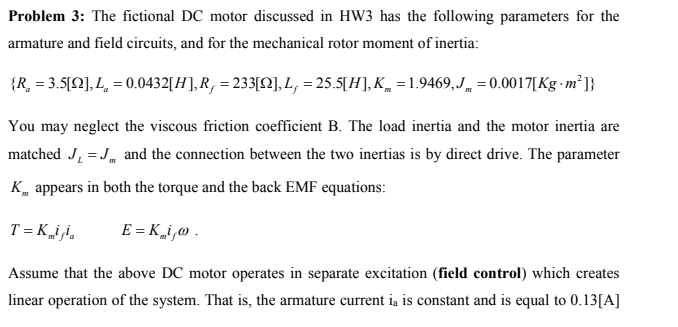
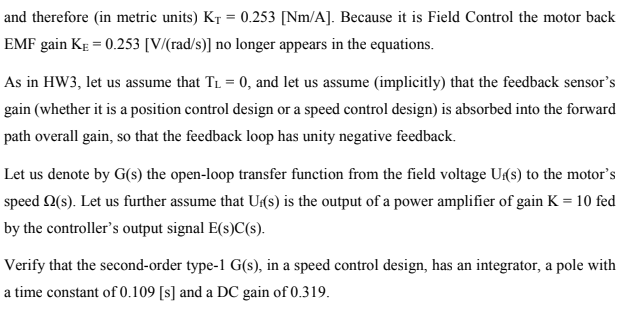
Problem 3: The fictional DC motor discussed in HW3 has the following parameters for the armature and field circuits, and for the mechanical rotor moment of inertia: {R. = 3.5[22], L = 0.0432[H],R, = 233[2],L, = 25.5[H], K = 1.9469,J = 0.0017[Kg.m]} You may neglect the viscous friction coefficient B. The load inertia and the motor inertia are matched J, = J. and the connection between the two inertias is by direct drive. The parameter K appears in both the torque and the back EMF equations: T = Kij. E = K 10. Assume that the above DC motor operates in separate excitation (field control) which creates linear operation of the system. That is, the armature current ia is constant and is equal to 0.13[A] and therefore (in metric units) KT = 0.253 [Nm/A]. Because it is Field Control the motor back EMF gain Ke=0.253 [V/(rad/s)] no longer appears in the equations. As in HW3, let us assume that TL = 0, and let us assume (implicitly) that the feedback sensor's gain (whether it is a position control design or a speed control design) is absorbed into the forward path overall gain, so that the feedback loop has unity negative feedback. Let us denote by G(s) the open-loop transfer function from the field voltage Uf(s) to the motor's speed 12(s). Let us further assume that Ur(s) is the output of a power amplifier of gain K = 10 fed by the controller's output signal E(S)C(s). Verify that the second-order type-1 G(s), in a speed control design, has an integrator, a pole with a time constant of 0.109 [s] and a DC gain of 0.319. 3.1 The design specifications for a speed control problem are: (1) high enough open-loop gain at low frequencies (such as o = 1 rad/s), and (ii) phase margin of 60 650. Find C(s) using a design that uses a sequence of Bode plots. 3.2 The same design specifications are now applied to a position control problem. Find C(s), explaining every step. 3.3 Repeat problems (3.1)-(3.2) using SISOTOOL as your main design tool. Explain every step- don't just jump to the final design. Problem 3: The fictional DC motor discussed in HW3 has the following parameters for the armature and field circuits, and for the mechanical rotor moment of inertia: {R. = 3.5[22], L = 0.0432[H],R, = 233[2],L, = 25.5[H], K = 1.9469,J = 0.0017[Kg.m]} You may neglect the viscous friction coefficient B. The load inertia and the motor inertia are matched J, = J. and the connection between the two inertias is by direct drive. The parameter K appears in both the torque and the back EMF equations: T = Kij. E = K 10. Assume that the above DC motor operates in separate excitation (field control) which creates linear operation of the system. That is, the armature current ia is constant and is equal to 0.13[A] and therefore (in metric units) KT = 0.253 [Nm/A]. Because it is Field Control the motor back EMF gain Ke=0.253 [V/(rad/s)] no longer appears in the equations. As in HW3, let us assume that TL = 0, and let us assume (implicitly) that the feedback sensor's gain (whether it is a position control design or a speed control design) is absorbed into the forward path overall gain, so that the feedback loop has unity negative feedback. Let us denote by G(s) the open-loop transfer function from the field voltage Uf(s) to the motor's speed 12(s). Let us further assume that Ur(s) is the output of a power amplifier of gain K = 10 fed by the controller's output signal E(S)C(s). Verify that the second-order type-1 G(s), in a speed control design, has an integrator, a pole with a time constant of 0.109 [s] and a DC gain of 0.319. 3.1 The design specifications for a speed control problem are: (1) high enough open-loop gain at low frequencies (such as o = 1 rad/s), and (ii) phase margin of 60 650. Find C(s) using a design that uses a sequence of Bode plots. 3.2 The same design specifications are now applied to a position control problem. Find C(s), explaining every step. 3.3 Repeat problems (3.1)-(3.2) using SISOTOOL as your main design tool. Explain every step- don't just jump to the final design
Step by Step Solution
There are 3 Steps involved in it

Get step-by-step solutions from verified subject matter experts
 Study Help