







Question: help pls I need solution for the answer 1(a) to 1(c) For Questions 1(a) to 1(C) : Consider the reaction of solid lead(II) oxide with
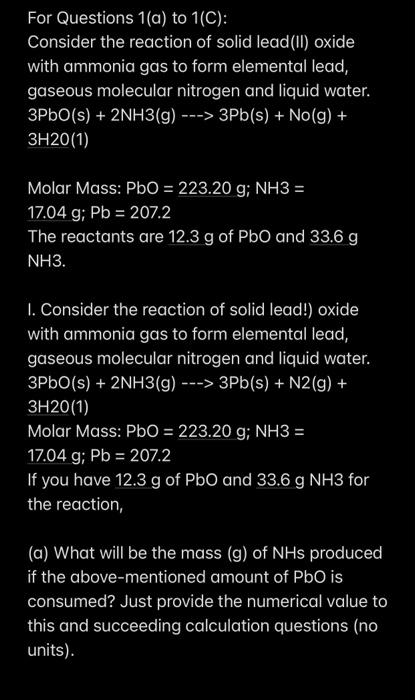
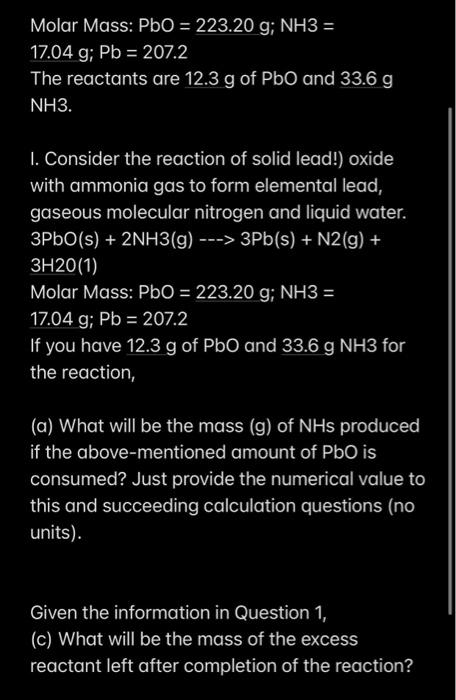
For Questions 1(a) to 1(C) : Consider the reaction of solid lead(II) oxide with ammonia gas to form elemental lead, gaseous molecular nitrogen and liquid water. 3PbO(s)+2NH3(g)3Pb(s)+No(g)+ 3H20(1) Molar Mass: PbO=223.20g;NH3= 17.04g;Pb=207.2 The reactants are 12.3g of PbO and 33.6g NH3. I. Consider the reaction of solid lead!) oxide with ammonia gas to form elemental lead, gaseous molecular nitrogen and liquid water. 3PbO(s)+2NH3(g)3Pb(s)+N2(g)+ 3H20(1) Molar Mass: PbO=223.20g;NH3= 17.04g;Pb=207.2 If you have 12.3g of PbO and 33.6gNH3 for the reaction, (a) What will be the mass (g) of NH produced if the above-mentioned amount of PbO is consumed? Just provide the numerical value to this and succeeding calculation questions (no units). Molar Mass: PbO=223.20g;NH3= 17.04g;Pb=207.2 The reactants are 12.3g of PbO and 33.6g NH3. I. Consider the reaction of solid lead!) oxide with ammonia gas to form elemental lead, gaseous molecular nitrogen and liquid water. 3PbO(s)+2NH3(g)>3Pb(s)+N2(g)+ 3H20(1) Molar Mass: PbO=223.20g;NH3= 17.04g;Pb=207.2 If you have 12.3g of PbO and 33.6gNH3 for the reaction, (a) What will be the mass (g) of NHs produced if the above-mentioned amount of PbO is consumed? Just provide the numerical value to this and succeeding calculation questions (no units). Given the information in Question 1, (c) What will be the mass of the excess reactant left after completion of the reaction
Step by Step Solution
There are 3 Steps involved in it

Get step-by-step solutions from verified subject matter experts
 Study Help