







Question: help with questions this was all provided 1. Include a brief summary of your experimental design below. Feel free to include a sketch or sketches
help with questions this was all provided 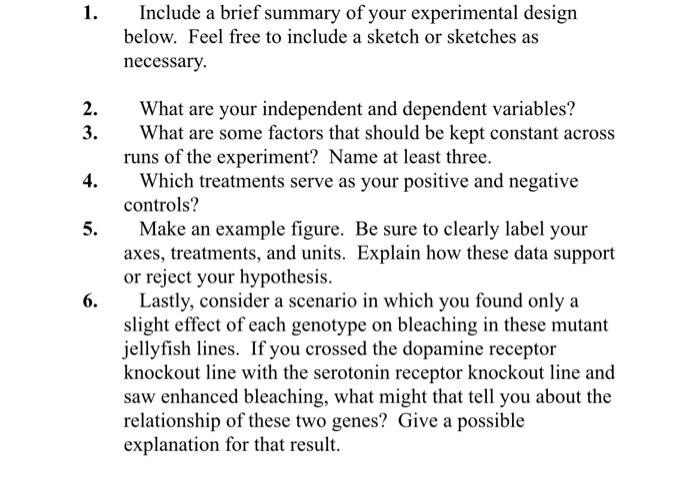
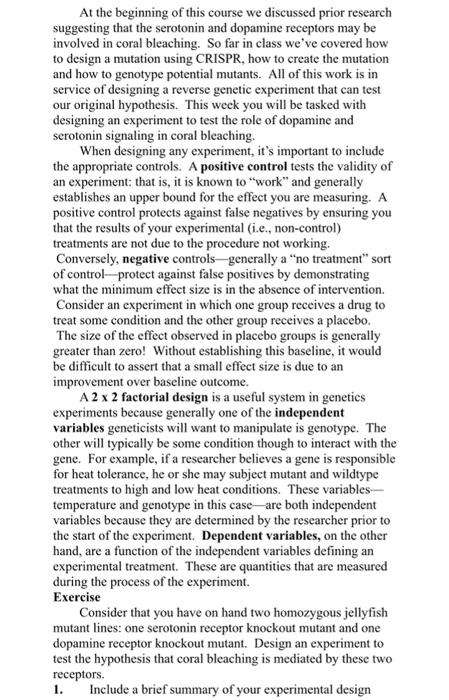
1. Include a brief summary of your experimental design below. Feel free to include a sketch or sketches as necessary. 2. 3. 4. 5. What are your independent and dependent variables? What are some factors that should be kept constant across runs of the experiment? Name at least three. Which treatments serve as your positive and negative controls? Make an example figure. Be sure to clearly label your axes, treatments, and units. Explain how these data support or reject your hypothesis. Lastly, consider a scenario in which you found only a slight effect of each genotype on bleaching in these mutant jellyfish lines. If you crossed the dopamine receptor knockout line with the serotonin receptor knockout line and saw enhanced bleaching, what might that tell you about the relationship of these two genes? Give a possible explanation for that result. 6. At the beginning of this course we discussed prior research suggesting that the serotonin and dopamine receptors may be involved in coral bleaching. So far in class we've covered how to design a mutation using CRISPR, how to create the mutation and how to genotype potential mutants. All of this work is in service of designing a reverse genetic experiment that can test our original hypothesis. This week you will be tasked with designing an experiment to test the role of dopamine and serotonin signaling in coral bleaching. When designing any experiment, it's important to include the appropriate controls. A positive control tests the validity of an experiment that is, it is known to "work" and generally establishes an upper bound for the effect you are measuring. A positive control protects against false negatives by ensuring you that the results of your experimental (i.e., non-control) treatments are not due to the procedure not working. Conversely, negative controls-generally a "no treatment" sort of control protect against false positives by demonstrating what the minimum effect size is in the absence of intervention. Consider an experiment in which one group receives a drug to treat some condition and the other group receives a placebo. The size of the effect observed in placebo groups is generally greater than zero! Without establishing this baseline, it would be difficult to assert that a small effect size is due to an improvement over baseline outcome. A 2 x 2 factorial design is a useful system in genetics experiments because generally one of the independent variables geneticists will want to manipulate is genotype. The other will typically be some condition though to interact with the gene. For example, if a researcher believes a gene is responsible for heat tolerance, he or she may subject mutant and wildtype treatments to high and low heat conditions. These variables- temperature and genotype in this case--are both independent variables because they are determined by the researcher prior to the start of the experiment. Dependent variables, on the other hand, are a function of the independent variables defining an experimental treatment. These are quantities that are measured during the process of the experiment. Exercise Consider that you have on hand two homozygous jellyfish mutant lines: one serotonin receptor knockout mutant and one dopamine receptor knockout mutant. Design an experiment to test the hypothesis that coral bleaching is mediated by these two receptors. 1. Include a brief summary of your experimental design 1. Include a brief summary of your experimental design below. Feel free to include a sketch or sketches as necessary. 2. 3. 4. 5. What are your independent and dependent variables? What are some factors that should be kept constant across runs of the experiment? Name at least three. Which treatments serve as your positive and negative controls? Make an example figure. Be sure to clearly label your axes, treatments, and units. Explain how these data support or reject your hypothesis. Lastly, consider a scenario in which you found only a slight effect of each genotype on bleaching in these mutant jellyfish lines. If you crossed the dopamine receptor knockout line with the serotonin receptor knockout line and saw enhanced bleaching, what might that tell you about the relationship of these two genes? Give a possible explanation for that result. 6. At the beginning of this course we discussed prior research suggesting that the serotonin and dopamine receptors may be involved in coral bleaching. So far in class we've covered how to design a mutation using CRISPR, how to create the mutation and how to genotype potential mutants. All of this work is in service of designing a reverse genetic experiment that can test our original hypothesis. This week you will be tasked with designing an experiment to test the role of dopamine and serotonin signaling in coral bleaching. When designing any experiment, it's important to include the appropriate controls. A positive control tests the validity of an experiment that is, it is known to "work" and generally establishes an upper bound for the effect you are measuring. A positive control protects against false negatives by ensuring you that the results of your experimental (i.e., non-control) treatments are not due to the procedure not working. Conversely, negative controls-generally a "no treatment" sort of control protect against false positives by demonstrating what the minimum effect size is in the absence of intervention. Consider an experiment in which one group receives a drug to treat some condition and the other group receives a placebo. The size of the effect observed in placebo groups is generally greater than zero! Without establishing this baseline, it would be difficult to assert that a small effect size is due to an improvement over baseline outcome. A 2 x 2 factorial design is a useful system in genetics experiments because generally one of the independent variables geneticists will want to manipulate is genotype. The other will typically be some condition though to interact with the gene. For example, if a researcher believes a gene is responsible for heat tolerance, he or she may subject mutant and wildtype treatments to high and low heat conditions. These variables- temperature and genotype in this case--are both independent variables because they are determined by the researcher prior to the start of the experiment. Dependent variables, on the other hand, are a function of the independent variables defining an experimental treatment. These are quantities that are measured during the process of the experiment. Exercise Consider that you have on hand two homozygous jellyfish mutant lines: one serotonin receptor knockout mutant and one dopamine receptor knockout mutant. Design an experiment to test the hypothesis that coral bleaching is mediated by these two receptors. 1. Include a brief summary of your experimental design Step by Step Solution
There are 3 Steps involved in it
1 Expert Approved Answer
Step: 1 Unlock

Question Has Been Solved by an Expert!
Get step-by-step solutions from verified subject matter experts
Step: 2 Unlock
Step: 3 Unlock
 Study Help