







Question: Help with these question 1-6 what do you mean by deeN? 4. Experiment Questions Write a lab report according to the format and discuss the
Help with these question 1-6 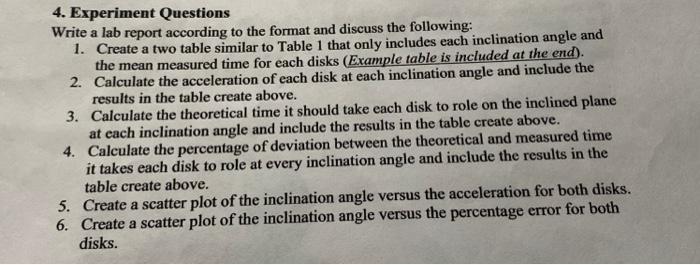
what do you mean by deeN?
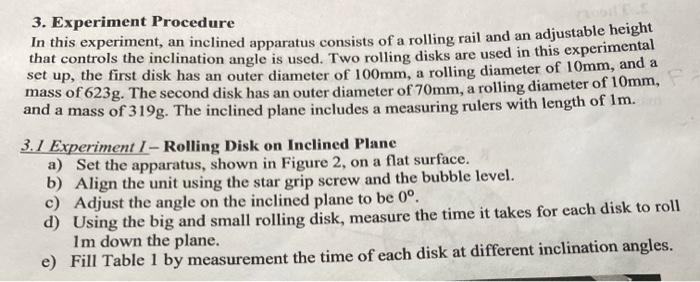
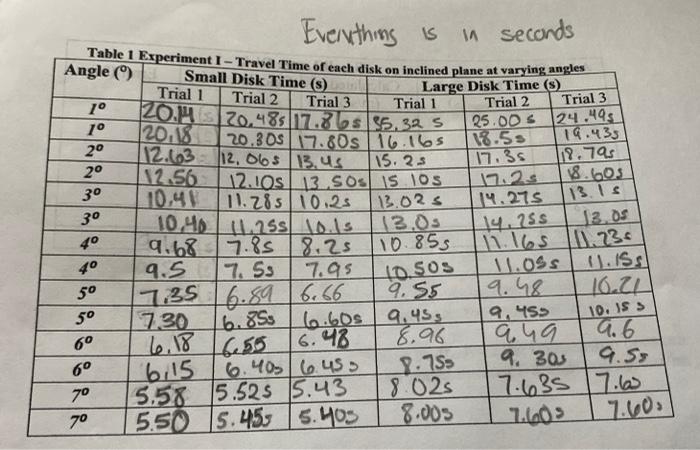
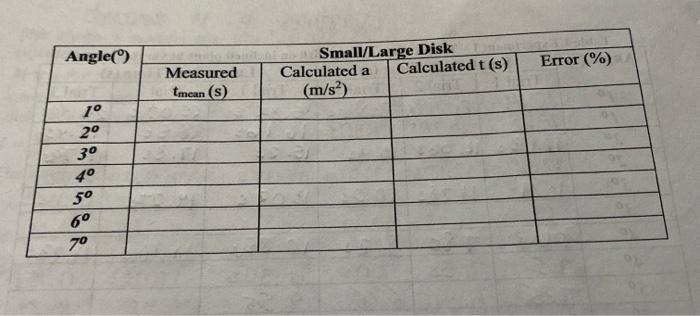
4. Experiment Questions Write a lab report according to the format and discuss the following: 1. Create a two table similar to Table 1 that only includes each inclination angle and the mean measured time for each disks (Example table is included at the end). 2. Calculate the acceleration of each disk at each inclination angle and include the results in the table create above. 3. Calculate the theoretical time it should take each disk to role on the inclined plane at each inclination angle and include the results in the table create above. 4. Calculate the percentage of deviation between the theoretical and measured time it takes each disk to role at every inclination angle and include the results in the table create above. 5. Create a scatter plot of the inclination angle versus the acceleration for both disks. 6. Create a scatter plot of the inclination angle versus the percentage error for both disks. 3. Experiment Procedure In this experiment, an inclined apparatus consists of a rolling rail and an adjustable height that controls the inclination angle is used. Two rolling disks are used in this experimental set up, the first disk has an outer diameter of 100mm, a rolling diameter of 10mm, and a mass of 623g. The second disk has an outer diameter of 70mm, a rolling diameter of 10mm, and a mass of 319g. The inclined plane includes a measuring rulers with length of Im. 3.1 Experiment 1 - Rolling Disk on Inclined Plane a) Set the apparatus, shown in Figure 2, on a flat surface. b) Align the unit using the star grip screw and the bubble level. c) Adjust the angle on the inclined plane to be 0. d) Using the big and small rolling disk, measure the time it takes for each disk to roll Im down the plane. e) Fill Table 1 by measurement the time of each disk at different inclination angles. Everything is in seconds Table 1 Experiment 1 Travel Time of each disk on inclined plane at varying angles Angle o Small Disk Time (S) Trial 1 Trial 2 Large Disk Time (s) 1 Trial 3 Trial 1 120,470.485 17.865 $5.32 Trial 3 Trial 2 1 120.18 25.00 S 24.495 20.30S 17.80s 16.165 18.55 19.433 20 112.63 12, 063 13.us 15.2.3 17.35 18.795 2 12.56 12.10s 13 SOs 15 JOS 18.603 30 10,44 11.285 10.2s 13.02s 14.275 3 10.40 I2S 1.15 13.03 40 9.68 17.85 8.25 8.25 10.855 11.165 111.735 4 9.5 7. 53 7.95 10.SOS 11.05s 50 7,35 6.89 6.66 9.55 7.30 10.605 9.453 9. 45 6.43 qug 9.6 6 6:15 6.40 6.45 9.75 9. 303 9.53 70 5,58 5.525 5.43 8025 7.635 17.00 7 5.50 5.453 15.45 5.405 8.003 7.603 13.1s 13.05 14.255 11.15 10.21 10.IS 50 6.85: 6.18 Angle Error (%) Measured Imean (s) Small/Large Disk Calculated a Calculated t(s) (m/s) 1 2 30 4 50 6 70 4. Experiment Questions Write a lab report according to the format and discuss the following: 1. Create a two table similar to Table 1 that only includes each inclination angle and the mean measured time for each disks (Example table is included at the end). 2. Calculate the acceleration of each disk at each inclination angle and include the results in the table create above. 3. Calculate the theoretical time it should take each disk to role on the inclined plane at each inclination angle and include the results in the table create above. 4. Calculate the percentage of deviation between the theoretical and measured time it takes each disk to role at every inclination angle and include the results in the table create above. 5. Create a scatter plot of the inclination angle versus the acceleration for both disks. 6. Create a scatter plot of the inclination angle versus the percentage error for both disks. 3. Experiment Procedure In this experiment, an inclined apparatus consists of a rolling rail and an adjustable height that controls the inclination angle is used. Two rolling disks are used in this experimental set up, the first disk has an outer diameter of 100mm, a rolling diameter of 10mm, and a mass of 623g. The second disk has an outer diameter of 70mm, a rolling diameter of 10mm, and a mass of 319g. The inclined plane includes a measuring rulers with length of Im. 3.1 Experiment 1 - Rolling Disk on Inclined Plane a) Set the apparatus, shown in Figure 2, on a flat surface. b) Align the unit using the star grip screw and the bubble level. c) Adjust the angle on the inclined plane to be 0. d) Using the big and small rolling disk, measure the time it takes for each disk to roll Im down the plane. e) Fill Table 1 by measurement the time of each disk at different inclination angles. Everything is in seconds Table 1 Experiment 1 Travel Time of each disk on inclined plane at varying angles Angle o Small Disk Time (S) Trial 1 Trial 2 Large Disk Time (s) 1 Trial 3 Trial 1 120,470.485 17.865 $5.32 Trial 3 Trial 2 1 120.18 25.00 S 24.495 20.30S 17.80s 16.165 18.55 19.433 20 112.63 12, 063 13.us 15.2.3 17.35 18.795 2 12.56 12.10s 13 SOs 15 JOS 18.603 30 10,44 11.285 10.2s 13.02s 14.275 3 10.40 I2S 1.15 13.03 40 9.68 17.85 8.25 8.25 10.855 11.165 111.735 4 9.5 7. 53 7.95 10.SOS 11.05s 50 7,35 6.89 6.66 9.55 7.30 10.605 9.453 9. 45 6.43 qug 9.6 6 6:15 6.40 6.45 9.75 9. 303 9.53 70 5,58 5.525 5.43 8025 7.635 17.00 7 5.50 5.453 15.45 5.405 8.003 7.603 13.1s 13.05 14.255 11.15 10.21 10.IS 50 6.85: 6.18 Angle Error (%) Measured Imean (s) Small/Large Disk Calculated a Calculated t(s) (m/s) 1 2 30 4 50 6 70
Step by Step Solution
There are 3 Steps involved in it
1 Expert Approved Answer
Step: 1 Unlock

Question Has Been Solved by an Expert!
Get step-by-step solutions from verified subject matter experts
Step: 2 Unlock
Step: 3 Unlock
 Study Help