







Question: Here is a statement of the Master Theorem. Master Theorem: Let a > 1 and b > 1 be constants, let f(n) be a function,
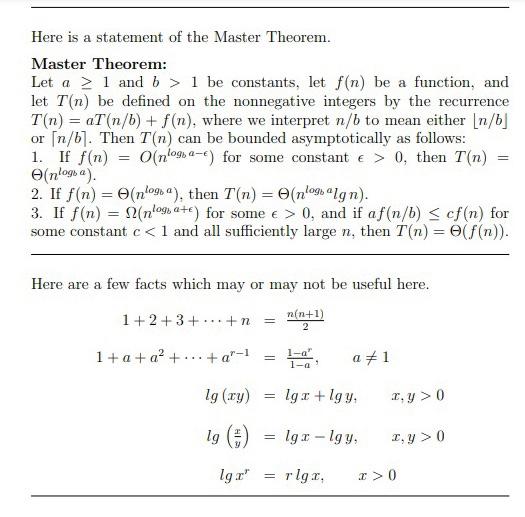
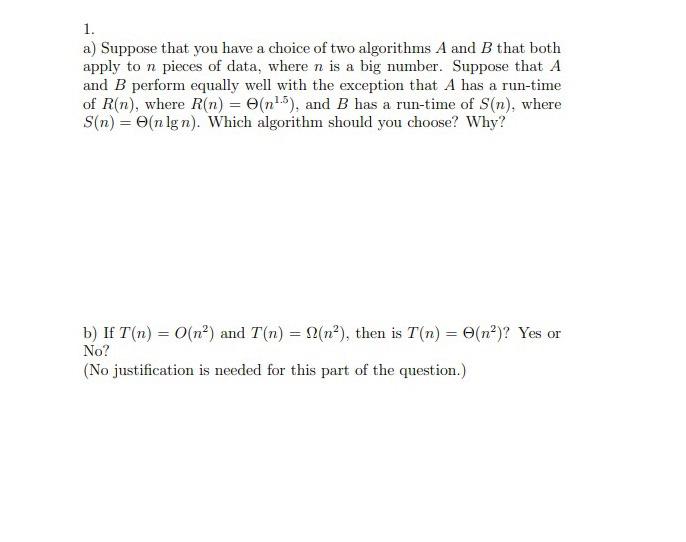
Here is a statement of the Master Theorem. Master Theorem: Let a > 1 and b > 1 be constants, let f(n) be a function, and let T(n) be defined on the nonnegative integers by the recurrence T(n) = aT(n/b) + f(n), where we interpret n/b to mean either [n/b] or [n/b]. Then T(n) can be bounded asymptotically as follows: 1. If f(n) = O(nlogs 2-6) for some constant e > 0, then T(n) (nlogna). 2. If f(n) = (nog), then T(n) = (nloggn). 3. If f(n) = 2(nlog, a+) for some e > 0, and if af(n/b)
Step by Step Solution
There are 3 Steps involved in it

Get step-by-step solutions from verified subject matter experts
 Study Help