







Question: Only 18 and 19 please 4.4 Eigenvalues and the Characteristic Polynomial 305 ultimately requires the evaluation of al/2 determinants of order (2 x 2). Even
Only 18 and 19 please
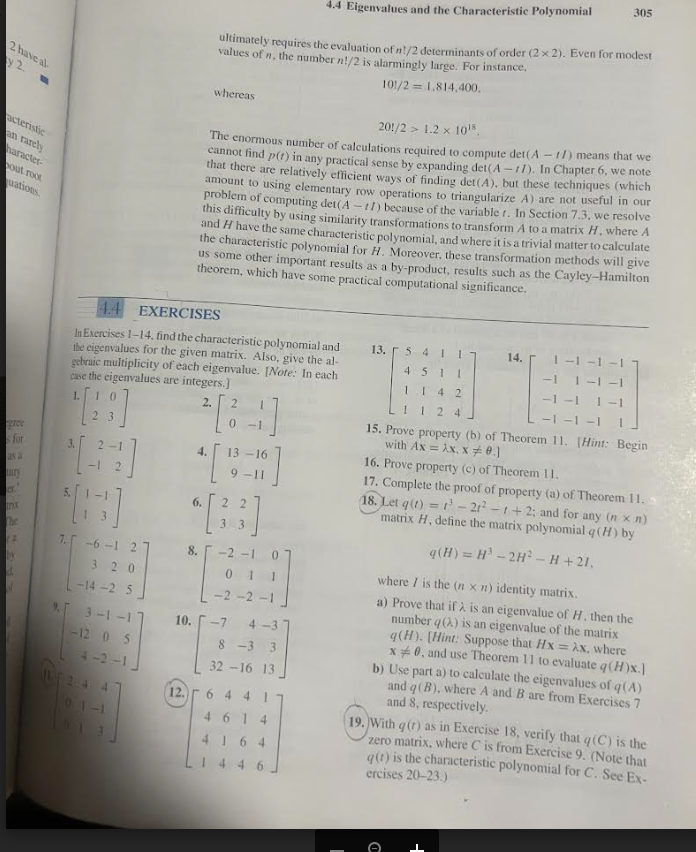
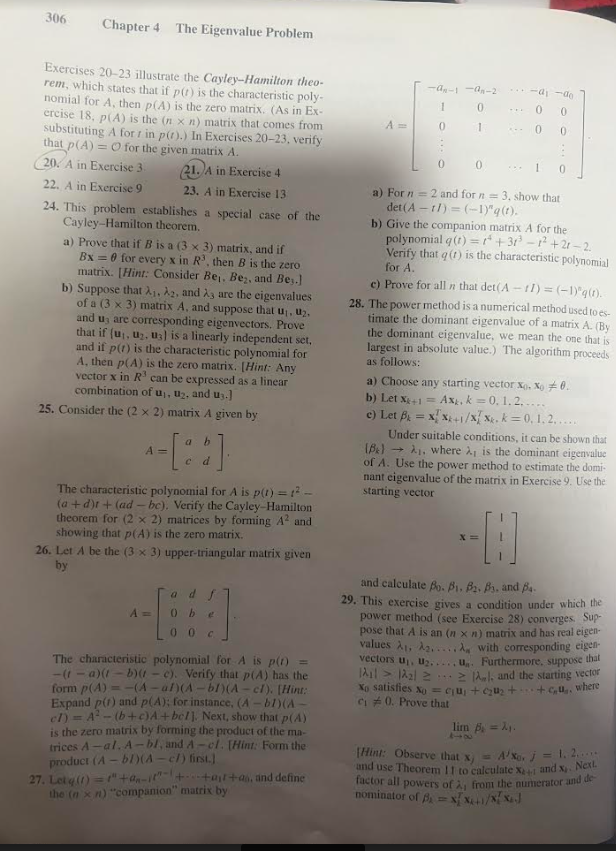
4.4 Eigenvalues and the Characteristic Polynomial 305 ultimately requires the evaluation of al/2 determinants of order (2 x 2). Even for modest values of n. the number a!/2 is alarmingly large. For instance. 2 have al. 2. 101/2 = 1,814,400. whereas 201/2 > 1.2 x 10¹⁵. acteristic The enormous number of calculations required to compute det (A - (/ ) means that we an rarely cannot find p() in any practical sense by expanding det(A - 1/). In Chapter 6, we note haracter- that there are relatively efficient ways of finding det(A), but these techniques (which pout rod amount to using elementary row operations to triangularize A) are not useful in our juations problem of computing det(A -1/) because of the variable f. In Section 7.3, we resolve this difficulty by using similarity transformations to transform A to a matrix H. where A and H have the same characteristic polynomial, and where it is a trivial matter to calculate the characteristic polynomial for H. Moreover, these transformation methods will give us some other important results as a by-product, results such as the Cayley-Hamilton theorem, which have some practical computational significance. 4.4 EXERCISES In Exercises 1-14, find the characteristic polynomial and 13. 14. 1 -1-1-1 the eigenvalues for the given matrix. Also, give the al- 4 -1 1-1-1 gebraic multiplicity of each eigenvalue. [Nore: In each case the eigenvalues are integers.] 4 2 -1-1 1-1 " [23] -1-1 -1 15. Prove property (b) of Theorem 11. [Hint: Begin with Ax = Ax. x # 0.] for 4. 13 - 16 16. Prove property (@) of Theorem 11. as a 9 - 11 17. Complete the proof of property (a) of Theorem II. 18. Let q (1) = 13 - 213 - 1 + 2: and for any (n x n) 6. 2 2 matrix H, define the matrix polynomial q (H ) by q (H) = H3 - 2H- - H + 21. 7. -6 -1 2 8. -2 -1 0 3 20 0 1 where / is the (n x n) identity matrix. - 14-2 5 -2-2-1 a) Prove that if A is an eigenvalue of H. then the number q (2) is an eigenvalue of the matrix 3 -1 -1 10. -7 4-3 q(H). [Hint: Suppose that Hx = Ax, where -12 0 5 8 -3 3 x # 0. and use Theorem 1 1 to evaluate q (H)x.] 4-2-1 32 -16 13 b) Use part a) to calculate the eigenvalues of q( A) 10 24 4 and q ( B), where A and B are from Exercises 7 12. 6 4 4 1 and 8, respectively. 1 4 19. )With q(r) as in Exercise 18, verify that q (C) is the zero matrix, where C is from Exercise 9. (Note that 6 4 q(r) is the characteristic polynomial for C. See Ex- 4 ercises 20-23.)306 Chapter 4 The Eigenvalue Problem Exercises 20-23 illustrate the Cayley-Hamilton theo- - - -On-2 -di -do rem, which states that if p() is the characteristic poly- nomial for A, then p(A) is the zero matrix. (As in Ex- ercise 18, p(A) is the (n x n) matrix that comes from A = 0 substituting A for r in p(r).) In Exercises 20-23, verify that p(A) = O for the given matrix A. (20. A in Exercise 3. 1. A in Exercise 4 22. A in Exercise 9 23. A in Exercise 13 a) For n = 2 and for n = 3. show that det(A - 1/) = (-1)"q(1). 24. This problem establishes a special case of the Cayley-Hamilton theorem. b) Give the companion matrix A for the polynomial q (1) = ( + 373-12 + 2r -2. a) Prove that if B is a (3 x 3) matrix, and if Verify that q (f) is the characteristic polynomial Bx = 0 for every x in R'. then B is the zero for A. matrix. [Hint: Consider Bej. Bez, and Bey.] c) Prove for all n that det(A - 17) = (-1)"q(1). b) Suppose that 21. Az, and As are the eigenvalues of a (3 x 3) matrix A, and suppose that u1, U2, 28. The power method is a numerical method used toes- and us are corresponding eigenvectors, Prove timate the dominant eigenvalue of a matrix A. (By that if {uj, uz, us) is a linearly independent set, the dominant eigenvalue, we mean the one that is and if p(r) is the characteristic polynomial for largest in absolute value.) The algorithm proceeds A, then p(A) is the zero matrix. [Hint: Any as follows: vector x in R' can be expressed as a linear a) Choose any starting vector xo. No # 0. combination of uj, u2, and u3.] b) Let Xe+1 = Axt, k = 0. 1. 2. .... 25. Consider the (2 x 2) matrix A given by c) Let Br = X X141 /x Xx. k = 0, 1. 2. .. . . Under suitable conditions, it can be shown that A = (8:) - 21, where A, is the dominant eigenvalue of A. Use the power method to estimate the domi- nant eigenvalue of the matrix in Exercise 9. Use the The characteristic polynomial for A is p(1) = ]- starting vector (a + d) + (ad - be). Verify the Cayley-Hamilton theorem for (2 x 2) matrices by forming A? and showing that p(A) is the zero matrix. 26. Let A be the (3 x 3) upper-triangular matrix given -[:] by and calculate Bo. Bi, By. By. and Ba. 29. This exercise gives a condition under which the A = 0 power method (see Exercise 28) converges. Sup- pose that A is an (n x n) matrix and has real eigen- values Al, Agree.. An with corresponding eigen- The characteristic polynomial for A is p() = vectors uj, U2. ... . U.. Furthermore. suppose that -(1 - a)(1 - b)(1 - c). Verify that p(A) has the 1211 3 1221 2 ... 2 1Awl, and the starting vector form p(A) = (4 -GD)(A -b/)(A - cl). [Hint: No satisfies x0 = cru, + cuz + + cou. where Expand p() and p(A); for instance, (A - b/)(A Ci # 0. Prove that cl) = A- - (b+c)A + be/]. Next, show that p(A) lim By = My. is the zero matrix by forming the product of the ma- trices A - al. A - bl, and A -cl. [Hint: Form the [Hint: Observe that x) = Axa, j = 1. 2... . product (A - 50)(A -c/) first.1. and use Theorem I I to calculate xat and xy. Next. 27. Letg(1) = (" tan-in" +. tartan, and define factor all powers of A, from the numerator and de the (n x n) "companion" matrix by nominator of BA = xx -xX41/X XAl
Step by Step Solution
There are 3 Steps involved in it

Get step-by-step solutions from verified subject matter experts
 Study Help