







Question: Here is an example: Zn (s) + Cu+ (aq) Zn (aq) + Cu (s) In this reaction two electrons are transferred from the solid
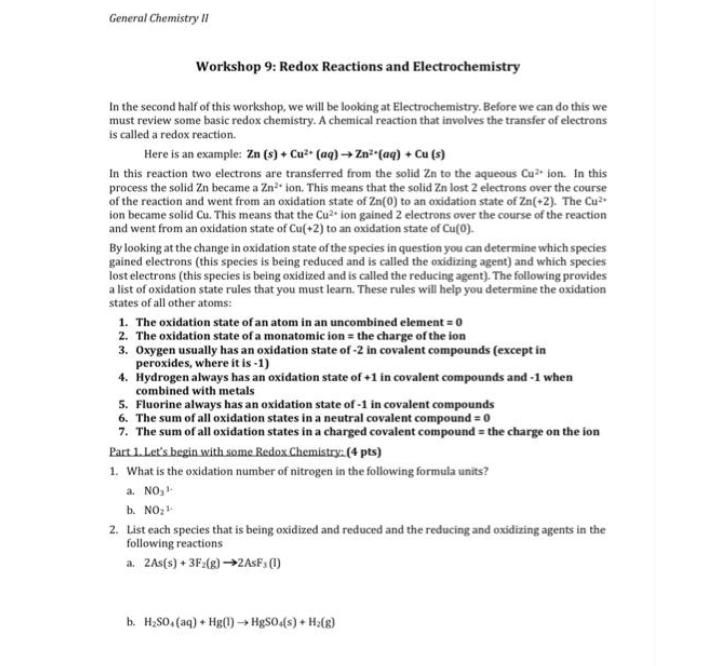
Here is an example: Zn (s) + Cu+ (aq) Zn (aq) + Cu (s) In this reaction two electrons are transferred from the solid Zn to the aqueous Cu+ ion. In this process the solid Zn became a Zn+ ion. This means that the solid Zn lost 2 electrons over the course of the reaction and went from an oxidation state of Zn(0) to an oxidation state of Zn(+2). The Cu+ ion became solid Cu. This means that the Cu+ ion gained 2 electrons over the course of the reaction and went from an oxidation state of Cu(+2) to an oxidation state of Cu(0). By looking at the change in oxidation state of the species in question you can determine which species gained electrons (this species is being reduced and is called the oxidizing agent) and which species lost electrons (this species is being oxidized and is called the reducing agent). The following provides a list of oxidation state rules that you must learn. These rules will help you determine the oxidation states of all other atoms: 1. The oxidation state of an atom in an uncombined element=0 2. The oxidation state of a monatomic ion = the charge of the ion 3. Oxygen usually has an oxidation state of -2 in covalent compounds (except in peroxides, where it is -1) 4. Hydrogen always has an oxidation state of +1 in covalent compounds and -1 when combined with metals 5. Fluorine always has an oxidation state of -1 in covalent compounds 6. The sum of all oxidation states in a neutral covalent compound = 0 7. The sum of all oxidation states in a charged covalent compound the charge on the ion Part 1. Let's begin with some Redox Chemistry: (4 pts) 1. What is the oxidation number of nitrogen in the following formula units? a. NO, b. NO 2. List each species that is being oxidized and reduced and the reducing and oxidizing agents in the following reactions a. 2As(s) + 3F:(g) 2AsF; (1) b. HSO4 (aq) + Hg(1) HgSO4(s) + H(g)
Step by Step Solution
3.46 Rating (156 Votes )
There are 3 Steps involved in it
The detailed ... View full answer

Get step-by-step solutions from verified subject matter experts
 Study Help