







Question: Hey! this is simulation is for extra help. I'm confused about this and would like to know how to do! Please make this as understanable
Hey! this is simulation is for extra help.
I'm confused about this and would like to know how to do!
Please make this as understanable as possible as I need help! Ty ??
Here is the link to the Simulation https://phet.colorado.edu/sims/html/projectile-motion/latest/projectile-motion_en.html
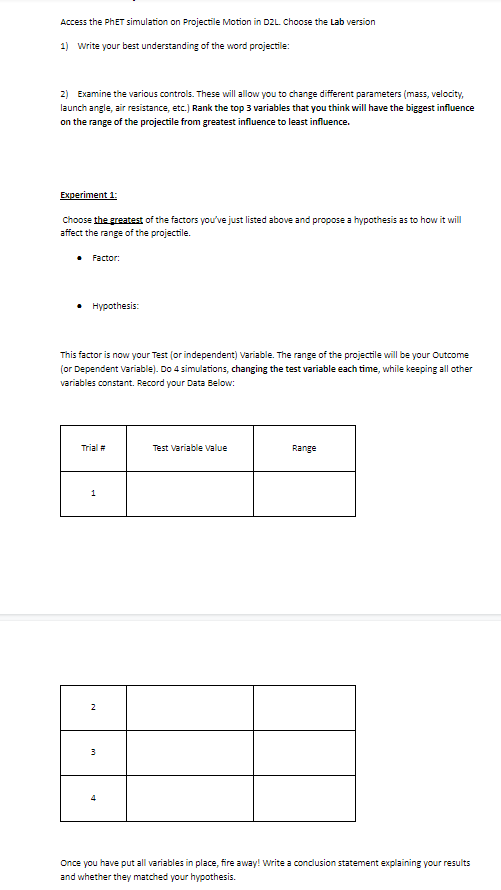
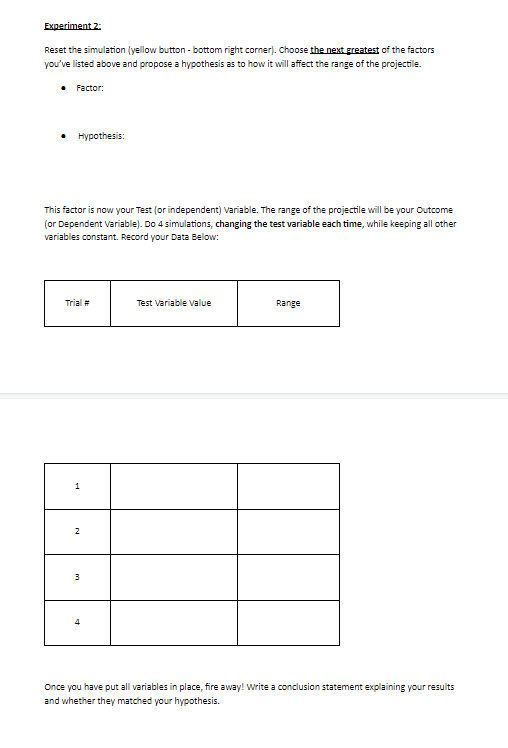
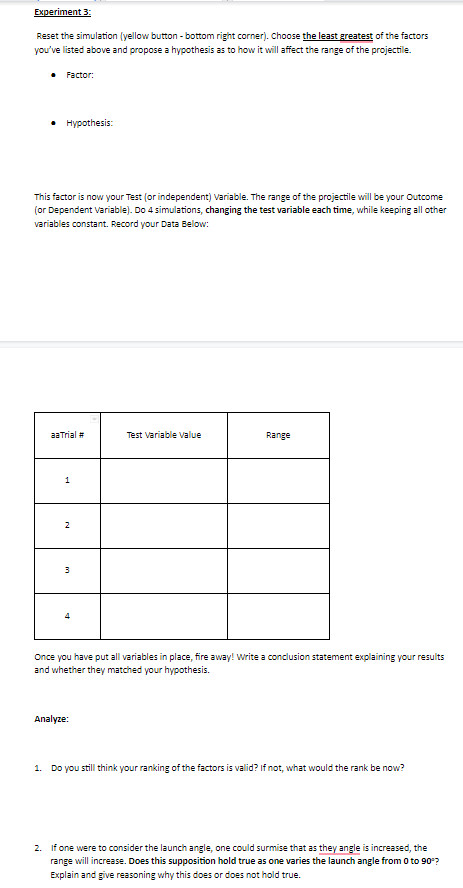
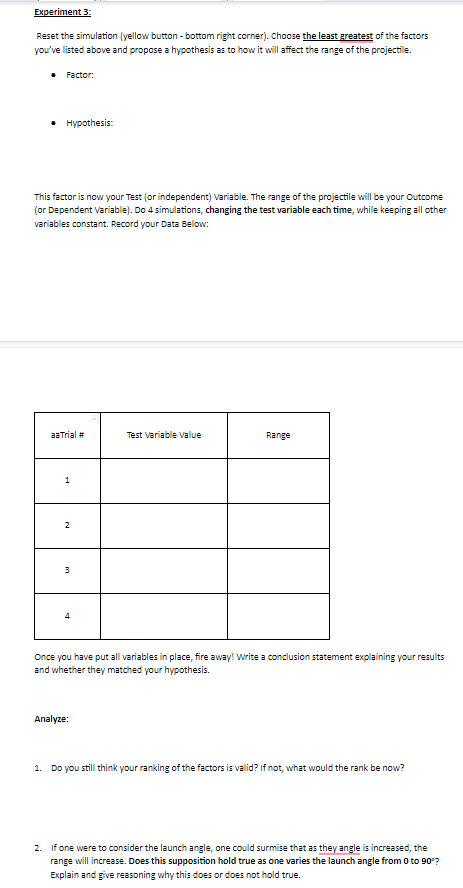
Access the PhET simulation on Projectile Motion in D2L. Choose the Lab version 1) write your best understanding of the word projectile: 2) Examine the various controls. These will allow you to change different parameters (mass, velocity, launch angle, air resistance, etc.] Rank the top 3 variables that you think will have the biggest influence on the range of the projectile from greatest influence to least influence. Experiment 1: Choose the greatest of the factors you've just listed above and propose a hypothesis as to how it will affect the range of the projectile. . Factor: . Hypothesis: This factor is now your Test (or independent) Variable. The range of the projectile will be your Outcome (or Dependent Variable]. Do 4 simulations, changing the test variable each time, while keeping all other variables constant. Record your Data Below: Trial # Test Variable Value Range 1 2 3 Once you have put all variables in place, fire away! Write a conclusion statement explaining your results and whether they matched your hypothesis.Experiment 2: Reset the simulation (yellow button - bottom right corner). Choose the next greatest of the factors you've listed above and propose a hypothesis as to how it will affect the range of the projectile. . Factor: Hypothesis: This factor is now your Test (or independent) Variable. The range of the projectile will be your Outcome (or Dependent Variable]. Do 4 simulations, changing the test variable each time, while keeping all other variables constant. Record your Data Below: Trial # Test Variable Value Range 3 Once you have put all variables in place, fire away! Write a conclusion statement explaining your results and whether they matched your hypothesis.Experiment 3: Reset the simulation (yellow button - bottom right corner). Choose the least greatest of the factors you've listed above and propose a hypothesis as to how it will affect the range of the projectile. Factor: . Hypothesis: This factor is now your Test (or independent) Variable. The range of the projectile will be your Outcome (or Dependent Variable]. Do 4 simulations, changing the test variable each time, while keeping all other variables constant. Record your Data Below: # BULEE Test Variable Value Range 1 LU Once you have put all variables in place, fire away! Write a conclusion statement explaining your results and whether they matched your hypothesis. Analyze: 1. Do you still think your ranking of the factors is valid? If not, what would the rank be now? 2. If one were to consider the launch angle, one could surmise that as they angle is increased, the range will increase. Does this supposition hold true as one varies the launch angle from 0 to 90"? Explain and give reasoning why this does or does not hold true
Step by Step Solution
There are 3 Steps involved in it

Get step-by-step solutions from verified subject matter experts
 Study Help