







Question: Hi do you mind showing clearly for the three question, they are the same problem but different parts, Thank you so very much. A new
Hi do you mind showing clearly for the three question, they are the same problem but different parts, Thank you so very much.
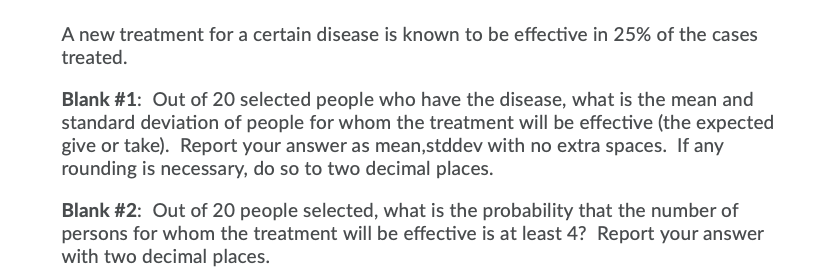
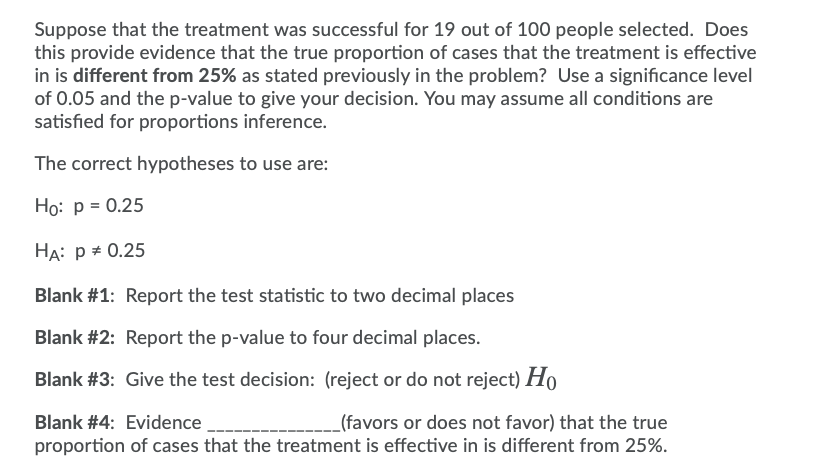
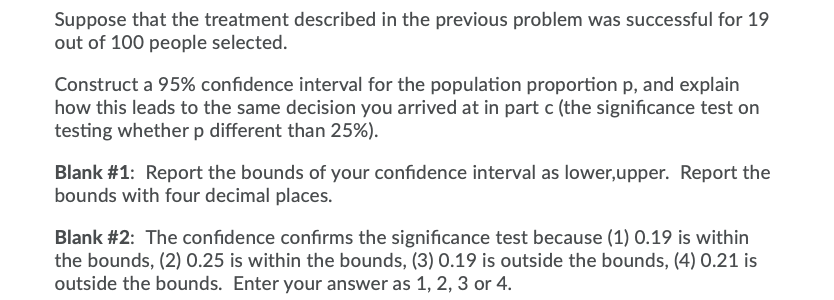
A new treatment for a certain disease is known to be effective in 25% of the cases treated. Blank #1: Out of 20 selected people who have the disease, what is the mean and standard deviation of people for whom the treatment will be effective [the expected give or take). Report your answer as mean.stddev with no extra spaces. If any rounding is necessary. do so to two decimal places. Blank #2: Out of 20 people selected, what is the probability that the number of persons for whom the treatment will be effective is at least 4? Report your answer with two decimal places. Suppose that the treatment was successful for 19 out of 100 people selected. Does this provide evidence that the true proportion of cases that the treatment is effective in is different from 25% as stated previously in the problem? Use a significance level of 0.05 and the p-value to give your decision. You may assume all conditions are satisfied for proportions inference. The correct hypotheses to use are: Ho: p = 0.25 HA: P * 0.25 Blank #1: Report the test statistic to two decimal places Blank #2: Report the p-value to four decimal places. Blank #3: Give the test decision: (reject or do not reject) Ho Blank #4: Evidence (favors or does not favor) that the true proportion of cases that the treatment is effective in is different from 25%.Suppose that the treatment described in the previous problem was successful for 19 out of 100 people selected. Construct a 95% confidence interval for the population proportion p, and explain how this leads to the same decision you arrived at in part c (the significance test on testing whether p different than 25%). Blank #1: Report the bounds of your confidence interval as lower,upper. Report the bounds with four decimal places. Blank #2: The confidence confirms the significance test because (1) 0.19 is within the bounds, (2) 0.25 is within the bounds, (3) 0.19 is outside the bounds, (4) 0.21 is outside the bounds. Enter your answer as 1, 2, 3 or 4
Step by Step Solution
There are 3 Steps involved in it

Get step-by-step solutions from verified subject matter experts
 Study Help