







Question: Hi i need help with the following task regarding drilling : Task 2: Loads on casing We now turn to the problem of calculating loads
Hi i need help with the following task regarding drilling :
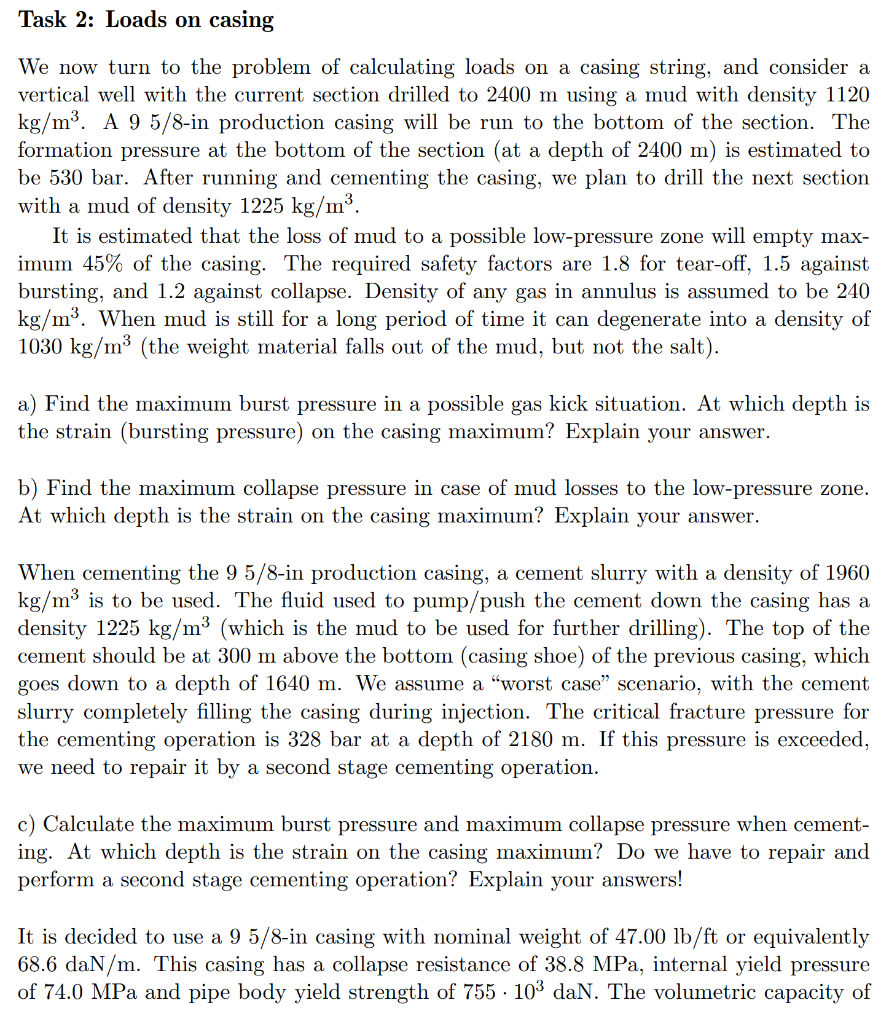
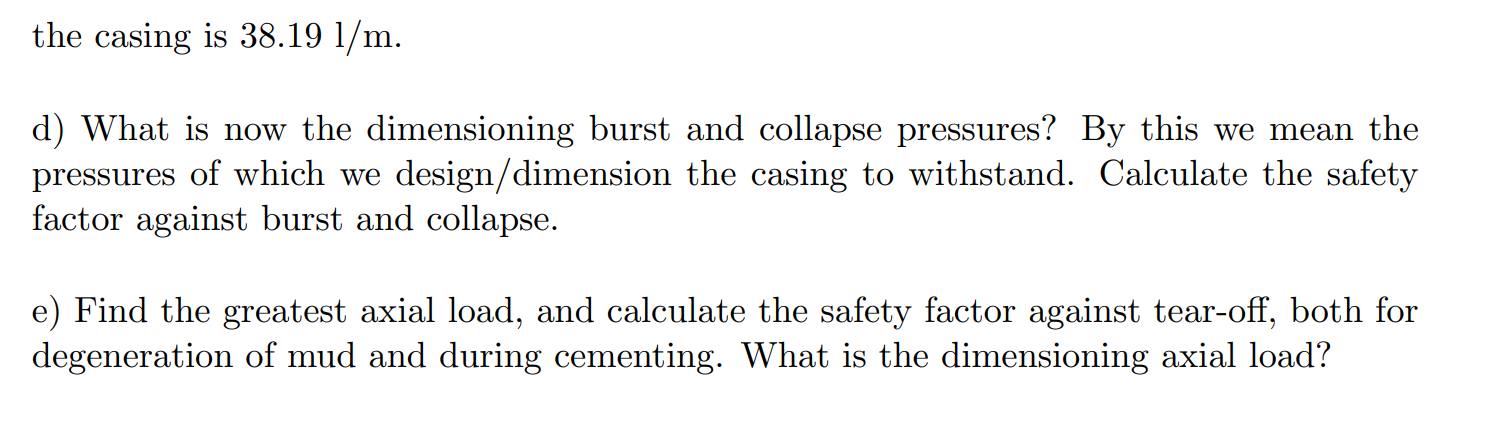
Task 2: Loads on casing We now turn to the problem of calculating loads on a casing string, and consider a vertical well with the current section drilled to 2400 m using a mud with density 1120 kg/m3. A 9 5/8-in production casing will be run to the bottom of the section. The formation pressure at the bottom of the section (at a depth of 2400 m) is estimated to be 530 bar. After running and cementing the casing, we plan to drill the next section with a mud of density 1225 kg/m3. It is estimated that the loss of mud to a possible low-pressure zone will empty max- imum 45% of the casing. The required safety factors are 1.8 for tear-off, 1.5 against bursting, and 1.2 against collapse. Density of any gas in annulus is assumed to be 240 kg/m. When mud is still for a long period of time it can degenerate into a density of 1030 kg/m3 (the weight material falls out of the mud, but not the salt). a) Find the maximum burst pressure in a possible gas kick situation. At which depth is the strain (bursting pressure) on the casing maximum? Explain your answer. b) Find the maximum collapse pressure in case of mud losses to the low-pressure zone. At which depth is the strain on the casing maximum? Explain your answer. When cementing the 9 5/8-in production casing, a cement slurry with a density of 1960 kg/m is to be used. The fluid used to pump/push the cement down the casing has a density 1225 kg/m3 (which is the mud to be used for further drilling). The top of the cement should be at 300 m above the bottom (casing shoe) of the previous casing, which goes down to a depth of 1640 m. We assume a "worst case scenario, with the cement slurry completely filling the casing during injection. The critical fracture pressure for the cementing operation is 328 bar at a depth of 2180 m. If this pressure is exceeded, we need to repair it by a second stage cementing operation. c) Calculate the maximum burst pressure and maximum collapse pressure when cement- ing. At which depth is the strain on the casing maximum? Do we have to repair and perform a second stage cementing operation? Explain your answers! It is decided to use a 9 5/8-in casing with nominal weight of 47.00 lb/ft or equivalently 68.6 daN/m. This casing has a collapse resistance of 38.8 MPa, internal yield pressure of 74.0 MPa and pipe body yield strength of 755 103 daN. The volumetric capacity of the casing is 38.19 1/m. d) What is now the dimensioning burst and collapse pressures? By this we mean the pressures of which we design/dimension the casing to withstand. Calculate the safety factor against burst and collapse. e) Find the greatest axial load, and calculate the safety factor against tear-off, both for degeneration of mud and during cementing. What is the dimensioning axial load? Task 2: Loads on casing We now turn to the problem of calculating loads on a casing string, and consider a vertical well with the current section drilled to 2400 m using a mud with density 1120 kg/m3. A 9 5/8-in production casing will be run to the bottom of the section. The formation pressure at the bottom of the section (at a depth of 2400 m) is estimated to be 530 bar. After running and cementing the casing, we plan to drill the next section with a mud of density 1225 kg/m3. It is estimated that the loss of mud to a possible low-pressure zone will empty max- imum 45% of the casing. The required safety factors are 1.8 for tear-off, 1.5 against bursting, and 1.2 against collapse. Density of any gas in annulus is assumed to be 240 kg/m. When mud is still for a long period of time it can degenerate into a density of 1030 kg/m3 (the weight material falls out of the mud, but not the salt). a) Find the maximum burst pressure in a possible gas kick situation. At which depth is the strain (bursting pressure) on the casing maximum? Explain your answer. b) Find the maximum collapse pressure in case of mud losses to the low-pressure zone. At which depth is the strain on the casing maximum? Explain your answer. When cementing the 9 5/8-in production casing, a cement slurry with a density of 1960 kg/m is to be used. The fluid used to pump/push the cement down the casing has a density 1225 kg/m3 (which is the mud to be used for further drilling). The top of the cement should be at 300 m above the bottom (casing shoe) of the previous casing, which goes down to a depth of 1640 m. We assume a "worst case scenario, with the cement slurry completely filling the casing during injection. The critical fracture pressure for the cementing operation is 328 bar at a depth of 2180 m. If this pressure is exceeded, we need to repair it by a second stage cementing operation. c) Calculate the maximum burst pressure and maximum collapse pressure when cement- ing. At which depth is the strain on the casing maximum? Do we have to repair and perform a second stage cementing operation? Explain your answers! It is decided to use a 9 5/8-in casing with nominal weight of 47.00 lb/ft or equivalently 68.6 daN/m. This casing has a collapse resistance of 38.8 MPa, internal yield pressure of 74.0 MPa and pipe body yield strength of 755 103 daN. The volumetric capacity of the casing is 38.19 1/m. d) What is now the dimensioning burst and collapse pressures? By this we mean the pressures of which we design/dimension the casing to withstand. Calculate the safety factor against burst and collapse. e) Find the greatest axial load, and calculate the safety factor against tear-off, both for degeneration of mud and during cementing. What is the dimensioning axial load
Step by Step Solution
There are 3 Steps involved in it

Get step-by-step solutions from verified subject matter experts
 Study Help