







Question: (Hint: Keep in mind that, if a function F is continuous (polynomials are always continuous) on an interval I, and is never zero on
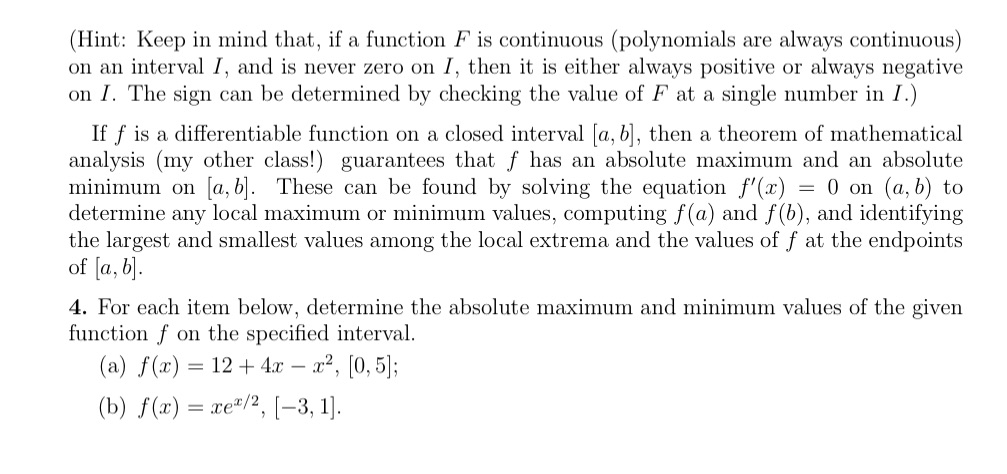
(Hint: Keep in mind that, if a function F is continuous (polynomials are always continuous) on an interval I, and is never zero on I, then it is either always positive or always negative on I. The sign can be determined by checking the value of F at a single number in I.) = If f is a differentiable function on a closed interval [a, b], then a theorem of mathematical analysis (my other class!) guarantees that f has an absolute maximum and an absolute minimum on [a, b]. These can be found by solving the equation f'(x) 0 on (a, b) to determine any local maximum or minimum values, computing f(a) and f(b), and identifying the largest and smallest values among the local extrema and the values of f at the endpoints of [a, b]. 4. For each item below, determine the absolute maximum and minimum values of the given function f on the specified interval. (a) f(x)=12+4x- x, [0,5]; (b) f(x) = xex/2, [3, 1].
Step by Step Solution
There are 3 Steps involved in it

Get step-by-step solutions from verified subject matter experts
 Study Help