







Question: HOMEWORK PROBLEMS 1. Classify the following as either batch or continuous pro- cesses, and indicate whether each is a steady-state or an unsteady- state process:
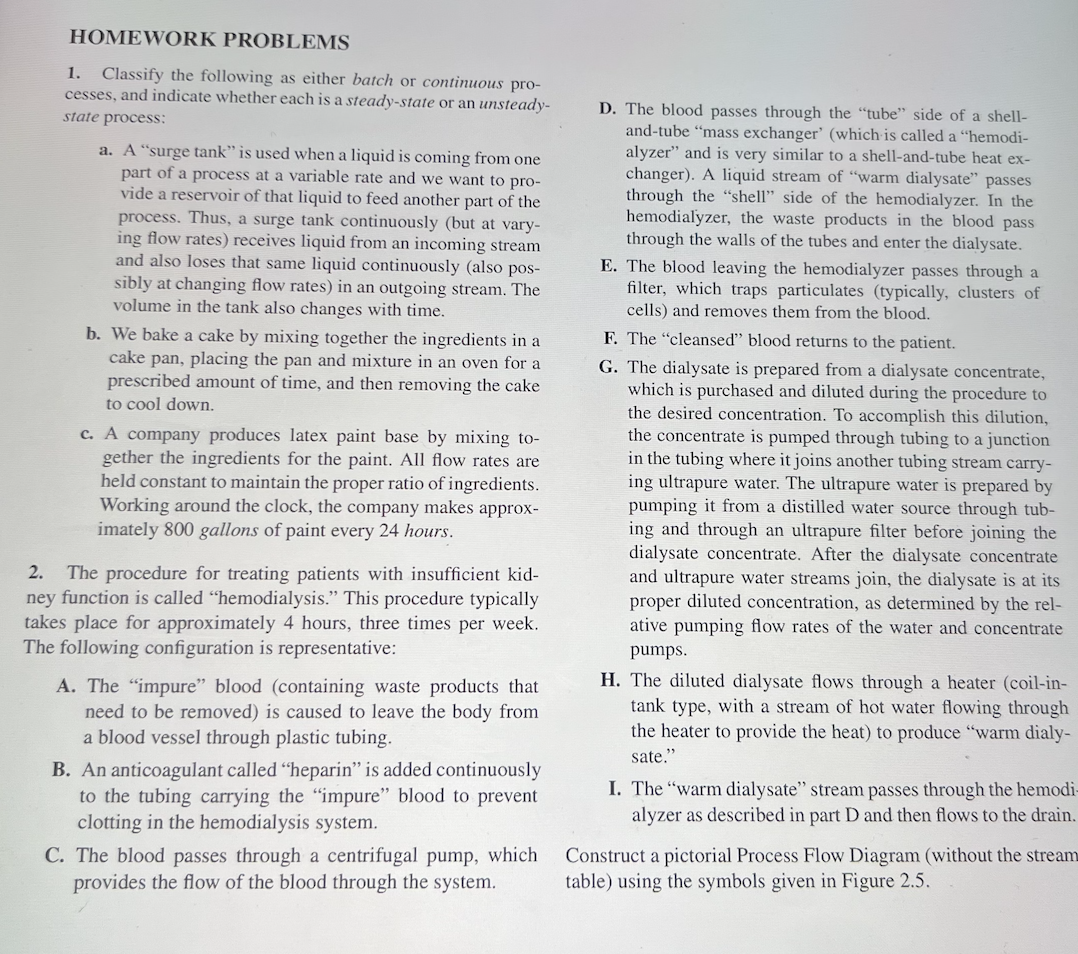
HOMEWORK PROBLEMS 1. Classify the following as either batch or continuous pro- cesses, and indicate whether each is a steady-state or an unsteady- state process: a. A "surge tank" is used when a liquid is coming from one part of a process at a variable rate and we want to pro- vide a reservoir of that liquid to feed another part of the process. Thus, a surge tank continuously (but at vary- ing flow rates) receives liquid from an incoming stream and also loses that same liquid continuously (also pos- sibly at changing flow rates) in an outgoing stream. The volume in the tank also changes with time. b. We bake a cake by mixing together the ingredients in a cake pan, placing the pan and mixture in an oven for a prescribed amount of time, and then removing the cake to cool down. C. A company produces latex paint base by mixing to- gether the ingredients for the paint. All flow rates are held constant to maintain the proper ratio of ingredients. Working around the clock, the company makes approx- imately 800 gallons of paint every 24 hours. D. The blood passes through the tube" side of a shell- and-tube "mass exchanger' (which is called a "hemodi- alyzer" and is very similar to a shell-and-tube heat ex- changer). A liquid stream of "warm dialysate" passes through the "shell side of the hemodialyzer. In the hemodialyzer, the waste products in the blood pass through the walls of the tubes and enter the dialysate. E. The blood leaving the hemodialyzer passes through a filter, which traps particulates (typically, clusters of cells) and removes them from the blood. F. The "cleansed" blood returns to the patient. G. The dialysate is prepared from a dialysate concentrate, which is purchased and diluted during the procedure to the desired concentration. To accomplish this dilution, the concentrate is pumped through tubing to a junction in the tubing where it joins another tubir stream carry- ing ultrapure water. The ultrapure water is prepared by pumping it from a distilled water source through tub- ing and through an ultrapure filter before joining the dialysate concentrate. After the dialysate concentrate and ultrapure water streams join, the dialysate is at its proper diluted concentration, as determined by the rel- ative pumping flow rates of the water and concentrate pumps. H. The diluted dialysate flows through a heater (coil-in- tank type, with a stream of hot water flowing through the heater to provide the heat) to produce "warm dialy- 2. The procedure for treating patients with insufficient kid- ney function is called hemodialysis. This procedure typically takes place for approximately 4 hours, three times per week. The following configuration is representative: A. The impure blood (containing waste products that need to be removed) is caused to leave the body from a blood vessel through plastic tubing. B. An anticoagulant called heparin is added continuously to the tubing carrying the impure blood to prevent clotting in the hemodialysis system. C. The blood passes through a centrifugal pump, which provides the flow of the blood through the system. sate." I. The "warm dialysate stream passes through the hemodi alyzer as described in part D and then flows to the drain. Construct a pictorial Process Flow Diagram (without the stream table) using the symbols given in Figure 2.5
Step by Step Solution
There are 3 Steps involved in it

Get step-by-step solutions from verified subject matter experts
 Study Help