







Question: homework review answer A-F :) answer parts B-F. B is on the bottom and after that they are in order:) here is an updated version
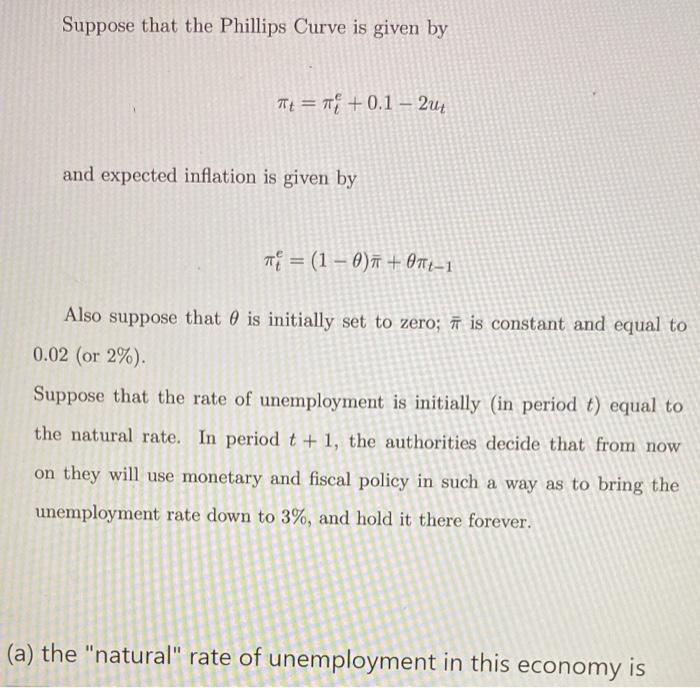
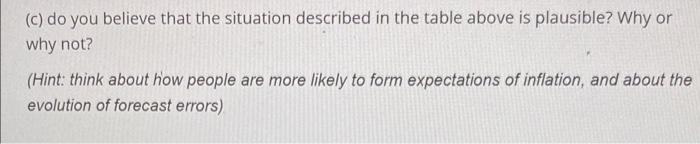
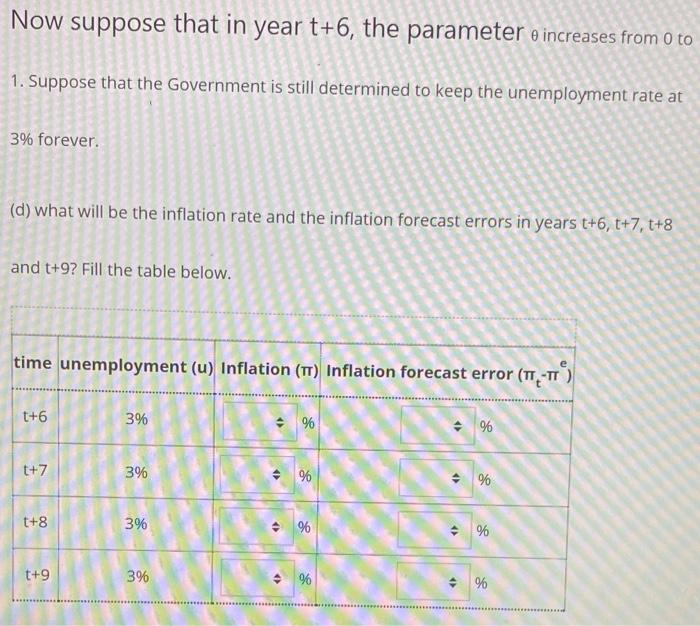
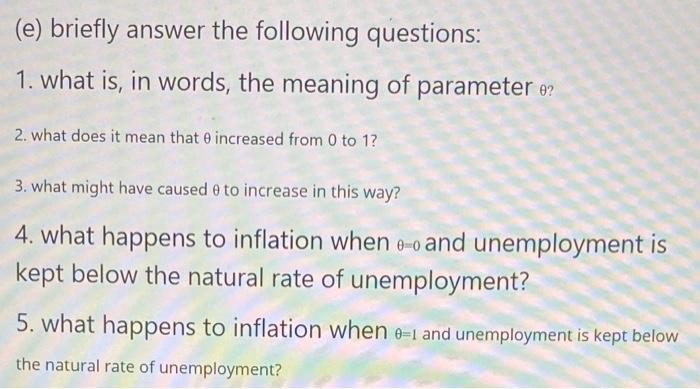
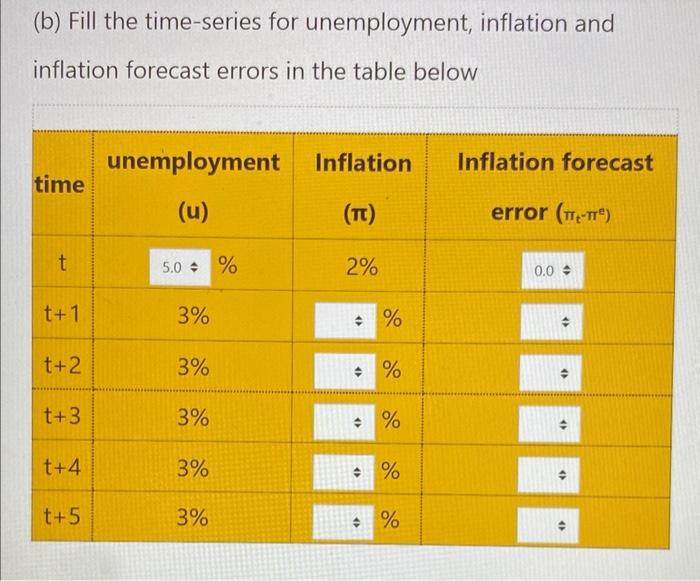
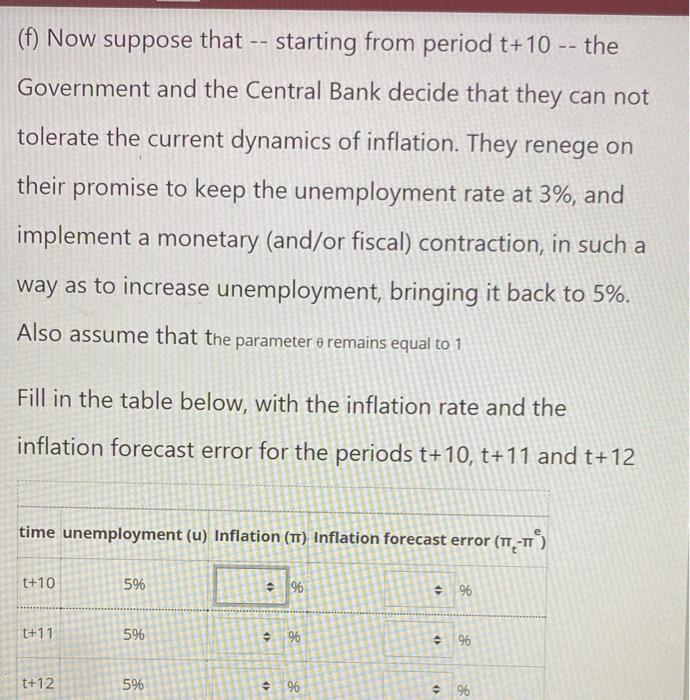
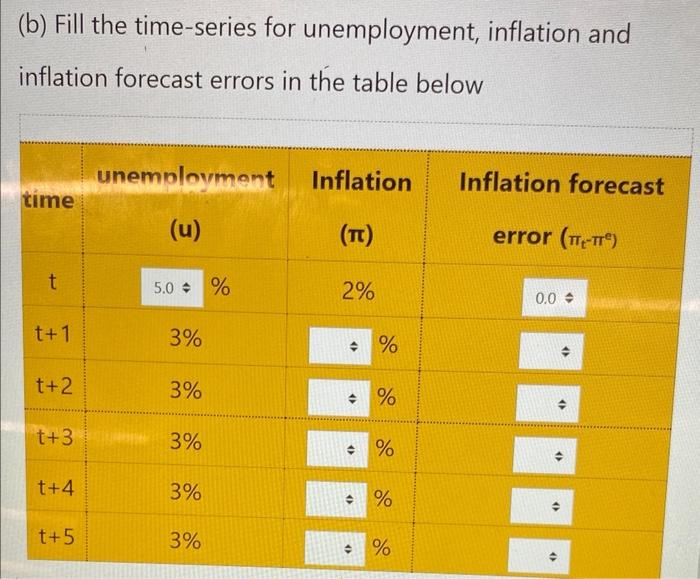

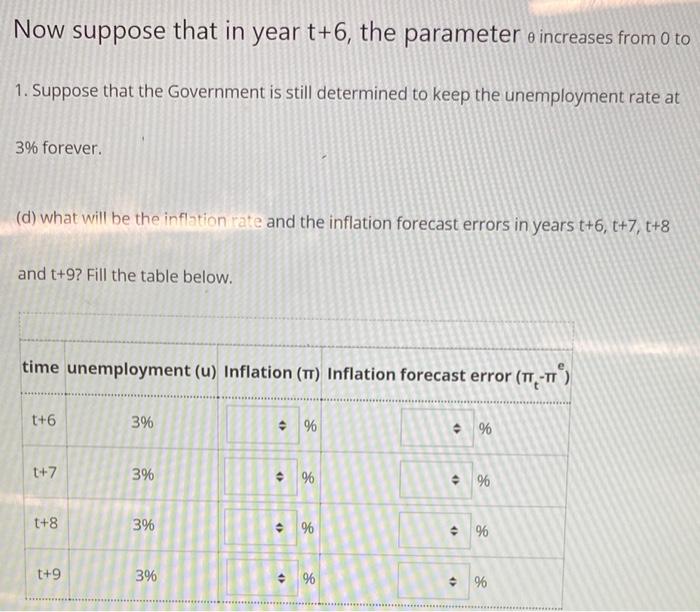
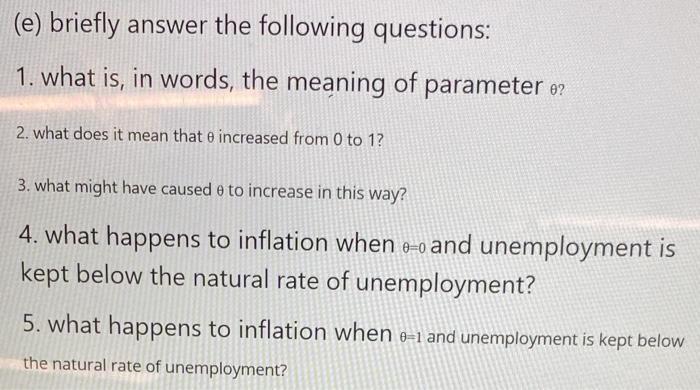
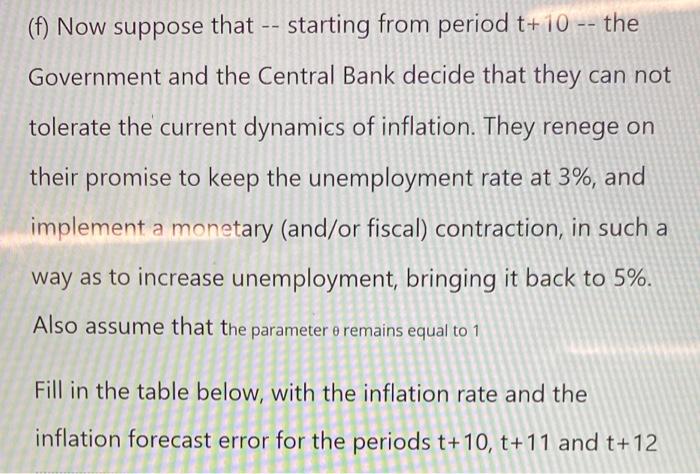
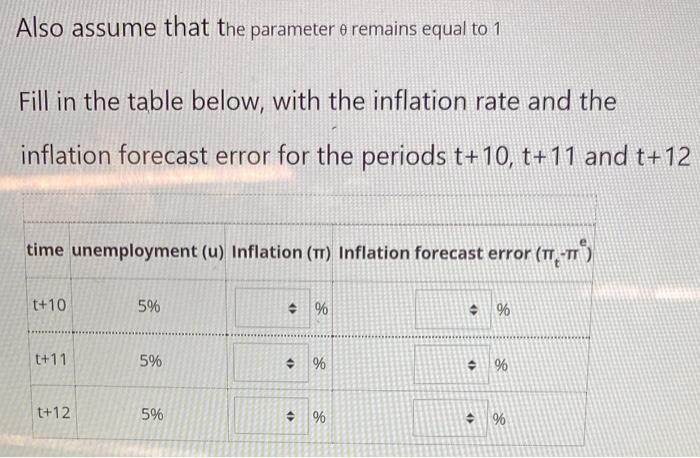
Suppose that the Phillips Curve is given by t=te+0.12ut and expected inflation is given by te=(1)+t1 Also suppose that is initially set to zero; is constant and equal to 0.02 (or 2% ) Suppose that the rate of unemployment is initially (in period t ) equal to the natural rate. In period t+1, the authorities decide that from now on they will use monetary and fiscal policy in such a way as to bring the unemployment rate down to 3%, and hold it there forever. (a) the "natural" rate of unemployment in this economy is (c) do you believe that the situation described in the table above is plausible? Why or why not? (Hint: think about how people are more likely to form expectations of inflation, and about the evolution of forecast errors) Now suppose that in year t+6, the parameter increases from 0 to 1. Suppose that the Government is still determined to keep the unemployment rate at 3% forever. (d) what will be the inflation rate and the inflation forecast errors in years t+6,t+7,t+8 and t+9 ? Fill the table below. (e) briefly answer the following questions: 1. what is, in words, the meaning of parameter ? 2. what does it mean that increased from 0 to 1 ? 3. what might have caused to increase in this way? 4. what happens to inflation when =0 and unemployment is kept below the natural rate of unemployment? 5. what happens to inflation when =1 and unemployment is kept below the natural rate of unemployment? (b) Fill the time-series for unemployment, inflation and inflation forecast errors in the table below (t) Now suppose that starting from period t+10 the Government and the Central Bank decide that they can not tolerate the current dynamics of inflation. They renege on their promise to keep the unemployment rate at 3%, and implement a monetary (and/or fiscal) contraction, in such a way as to increase unemployment, bringing it back to 5%. Also assume that the parameter remains equal to 1 Fill in the table below, with the inflation rate and the inflation forecast error for the periods t+10,t+11 and t+12 time unemployment (u) Inflation ( ) Inflation forecast error (te) (b) Fill the time-series for unemployment, inflation and inflation forecast errors in the table below (c) do you believe that the situation described in the table above is plausible? Why or why not? (Hint: think about how people are more likely to form expectations of inflation, and about the evolution of forecast errors) Now suppose that in year t+6, the parameter increases from 0 to 1. Suppose that the Government is still determined to keep the unemployment rate at 3% forever. (d) what will be the inflation rate and the inflation forecast errors in years t+6,t+7,t+8 and t+9 ? Fill the table below. (e) briefly answer the following questions: 1. what is, in words, the meaning of parameter ? 2. what does it mean that increased from 0 to 1 ? 3. what might have caused to increase in this way? 4. what happens to inflation when =0 and unemployment is kept below the natural rate of unemployment? 5. what happens to inflation when =1 and unemployment is kept below the natural rate of unemployment? (f) Now suppose that - - starting from period t+10 the Government and the Central Bank decide that they can not tolerate the current dynamics of inflation. They renege on their promise to keep the unemployment rate at 3%, and implement a monetary (and/or fiscal) contraction, in such a way as to increase unemployment, bringing it back to 5%. Also assume that the parameter remains equal to 1 Fill in the table below, with the inflation rate and the inflation forecast error for the periods t+10,t+11 and t+12 Also assume that the parameter e remains equal to 1 Fill in the table below, with the inflation rate and the inflation forecast error for the periods t+10,t+11 and t+ Suppose that the Phillips Curve is given by t=te+0.12ut and expected inflation is given by te=(1)+t1 Also suppose that is initially set to zero; is constant and equal to 0.02 (or 2% ) Suppose that the rate of unemployment is initially (in period t ) equal to the natural rate. In period t+1, the authorities decide that from now on they will use monetary and fiscal policy in such a way as to bring the unemployment rate down to 3%, and hold it there forever. (a) the "natural" rate of unemployment in this economy is (c) do you believe that the situation described in the table above is plausible? Why or why not? (Hint: think about how people are more likely to form expectations of inflation, and about the evolution of forecast errors) Now suppose that in year t+6, the parameter increases from 0 to 1. Suppose that the Government is still determined to keep the unemployment rate at 3% forever. (d) what will be the inflation rate and the inflation forecast errors in years t+6,t+7,t+8 and t+9 ? Fill the table below. (e) briefly answer the following questions: 1. what is, in words, the meaning of parameter ? 2. what does it mean that increased from 0 to 1 ? 3. what might have caused to increase in this way? 4. what happens to inflation when =0 and unemployment is kept below the natural rate of unemployment? 5. what happens to inflation when =1 and unemployment is kept below the natural rate of unemployment? (b) Fill the time-series for unemployment, inflation and inflation forecast errors in the table below (t) Now suppose that starting from period t+10 the Government and the Central Bank decide that they can not tolerate the current dynamics of inflation. They renege on their promise to keep the unemployment rate at 3%, and implement a monetary (and/or fiscal) contraction, in such a way as to increase unemployment, bringing it back to 5%. Also assume that the parameter remains equal to 1 Fill in the table below, with the inflation rate and the inflation forecast error for the periods t+10,t+11 and t+12 time unemployment (u) Inflation ( ) Inflation forecast error (te) (b) Fill the time-series for unemployment, inflation and inflation forecast errors in the table below (c) do you believe that the situation described in the table above is plausible? Why or why not? (Hint: think about how people are more likely to form expectations of inflation, and about the evolution of forecast errors) Now suppose that in year t+6, the parameter increases from 0 to 1. Suppose that the Government is still determined to keep the unemployment rate at 3% forever. (d) what will be the inflation rate and the inflation forecast errors in years t+6,t+7,t+8 and t+9 ? Fill the table below. (e) briefly answer the following questions: 1. what is, in words, the meaning of parameter ? 2. what does it mean that increased from 0 to 1 ? 3. what might have caused to increase in this way? 4. what happens to inflation when =0 and unemployment is kept below the natural rate of unemployment? 5. what happens to inflation when =1 and unemployment is kept below the natural rate of unemployment? (f) Now suppose that - - starting from period t+10 the Government and the Central Bank decide that they can not tolerate the current dynamics of inflation. They renege on their promise to keep the unemployment rate at 3%, and implement a monetary (and/or fiscal) contraction, in such a way as to increase unemployment, bringing it back to 5%. Also assume that the parameter remains equal to 1 Fill in the table below, with the inflation rate and the inflation forecast error for the periods t+10,t+11 and t+12 Also assume that the parameter e remains equal to 1 Fill in the table below, with the inflation rate and the inflation forecast error for the periods t+10,t+11 and t+
Step by Step Solution
There are 3 Steps involved in it

Get step-by-step solutions from verified subject matter experts
 Study Help