



Question: Homework Suppose a network exchange theory experiment is run on the following graph using the one-exchange rule with $10 placed on each edge (a) Say
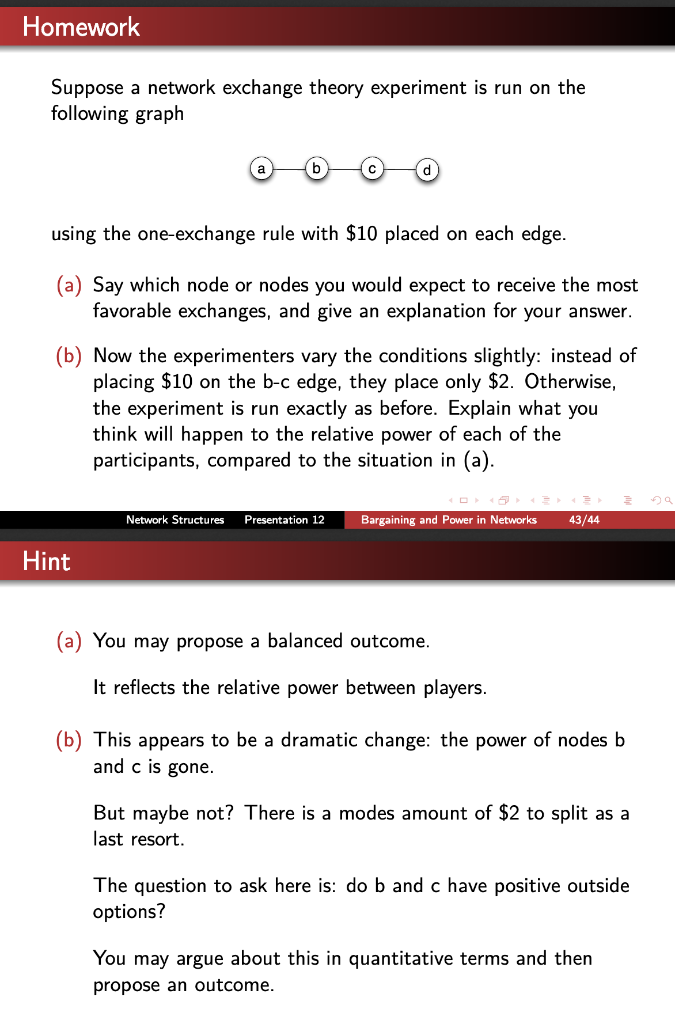
Homework Suppose a network exchange theory experiment is run on the following graph using the one-exchange rule with $10 placed on each edge (a) Say which node or nodes you would expect to receive the most (b) Now the experimenters vary the conditions slightly: instead of favorable exchanges, and give an explanation for your answer placing $10 on the b-c edge, they place only $2. Otherwise, the experiment is run exactly as before. Explain what you think will happen to the relative power of each of the participants, compared to the situation in (a Network Structures Presentation 12 Bargaining and Power in Networks43/44 Hint (a) You may propose a balanced outcome It reflects the relative power between players (b) This appears to be a dramatic change: the power of nodes b and c is gone But maybe not? There is a modes amount of $2 to split as a last resort The question to ask here is: do b and c have positive outside options? You may argue about this in quantitative terms and then propose an outcome Homework Suppose a network exchange theory experiment is run on the following graph using the one-exchange rule with $10 placed on each edge (a) Say which node or nodes you would expect to receive the most (b) Now the experimenters vary the conditions slightly: instead of favorable exchanges, and give an explanation for your answer placing $10 on the b-c edge, they place only $2. Otherwise, the experiment is run exactly as before. Explain what you think will happen to the relative power of each of the participants, compared to the situation in (a Network Structures Presentation 12 Bargaining and Power in Networks43/44 Hint (a) You may propose a balanced outcome It reflects the relative power between players (b) This appears to be a dramatic change: the power of nodes b and c is gone But maybe not? There is a modes amount of $2 to split as a last resort The question to ask here is: do b and c have positive outside options? You may argue about this in quantitative terms and then propose an outcome
Step by Step Solution
There are 3 Steps involved in it

Get step-by-step solutions from verified subject matter experts