







Question: How did the y* changes into (k*)^alpha ? Please do try, i will vote if ti helps, thanks! Using the baseline numbers above, we can
How did the y* changes into (k*)^alpha ?
Please do try, i will vote if ti helps, thanks!
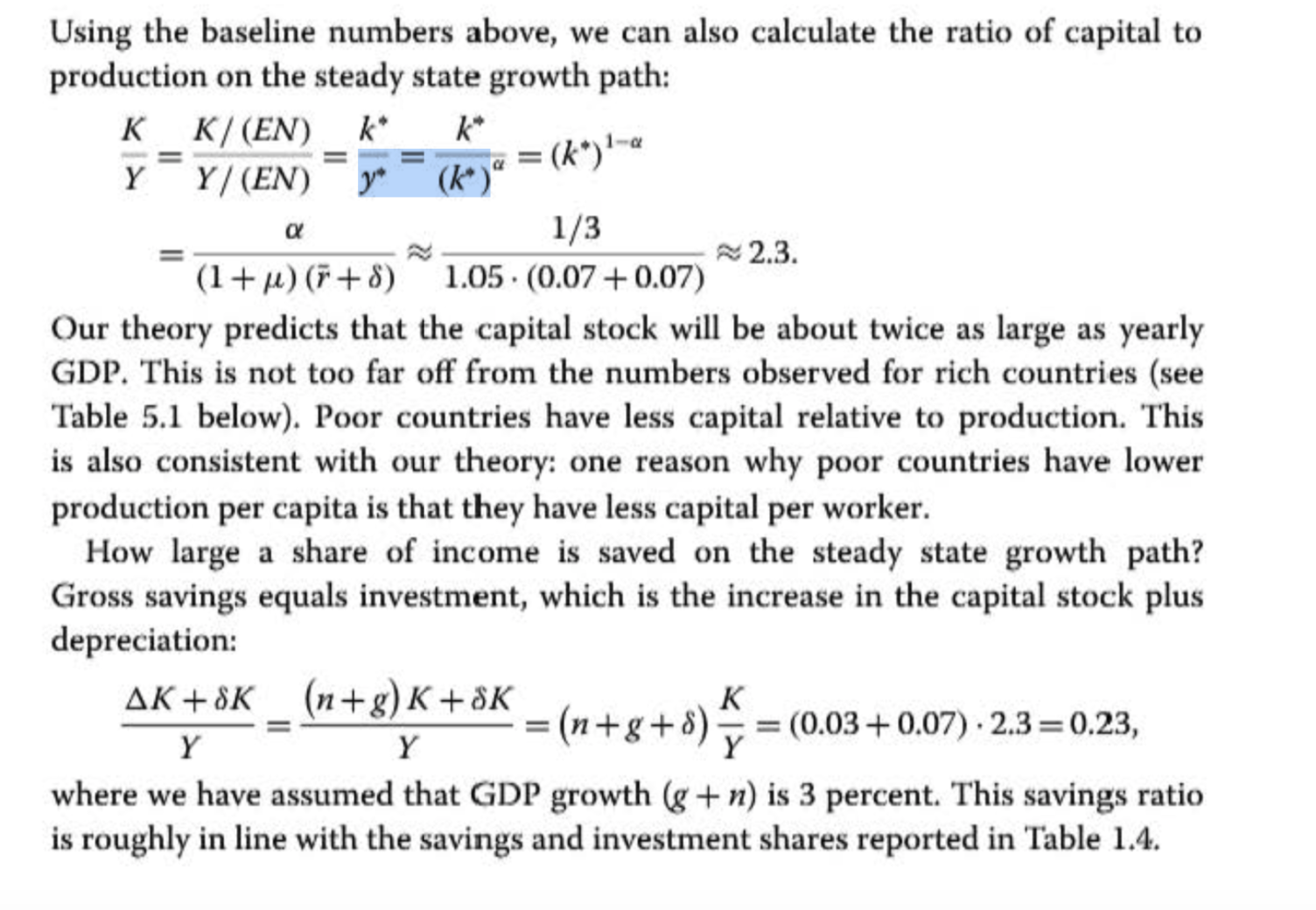
Using the baseline numbers above, we can also calculate the ratio of capital to production on the steady state growth path: 5 = Kl (EN) = $3. . = 0\")...\" Y Y/(EN) ' " -' = 4 a -V3_ (1+ [1.)(F + 6) 1.05 - (0.07 + 0.07) Our theory predicts that the capital stock will be about twice as large as yearly GDP. This is not too far off from the numbers observed for rich countries (see Table 5.1 below). Poor countries have less capital relative to production. This is also consistent with our theory: one reason why poor countries have lower production per capita is that they have less capital per worker. How large a share of income is saved on the steady state growth path? Gross savings equals investment, which is the increase in the capital stock plus depreciation: AK+aK_ (n+g)K+aK r ' Y where we have assumed that GDP growth (3 + n) is 3 percent. This savings ratio is roughly in line with the savings and investment shares reported in Table 1.4. J a: 2.3. K = (n +3 + 5) V = (0.03 + 0.07) - 2.3 = 0.23
Step by Step Solution
There are 3 Steps involved in it

Get step-by-step solutions from verified subject matter experts
 Study Help