







Question: how do I choose when to use enthalpy and when to use internal energy to solve an exercise? A promising new idea is to use
how do I choose when to use enthalpy and when to use internal energy to solve an exercise?
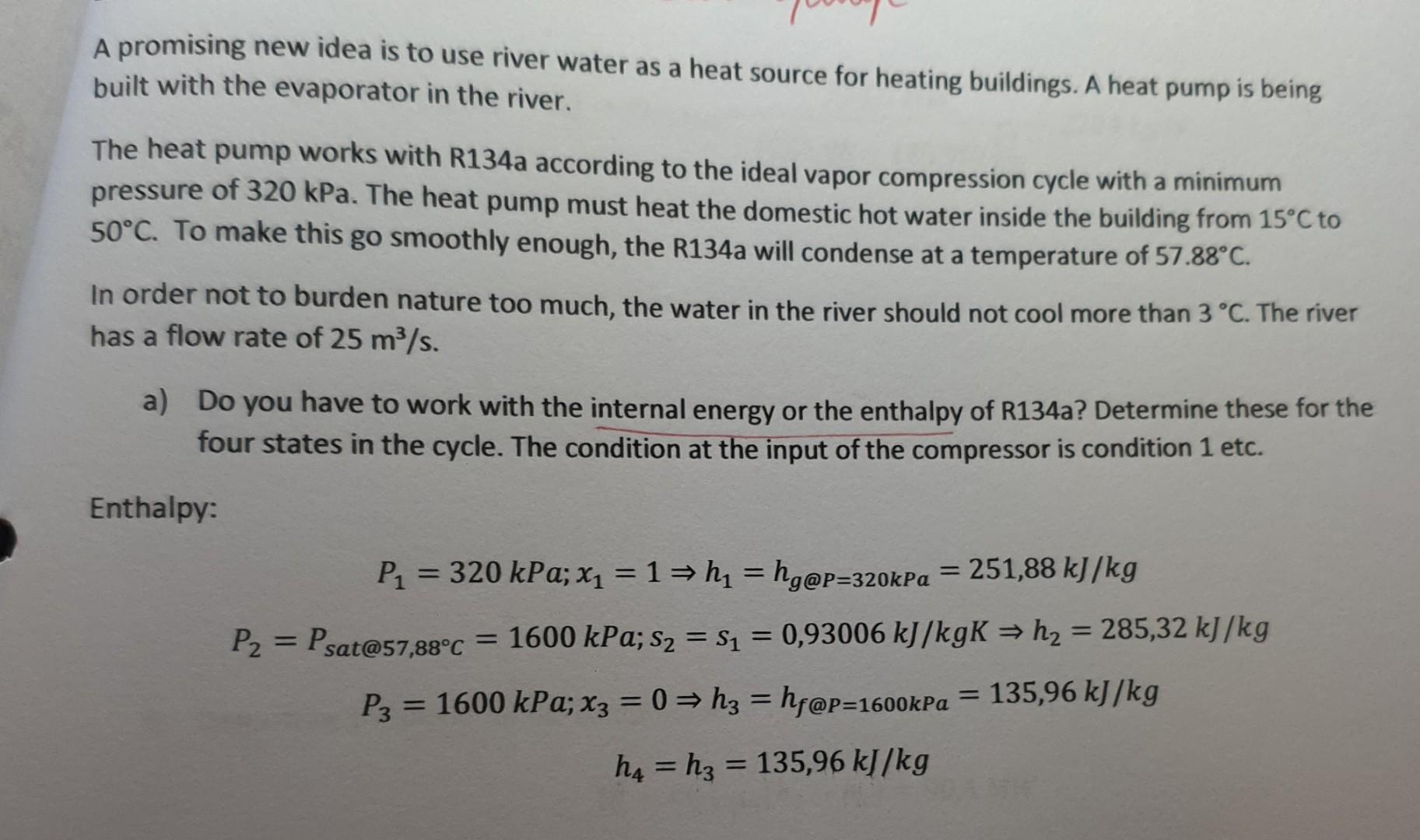
A promising new idea is to use river water as a heat source for heating buildings. A heat pump is being built with the evaporator in the river. The heat pump works with R134a according to the ideal vapor compression cycle with a minimum pressure of 320kPa. The heat pump must heat the domestic hot water inside the building from 15C to 50C. To make this go smoothly enough, the R134a will condense at a temperature of 57.88C. In order not to burden nature too much, the water in the river should not cool more than 3C. The river has a flow rate of 25m3/s. a) Do you have to work with the internal energy or the enthalpy of R134a? Determine these for the four states in the cycle. The condition at the input of the compressor is condition 1 etc. Enthalpy: P1=320kPa;x1=1h1=hg@P=320kPa=251,88kJ/kgP2=Psat@57,88C=1600kPa;s2=s1=0,93006kJ/kgKh2=285,32kJ/kgP3=1600kPa;x3=0h3=hf@P=1600kPa=135,96kJ/kgh4=h3=135,96kJ/kg A promising new idea is to use river water as a heat source for heating buildings. A heat pump is being built with the evaporator in the river. The heat pump works with R134a according to the ideal vapor compression cycle with a minimum pressure of 320kPa. The heat pump must heat the domestic hot water inside the building from 15C to 50C. To make this go smoothly enough, the R134a will condense at a temperature of 57.88C. In order not to burden nature too much, the water in the river should not cool more than 3C. The river has a flow rate of 25m3/s. a) Do you have to work with the internal energy or the enthalpy of R134a? Determine these for the four states in the cycle. The condition at the input of the compressor is condition 1 etc. Enthalpy: P1=320kPa;x1=1h1=hg@P=320kPa=251,88kJ/kgP2=Psat@57,88C=1600kPa;s2=s1=0,93006kJ/kgKh2=285,32kJ/kgP3=1600kPa;x3=0h3=hf@P=1600kPa=135,96kJ/kgh4=h3=135,96kJ/kg
Step by Step Solution
There are 3 Steps involved in it

Get step-by-step solutions from verified subject matter experts
 Study Help