Question: How do I modify the benchmark.cpp below so that I can compare the runtime of BST and RBT? Thanks for you help! #include #include #include
How do I modify the benchmark.cpp below so that I can compare the runtime of BST and RBT? Thanks for you help!
| // This is an example of runtime benchmarking |
| // TODO (final): Replace the following with a benchmarking comparison |
| // of two data structures, as described in the project instructions |
| vector times(numTrials, 0); |
| default_random_engine generator; |
| uniform_real_distribution distribution(-1.0, 1.0); |
| // Run benchmarks and time each trial |
| for (int trialIndex = 0; trialIndex |
| generator.seed(1 + trialIndex); |
| for (int dataIndex = 0; dataIndex |
| double currentRandom = distribution(generator); |
| times[trialIndex] = t.end_timer(); |
| // Compute statistics from trial times |
| double meanTime = totalTime / ((double) numTrials); |
}
Let me know if you need util.hpp/util.cpp. Thanks once again.
EDIT:
util.hpp
| std::chrono::time_point<:chrono::high_resolution_clock> start; |
| * Function called when starting the timer. |
| * Function called when ending the timer. Returns duration in nanoseconds |
| * PRECONDITION: begin_timer() must be called before this function |
| * Load all lines from istream `in` into the vector `v` |
| void static load_vector(std::vector<:string>& v, istream& in); |
| * Load the specified number of lines from istream `in` into the vector `v` |
| void static load_vector(std::vector<:string>& v, istream& in, unsigned int num_lines); |
#endif //UTIL_H
-------------------------------------------------------------------------
util.cpp
| * Starts the timer. Saves the current time. |
| void Timer::begin_timer() |
| start = std::chrono::high_resolution_clock::now(); |
| * Ends the timer. Compares end time with the start time and returns number of nanoseconds |
| long long Timer::end_timer() |
| std::chrono::time_point<:chrono::high_resolution_clock> end; |
| end = std::chrono::high_resolution_clock::now(); |
| return (long long)std::chrono::duration_cast<:chrono::nanoseconds>(end - start).count(); |
| * Load all lines from istream `in` into the vector `v` |
| void Utils::load_vector(vector& v, istream& in) |
| * Load the specified number of lines from istream `in` into the vector `v` |
| void Utils::load_vector(vector& v, istream& in, unsigned int num_lines) |
| for (unsigned int i = 0; i |
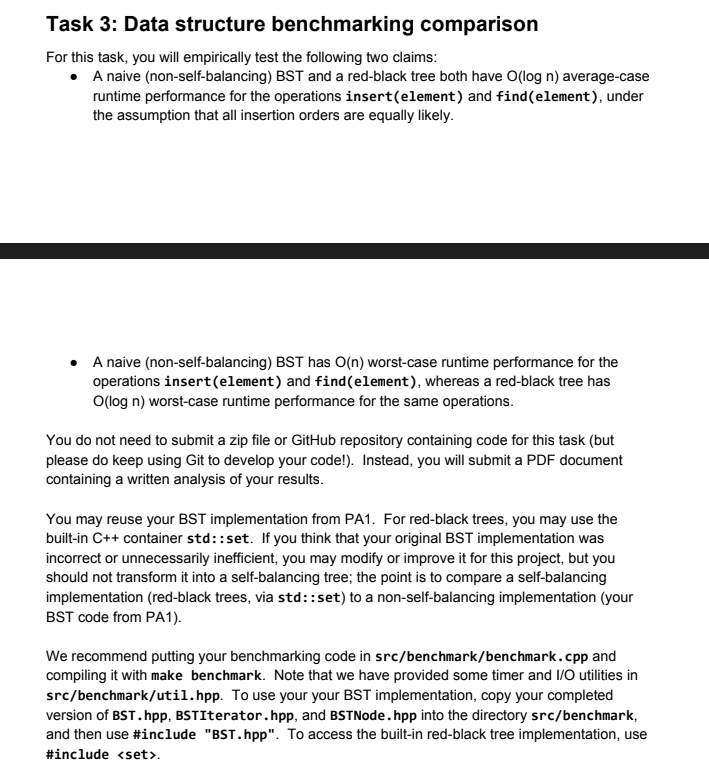
Task 3: Data structure benchmarking comparison For this task, you will empirically test the following two claims A naive (non-self-balancing) BST and a red-black tree both have O(log n) average-case runtime performance for the operations insert(element) and find(element), under the assumption that all insertion orders are equally likely A naive (non-self-balancing) BST has O(n) worst-case runtime performance for the operations insert(element) and find(element), whereas a red-black tree has O(log n) worst-case runtime performance for the same operations You do not need to submit a zip file or GitHub repository containing code for this task (but please do keep using Git to develop your code!). Instead, you will submit a PDF document containing a written analysis of your results You may reuse your BST implementation from PA1. For red-black trees, you may use the built-in C++ container std::set. If you think that your original BST implementation was incorrect or unnecessarily inefficient, you may modify or improve it for this project, but you should not transform it into a self-balancing tree; the point is to compare a self-balancing implementation (red-black trees, via std::set) to a non-self-balancing implementation (your BST code from PA1). We recommend putting your benchmarking code in src/benchmark/benchmark.cpp and compiling it with make benchmark. Note that we have provided some timer and I/O utilities in src/benchmark/util.hpp. To use your your BST implementation, copy your completed version of BST.hpp, BSTIterator.hpp, and BSTNode.hpp into the directory src/benchmark, and then use #include "BST .hpp". To access the built-in red-black tree implementation, use #include









 Study Help