Question: How effective is Johnson & Johnson's Employee Assistance Program and Wellness Program? Do you believe such programs can effectively be implemented in large, decentralized organizations?
How effective is Johnson & Johnson's Employee Assistance Program and Wellness Program? Do you believe such programs can effectively be implemented in large, decentralized organizations?
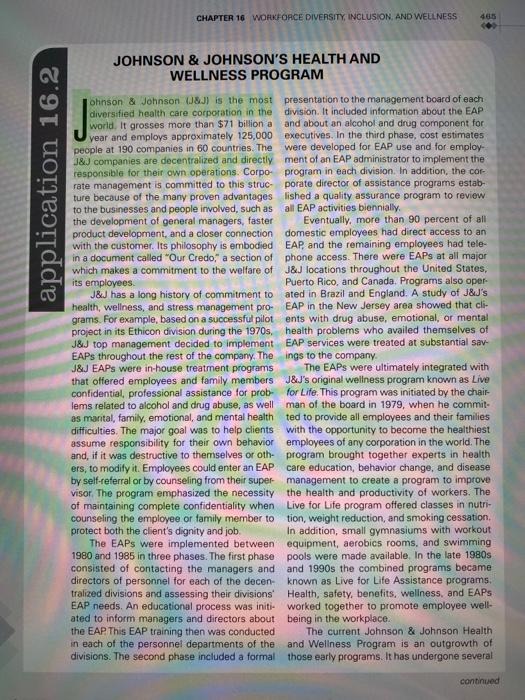
CHAPTER 16 WORKFORCE DIVERSITY, INCLUSION, AND WELLNESS JOHNSON & JOHNSON'S HEALTH AND WELLNESS PROGRAM application 16.2 ohnson & Johnson & J) is the most presentation to the management board of each diversified health care corporation in the division. It included information about the EAP world. It grosses more than $71 billion a and about an alcohol and drug component for year and employs approximately 125,000 executives. In the third phase, cost estimates people at 190 companies in 60 countries. The were developed for EAP use and for employ- J&J companies are decentralized and directly ment of an EAP administrator to implement the responsible for their own operations. Corpo program in each division. In addition, the cor- rate management is committed to this struc porate director of assistance programs estab- ture because of the many proven advantages lished a quality assurance program to review to the businesses and people involved, such as all EAP activities biennially, the development of general managers, faster Eventually, more than 90 percent of all product development, and a closer connection domestic employees had ect access to an with the customer. Its philosophy is embodied EAP, and the remaining employees had tele- in a document called "Our Credo," a section of phone access. There were EAPs at all major which makes a commitment to the welfare of J&J locations throughout the United States, its employees Puerto Rico, and Canada. Programs also oper J&J has a long history of commitment to ated in Brazil and England. A study of J&J's health, wellness, and stress management pro- EAP in the New Jersey area showed that cli- grams. For example, based on a successful pilot ents with drug abuse, emotional, or mental project in its Ethicon division during the 1970s. health problems who availed themselves of J&J top management decided to implement EAP services were treated at substantial sav- EAPs throughout the rest of the company. The ings to the company J&J EAPs were in-house treatment programs The EAPs were ultimately integrated with that offered employees and family members J&J's original wellness program known as Live confidential professional assistance for prob- for Life. This program was initiated by the chair lems related to alcohol and drug abuse, as well man of the board in 1979, when he commit. as mantal, family, emotional, and mental health ted to provide all employees and their families difficulties. The major goal was to help clients with the opportunity to become the healthiest assume responsibility for their own behavior employees of any corporation in the world. The and, if it was destructive to themselves or oth- program brought together experts in health ers, to modify it. Employees could enter an EAP care education, behavior change, and disease by self-referral or by counseling from their super management to create a program to improve visor. The program emphasized the necessity the health and productivity of workers. The of maintaining complete confidentiality when Live for Life program offered classes in nutri- counseling the employee or family member to tion, weight reduction, and smoking cessation protect both the client's dignity and job In addition, small gymnasiums with workout The EAPs were implemented between equipment, aerobics rooms, and swimming 1980 and 1985 in three phases. The first phase pools were made available. In the late 1980s consisted of contacting the managers and and 1990s the combined programs became directors of personnel for each of the decen known as Live for Life Assistance programs. tralized divisions and assessing their divisions' Health, safety, benefits, wellness, and EAPs EAP needs. An educational process was initi- worked together to promote employee well- ated to inform managers and directors about being in the workplace. the EAP This EAP training then was conducted The current Johnson & Johnson Health in each of the personnel departments of the and Wellness Program is an outgrowth divisions. The second phase included a formal those early programs. It has undergone several continued Seesaw Blackboard Learn WBU Self Service 406 PARTS HUMAN RESOURCE INTERVENTIONS transformations in the past three decades to programs they will benefit from. They use the hard respond to shifting business requirements and data to guide their wellness program choices. "We changing employee health needs. The Johnson & are making better use of our health care dollars. Johnson Health and Wellness Program includes dis- thanks to the assessment information ability management, occupational health, employee The initial assessment showed that the employ assistance, work-life programs, and wellness and ees had three areas of risk: high cholesterol, high fitness programs. The program is often studied by blood pressure, and inactivity. In response, the other corporations because of its integrated service company offered exercise and counseling pro- deliveries grams to help employees reduce cholesterol and In 1995, Johnson & Johnson's health and fit- blood pressure and manage weight. There were ness group took a simple step that catapulted par also subtle additions to the workplace environment ticipation in the company's wellness program from that contributed to a healthy culture, such as nutri- 26 to 90 percent. Patricia Flynn, former vice presi- tious choices in the cafeteria, scales in all of the dent of Johnson & Johnson's health care system, bathrooms, and a nonsmoking environment. J&J's described how J&J offered every employee a $500 wellness programs have continued to evolve in a health benefits credit in exchange for completing variety of ways, including offering wellness services an annual health-risk assessment before enrolling as a business area. in the plan. Although the company has offered the Johnson & Johnson's Live for Life program is assessment optionally for years as part of its well one of the most emulated and evaluated programs ness program, it was not until the incentive was of its kind. A 2011 evaluation compared J&J's pro- attached that employees flocked to it. "People think gram against 16 other programs over time and they are fit and might not want to bother with an found that their average annual growth in med- assessment Flynn says. "This incentive got them ical costs were 3.7 percent lower. That is, after to do it." accounting for inflation, J&J's average medical and In the past, organization members were given drug costs increased 1 percent per year between incentives for participating in various wellness pro- 2002 and 2008 compared to the average increase grams, but the company's focus has shifted all of of 4.8 percent in other companies with EAPs. That its incentive dollars toward risk assessment. "We translated to an average annual savings of $565 per are confident that once employees know what their employee, and a return on investment estimate of risks are, then we can make a positive impact on between $1.88 and $3.92 for every dollar spent. their health said Jennifer Bruno, former director of Further tests suggested that J&J employees were business planning. Early studies conducted at the significantly less likely to be at risk for high blood company showed that even those employees who pressure, high cholesterol, poor nutrition, obesity. took the assessment but had no follow-up support physical inactivity, and tobacco use. The researchers through wellness programs showed improvements conclude that the benefits from health promotion in their health programs, especially those as comprehensive as But for Johnson & Johnson, the assessment J&Js, may be long lasting. Johnson & Johnson's is just the beginning. The aggregate data helps the Health and Wellness program demonstrates a long- health care group choose the right wellness pro term commitment to its strategy, its industry, and grams for the exact needs of the population Pro its people. The execution and coordination of the gram developers aren't guessing at employees different wellness components has paid off hand- health interests or expecting them to know what somely for many stakeholders









 Study Help