







Question: How is the cultural difference in Uncertainty Avoidance reflected in this case? The IKEA Way in Germany Case description: After firmly attaining leadership within Sweden,
How is the cultural difference in Uncertainty Avoidance reflected in this case?
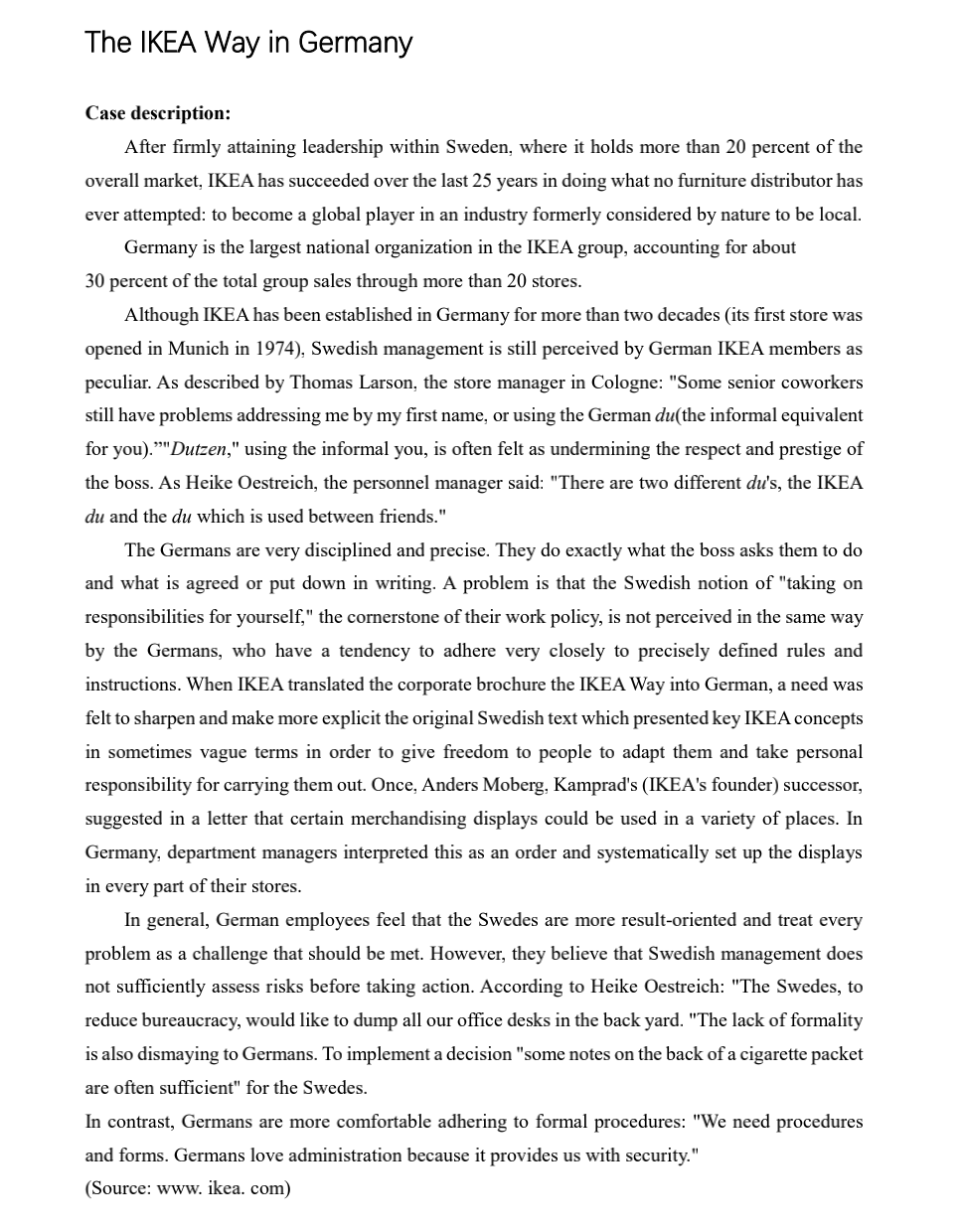
The IKEA Way in Germany Case description: After firmly attaining leadership within Sweden, where it holds more than 20 percent of the overall market, IKEA has succeeded over the last 25 years in doing what no furniture distributor has ever attempted: to become a global player in an industry formerly considered by nature to be local. Germany is the largest national organization in the IKEA group, accounting for about 30 percent of the total group sales through more than 20 stores. Although IKEA has been established in Germany for more than two decades (its first store was opened in Munich in 1974), Swedish management is still perceived by German IKEA members as peculiar. As described by Thomas Larson, the store manager in Cologne: "Some senior coworkers still have problems addressing me by my first name, or using the German du(the informal equivalent for you).""Dutzen," using the informal you, is often felt as undermining the respect and prestige of the boss. As Heike Oestreich, the personnel manager said: "There are two different du's, the IKEA du and the du which is used between friends." The Germans are very disciplined and precise. They do exactly what the boss asks them to do and what is agreed or put down in writing. A problem is that the Swedish notion of "taking on responsibilities for yourself," the cornerstone of their work policy, is not perceived in the same way by the Germans, who have a tendency to adhere very closely to precisely defined rules and instructions. When IKEA translated the corporate brochure the IKEA Way into German, a need was felt to sharpen and make more explicit the original Swedish text which presented key IKEA concepts in sometimes vague terms in order to give freedom to people to adapt them and take personal responsibility for carrying them out. Once, Anders Moberg, Kamprad's (IKEA's founder) successor, suggested in a letter that certain merchandising displays could be used in a variety of places. In Germany, department managers interpreted this as an order and systematically set up the displays in every part of their stores. In general, German employees feel that the Swedes are more result-oriented and treat every problem as a challenge that should be met. However, they believe that Swedish management does not sufficiently assess risks before taking action. According to Heike Oestreich: "The Swedes, to reduce bureaucracy, would like to dump all our office desks in the back yard. "The lack of formality is also dismaying to Germans. To implement a decision "some notes on the back of a cigarette packet are often sufficient" for the Swedes. In contrast, Germans are more comfortable adhering to formal procedures: "We need procedures and forms. Germans love administration because it provides us with security." (Source: www.ikea.com)Step by Step Solution
There are 3 Steps involved in it
1 Expert Approved Answer
Step: 1 Unlock

Question Has Been Solved by an Expert!
Get step-by-step solutions from verified subject matter experts
Step: 2 Unlock
Step: 3 Unlock
 Study Help