







Question: How many main points does the speaker cover in this presentation outline? Two points Three points Six points Organize your speech by composing a carefully
 How many main points does the speaker cover in this presentation outline? Two points Three points Six points
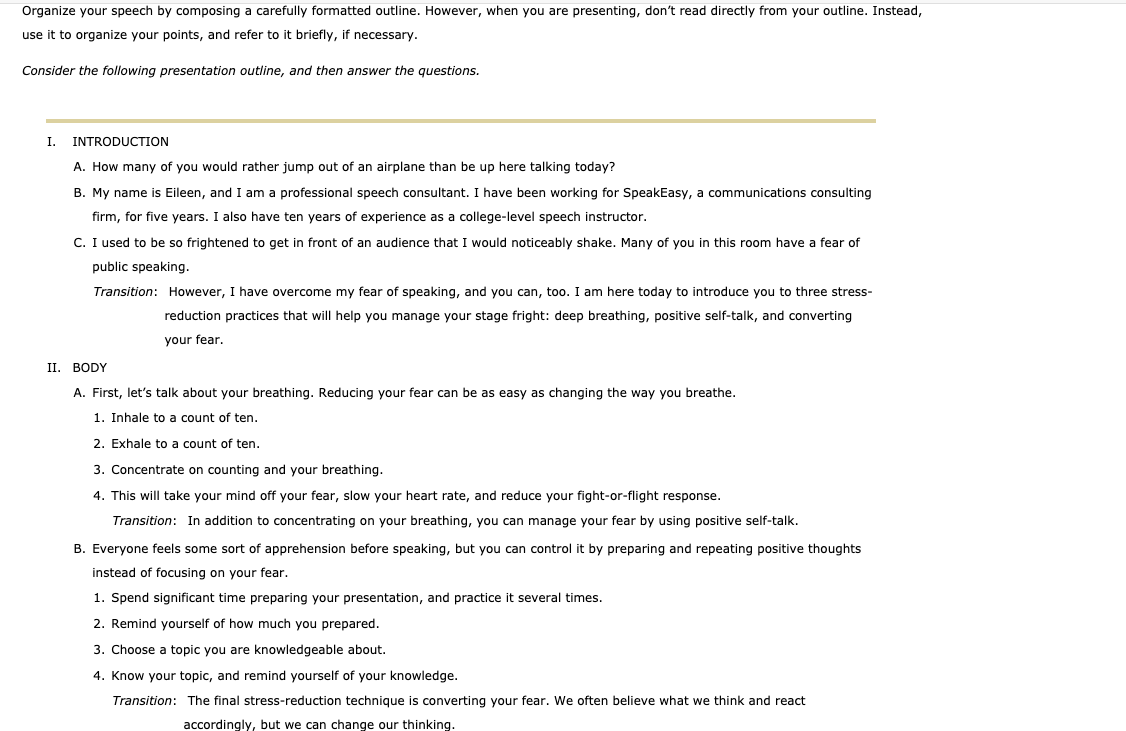
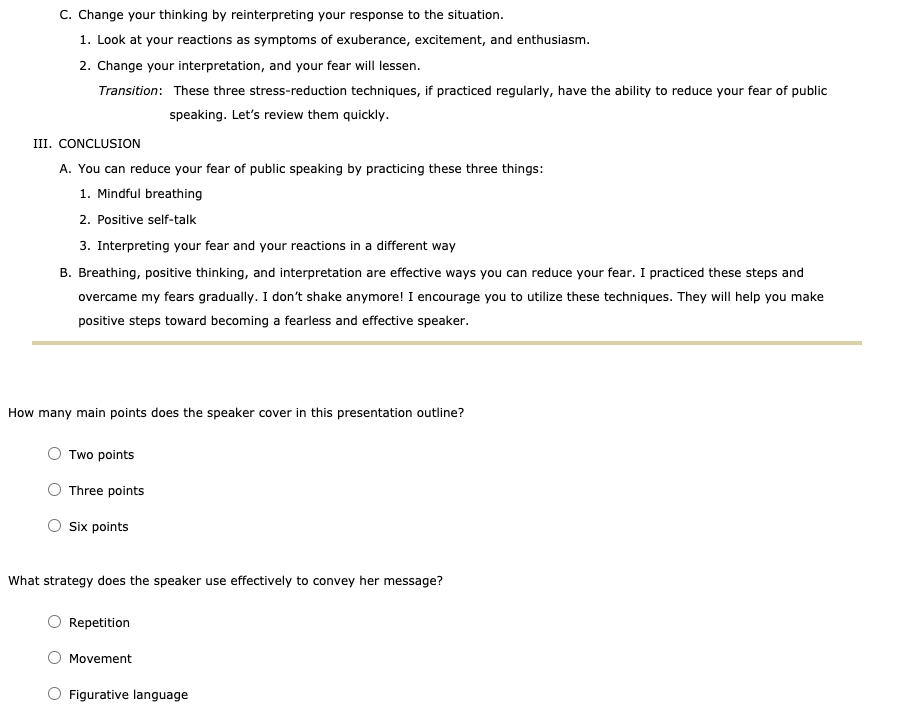
Organize your speech by composing a carefully formatted outline. However, when you are presenting, don't read directly from your outline. Instead, use it to organize your points, and refer to it briefly, if necessary. Consider the following presentation outline, and then answer the questions. I. INTRODUCTION A. How many of you would rather jump out of an airplane than be up here talking today? B. My name is Eileen, and I am a professional speech consultant. I have been working for SpeakEasy, a communications consulting firm, for five years. I also have ten years of experience as a college-level speech instructor. C. I used to be so frightened to get in front of an audience that I would noticeably shake. Many of you in this room have a fear of public speaking. Transition: However, I have overcome my fear of speaking, and you can, too. I am here today to introduce you to three stressreduction practices that will help you manage your stage fright: deep breathing, positive self-talk, and converting your fear. II. BODY A. First, let's talk about your breathing. Reducing your fear can be as easy as changing the way you breathe. 1. Inhale to a count of ten. 2. Exhale to a count of ten. 3. Concentrate on counting and your breathing. 4. This will take your mind off your fear, slow your heart rate, and reduce your fight-or-flight response. Transition: In addition to concentrating on your breathing, you can manage your fear by using positive self-talk. B. Everyone feels some sort of apprehension before speaking, but you can control it by preparing and repeating positive thoughts instead of focusing on your fear. 1. Spend significant time preparing your presentation, and practice it several times. 2. Remind yourself of how much you prepared. 3. Choose a topic you are knowledgeable about. 4. Know your topic, and remind yourself of your knowledge. Transition: The final stress-reduction technique is converting your fear. We often believe what we think and react accordingly, but we can change our thinking. C. Change your thinking by reinterpreting your response to the situation. 1. Look at your reactions as symptoms of exuberance, excitement, and enthusiasm. 2. Change your interpretation, and your fear will lessen. Transition: These three stress-reduction techniques, if practiced regularly, have the ability to reduce your fear of public speaking. Let's review them quickly. III. CONCLUSION A. You can reduce your fear of public speaking by practicing these three things: 1. Mindful breathing 2. Positive self-talk 3. Interpreting your fear and your reactions in a different way B. Breathing, positive thinking, and interpretation are effective ways you can reduce your fear. I practiced these steps and overcame my fears gradually. I don't shake anymore! I encourage you to utilize these techniques. They will help you make positive steps toward becoming a fearless and effective speaker. How many main points does the speaker cover in this presentation outline? Two points Three points Six points What strategy does the speaker use effectively to convey her message? Repetition Movement Figurative language
Step by Step Solution
There are 3 Steps involved in it

Get step-by-step solutions from verified subject matter experts
 Study Help