







Question: How to answer those questions? No need to answer question 1 Case: Barbie vs. the Bratz Girls For more than 40 years, since her launch
How to answer those questions? No need to answer question 1
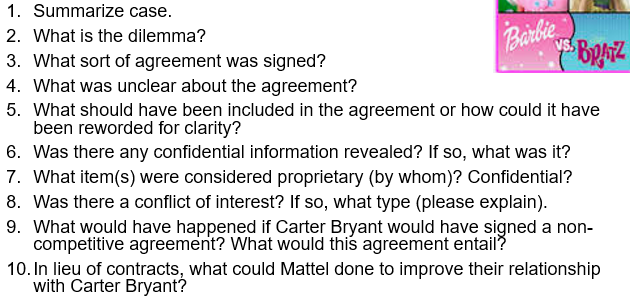
Case: Barbie vs. the Bratz Girls For more than 40 years, since her launch in 1959, Barbie dom- inated the fashion-doll market. As the most popular doll ever produced, Barbie contributed greatly to the profitability of its developer, Mattel. In 2001, challengers emerged in the form of pouty, sultry dolls with large lips and eyes and indeterminate but exotic ethnicity. Promoted as dolls with a passion for fashion" and "some serious attitude," these Bratz girls capti- vated the imagination of the Barbie market demographic, the 6-to-12-year-old age group, known in the industry as "tweens." Executives at Mattel were alarmed by more than the unwelcome competition: The creator of the Bratz girls was a former employee who had approached a competitor, MGA Entertainment, with a few drawings and a crude model that he had developed while working at Mattel. Mattel's Charges The employee, Carter Bryant, had worked two stints at Mattel, between September 1995 and April 1998 and then again from January 1999 until October 2000. He was employed in the "Barbie Collectibles" department to design clothing and hairstyles for specialty dolls that were aimed at collectors rather than youngsters. In August of 2000, Mr. Bryant approached MGA, a small toy manufacturer located near Mattel in the Los Angeles area, and pitched the idea for the Bratz line of dolls. He signed a consulting agreement with MGA on October 4, 2000, gave Mattel two weeks' notice the same day, and left for new employment on Octo- ber 19. During this two-week period, he worked with MGA on the new doll line, including the creation of a clay model that was made by a sculptor under Mr. Bryant's direction. Upon rejoining Mattel in 1999, Mr. Bryant signed an em- ployment agreement, which included the provisions: I agree to communicate to the Company ... all inventions (as defined below) conceived or reduced to practice by me (alone or jointly with others) at any time during my employment by the Company. I hereby assign to the Company ... all my right, title and inter- est in such inventions." The contract further specifies that "the term 'inventions includes, but is not limited to, all discoveries, improvements, processes, development, designs, know-how, data computer programs and formulae, whether patentable or unpatentable." About six months after Mr. Bryant's departure from Mattel, in May 2001, MGA launched the four original dolls in the Bratz line, named Cloe, Yasmin, Sasha, and Jade. By the end of 2005, MGA had sold 125 million Bratz dolls worldwide and captured about 40 percent of the fashion-doll market, leaving Barbie a 60 percent share.? Mattel attempted to counter MGA's Bratz line in 2002 with a redesign of Barbie in the "My Scene" series, in which this once-demure doll now had platform shoes, low-rise jeans, heavier makeup, and an exposed navel. In 2003, Mattel intro- duced the urban, hip-hop Flavas line, which Newsweek magazine described as "ghetto-fabulous."4 At some point, Mattel became aware of Carter Bryant's role in MGA's development of the Bratz 82 dolls and charged him with violation of his employment contract. Specifically, Mattel claimed that his drawings and the model be- longed to the company and that he had also wrongfully appro- priated the name "Bratz." The drawings and model should have been tumed over to his employer and certainly not shown to a competitor. Mattel further alleged that it had considered using the name "Brats" in connection with the Diva Starz doll, launched in 2000, so Mr. Bryant's use of the similar sounding "Bratz" was also in violation of his employment contract. Developer's Defense Mr. Bryant defended his right to the drawings by claiming that he developed the idea and made the original drawings in the summer of 1998 while living with his parents in Missouri between the two stints at Mattel. The inspiration for the characters, he said, came from, among other sources, shoe ads in Seventeen magazine and the cover of a Dixie Chicks album. The drawings he showed to MGA, he argued, were simply transfers from these original drawings. All the work on the idea of a Bratz line was done, he claimed, on his own time and not while performing his assigned tasks at Mattel. Furthermore, these tasks did not include generating new ideas for doll lines, so work on the Bratz dolls occurred outside the scope of his employment. Also, the phrase in the employment contract, "at any time during my employment by the Company," was ambiguous, he claimed, and could mean only during working hours and not apply to time spent away. More crucially, the employment contract is phrased in terms of inventions, which it defines in some detail. No part of the definition would seem to apply to ideas for a new doll line. Inventions are generally regarded as concrete creations that can be implemented, while ideas are more ephemeral, exist- ing initially only in the mind of a conceiver. For example, the idea of a machine to remove seeds from cotton fiber is different from the invention of the cotton gin. Moreover, the drawings themselves were sketchy and far removed from the eventual design of the Bratz dolls. What was original in Mr. Bryant's idea was not the actual appearance of the dolls themselves which were not yet fully developed in the drawings- but the element of edginess or transgressive behavior in a doll. As one writer explains: "What Bratz dolls are both contributing to and feed- ing on is a culture in which girls play at being 'sassy' - the toy industry's favorite euphemism for sexy." Even if Mattel owned the drawings and the model that Mr. Bryant had created, would the four original Bratz dolls constitute a violation of Mattel's property rights? Compare Your Thoughts The same question could also be raised about the other Bratz dolls developed by MGA, including Bratz Boyz, Bratz Kidz, and Baby Bratz, as well as many other Bratz characters in MGA television shows and movies. If Mattel owned the drawings, it would presumably have a right to a specific, unique expression of an idea, such that the production of any dolls by a competi- tor that looked virtually identical to the drawings would be a violation of their property rights, but the idea of bratty dolls itself would not seem to be protectable as a form of property. For example, the writer of a vampire novel can rightfully protect a specific character or plot (an expression, but could not pre- vent others from writing a novel about vampires (an idea). Even if an expression of an idea is substantially similar with- out being virtually identical (which would be a kind of theft), much more contributes to success than the mere appearance of a doll. Many competitors sought to emulate Mattel's success with the Barbie doll but failed due to the difficulties of marketing such a product, and Mattel tried but failed with dolls similar to the Bratz girls, such as Diva Starz and the Flavas line, and even with the Barbie "My Scene" series. In these failures, Mattel was attempting to use the idea, though not the expression, employed by a com- petitor. As for the charge of wrongfully appropriating the name "Bratz" from Mattel's development of the Diva Starz, MGA denies that Mr. Bryant was aware of any discussions. The name was first used in 1994 for a line of children's clothing that is sold exclusively at Costco, and it was assigned by the owner to MGA in 2002.7 Birbie vs. BRATZ 1. Summarize case. 2. What is the dilemma? 3. What sort of agreement was signed? 4. What was unclear about the agreement? 5. What should have been included in the agreement or how could it have been reworded for clarity? 6. Was there any confidential information revealed? If so, what was it? 7. What item(s) were considered proprietary (by whom)? Confidential? 8. Was there a conflict of interest? If so, what type (please explain). 9. What would have happened if Carter Bryant would have signed a non- competitive agreement? What would this agreement entail? 10. In lieu of contracts, what could Mattel done to improve their relationship with Carter BryantStep by Step Solution
There are 3 Steps involved in it
1 Expert Approved Answer
Step: 1 Unlock

Question Has Been Solved by an Expert!
Get step-by-step solutions from verified subject matter experts
Step: 2 Unlock
Step: 3 Unlock
 Study Help