







Question: How would I go about solving this problem? There are multiple answers and I cant figure out the right ones. I keep missing answers. multiple
How would I go about solving this problem? There are multiple answers and I cant figure out the right ones. I keep missing answers.
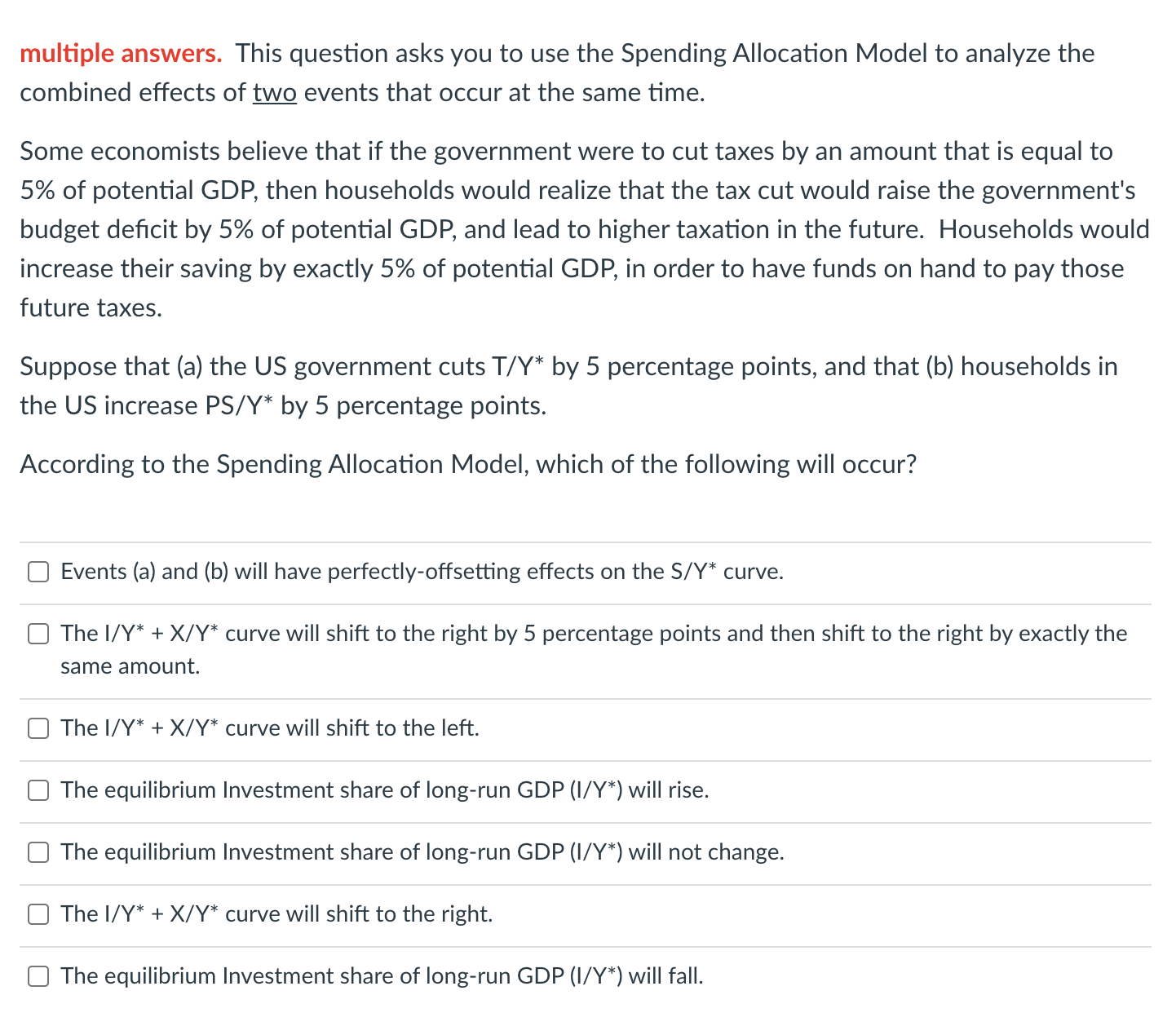
multiple answers. This question asks you to use the Spending Allocation Model to analyze the combined effects of M events that occur at the same time. Some economists believe that if the government were to cut taxes by an amount that is equal to 5% of potential GDP, then households would realize that the tax cut would raise the government's budget decit by 5% of potential GDP, and lead to higher taxation in the future. Households would increase their saving by exactly 5% of potential GDP, in order to have funds on hand to pay those future taxes. Suppose that (a) the US government cuts T/Y* by 5 percentage points, and that (b) households in the US increase PS/Y* by 5 percentage points. According to the Spending Allocation Model, which of the following will occur? C] Events (3) and (b) will have perfectly-offsetting effects on the SN\" curve. C] The |/Y* + X/Y* curve will shift to the right by 5 percentage points and then shift to the right by exactly the same amount. C] The |/Y* + X/Y* curve will shift to the left. C] The equilibrium Investment share of long-run GDP (l/Y*) will rise. C] The equilibrium Investment share of long-run GDP (l/Y*) will not change. C] The |/Y* + X/Y* curve will shift to the right. C] The equilibrium Investment share of long-run GDP (l/Y*) will fall
Step by Step Solution
There are 3 Steps involved in it

Get step-by-step solutions from verified subject matter experts
 Study Help