







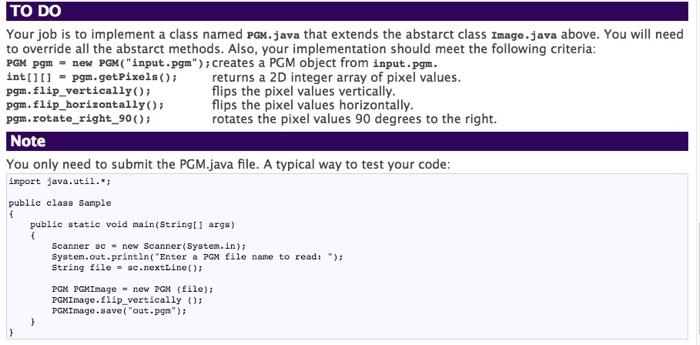
Question: How would I implement this using Java. (Visual Studio Code) PGM: I/O and Polymorphism The purpose of this assignment is to continue practicing inheritance and
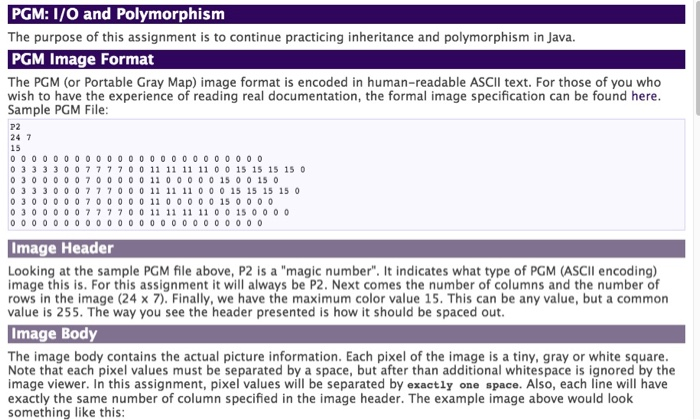
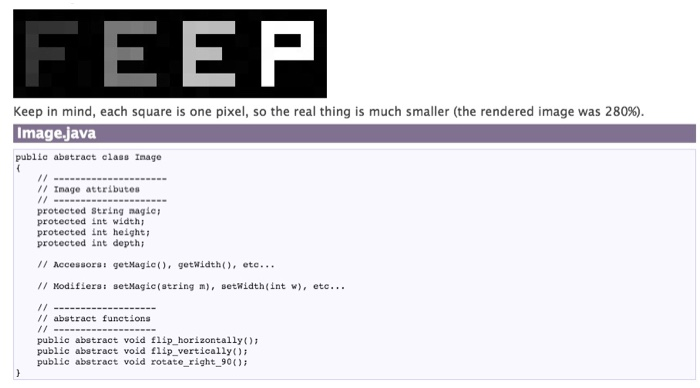
PGM: I/O and Polymorphism The purpose of this assignment is to continue practicing inheritance and polymorphism in Java PGM Image Format The PGM (or Portable Gray Map) image format is encoded in human-readable ASCII text. For those of you who wish to have the experience of reading real documentation, the formal image specification can be found here. Sample PGM File: P2 24 7 15 0 300 00 0 700 000 11 00 0 00 15 0 0 15 0 0 3 0 0 0 0 07 0 0 0 0 0 11 0 000 0 15 0 0 0 0 Image Header Looking at the sample PGM file above, P2 is a "magic number". It indicates what type of PGM (ASCIl encoding) image this is. For this assignment it will always be P2. Next comes the number of columns and the number of rows in the image (24 x 7). Finally, we have the maximum color value 15. This can be any value, but a common value is 255. The way you see the header presented is how it should be spaced out. Image Body The image body contains the actual picture information. Each pixel of the image is a tiny, gray or white square Note that each pixel values must be separated by a space, but after than additional whitespace is ignored by the image viewer. In this assignment, pixel values will be separated by exactly one space. Also, each line will have exactly the same number of column specified in the image header. The example image above would look something like this
Step by Step Solution
There are 3 Steps involved in it

Get step-by-step solutions from verified subject matter experts
 Study Help