







Question: https://www.chegg.com/homework-help/Programming-Language-Pragmatics-4th-edition-chapter-2-problem-18E-solution-9780124104099 (answer for 2.18) 4.5 Lisp has the unusual property that its programs take the form of parenthe- sized lists. The natural syntax tree for
 https://www.chegg.com/homework-help/Programming-Language-Pragmatics-4th-edition-chapter-2-problem-18E-solution-9780124104099 (answer for 2.18)
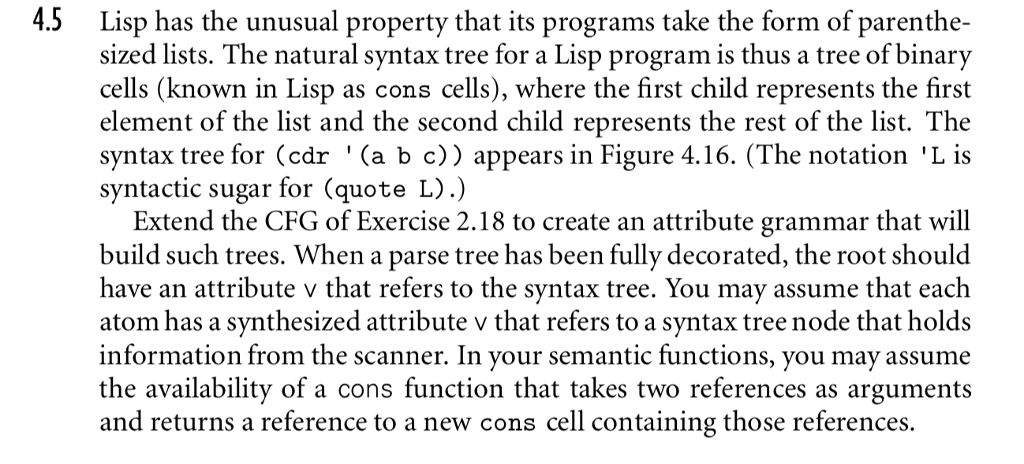
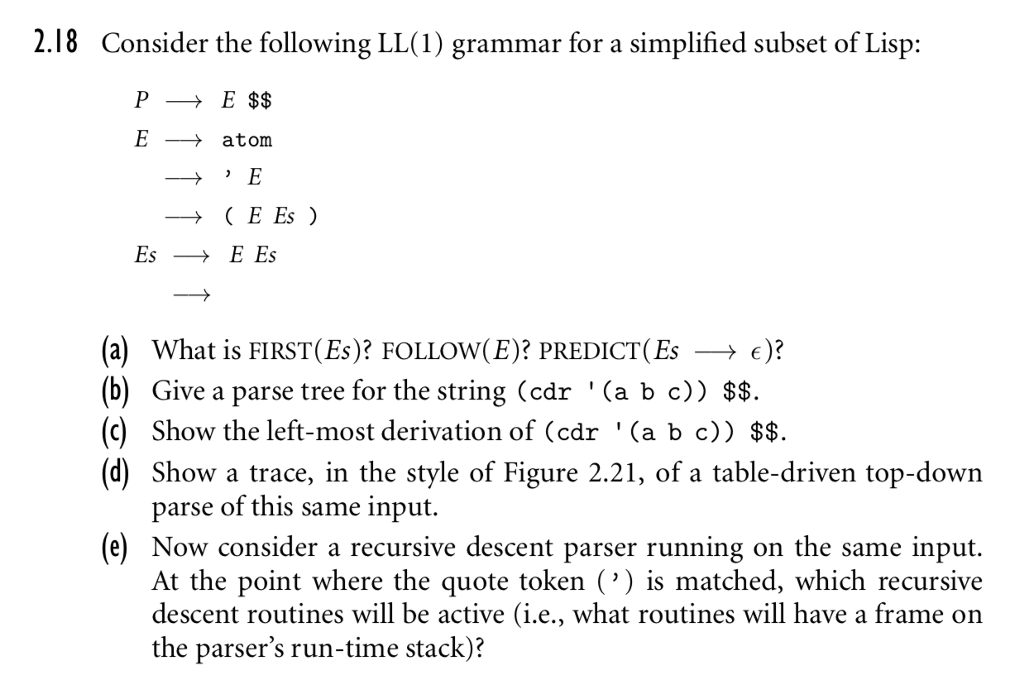
4.5 Lisp has the unusual property that its programs take the form of parenthe- sized lists. The natural syntax tree for a Lisp program is thus a tree of binary cells (known in Lisp as cons cells), where the first child represents the first element of the list and the second child represents the rest of the list. The syntax tree for (cdr '(a b c)) appears in Figure 4.16. (The notation 'L is syntactic sugar for (quote L).) Extend the CFG of Exercise 2.18 to create an attribute grammar that will build such trees. When a parse tree has been fully decorated, the root should have an attribute v that refers to the syntax tree. You may assume that each atom has a synthesized attribute v that refers to a syntax tree node that holds information from the scanner. In your semantic functions, you may assume the availability of a cons function that takes two references as arguments and returns a reference to a new cons cell containing those references. 4.5 Lisp has the unusual property that its programs take the form of parenthe- sized lists. The natural syntax tree for a Lisp program is thus a tree of binary cells (known in Lisp as cons cells), where the first child represents the first element of the list and the second child represents the rest of the list. The syntax tree for (cdr '(a b c)) appears in Figure 4.16. (The notation 'L is syntactic sugar for (quote L).) Extend the CFG of Exercise 2.18 to create an attribute grammar that will build such trees. When a parse tree has been fully decorated, the root should have an attribute v that refers to the syntax tree. You may assume that each atom has a synthesized attribute v that refers to a syntax tree node that holds information from the scanner. In your semantic functions, you may assume the availability of a cons function that takes two references as arguments and returns a reference to a new cons cell containing those references
Step by Step Solution
There are 3 Steps involved in it

Get step-by-step solutions from verified subject matter experts
 Study Help