







Question: HW#5: Rather than developing problem-specific shape functions to create element properties (as in lecture examples and handouts on Canvas), now use pre-assembled beam elements from
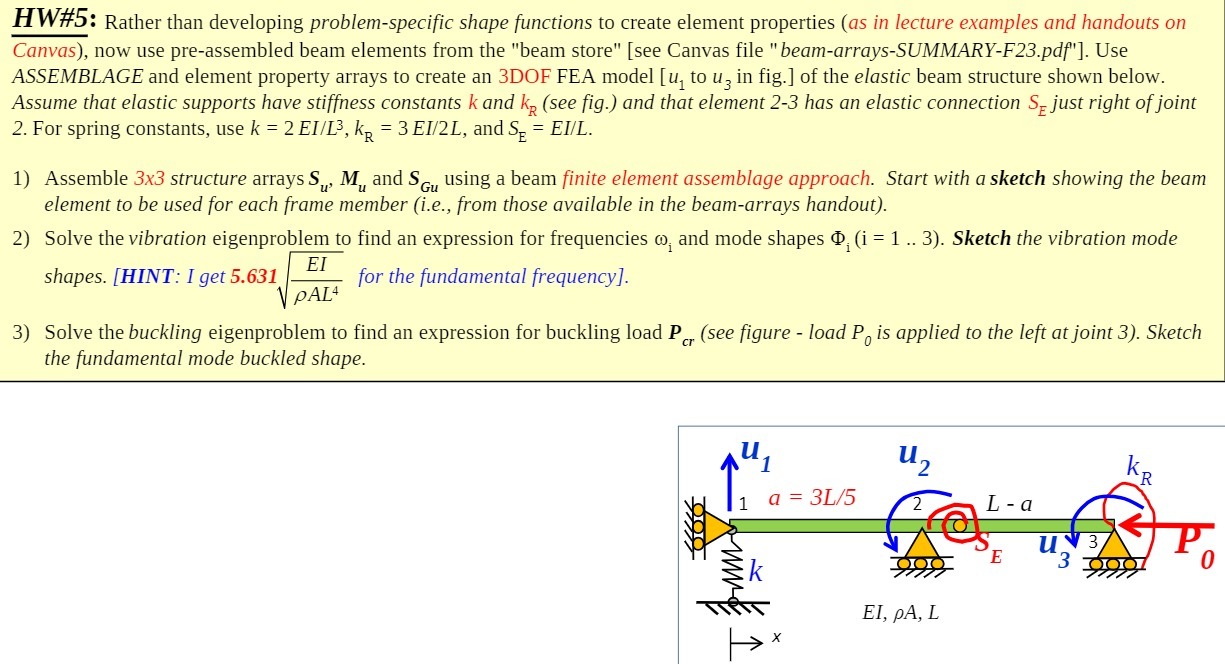
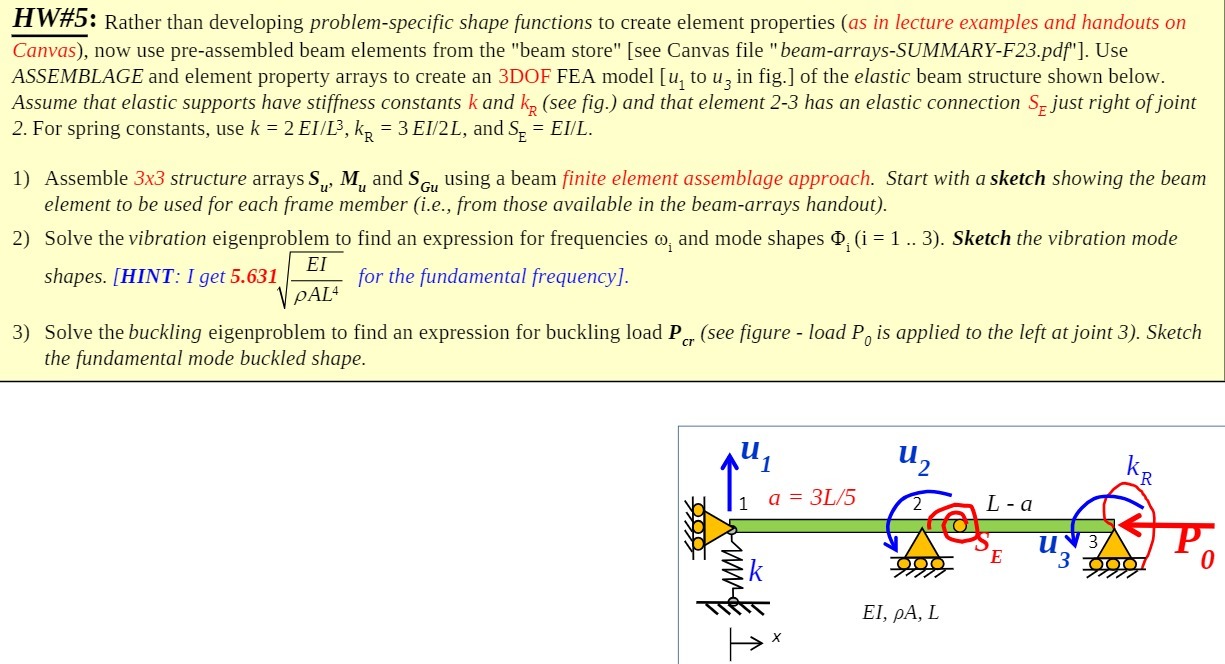
HW#5: Rather than developing problem-specific shape functions to create element properties (as in lecture examples and handouts on Canvas), now use pre-assembled beam elements from the "beam store" [see Canvas file " beam-arrays-SUMMARY-F23.pdf']. Use ASSEMBLAGE and element property arrays to create an 3DOF FEA model [u, to u, in fig.] of the elastic beam structure shown below. Assume that elastic supports have stiffness constants k and ke (see fig.) and that element 2-3 has an elastic connection S, just right of joint 2. For spring constants, use k = 2 EI/L3, KR = 3 EI/2L, and S, = EI/L. 1) Assemble 3x3 structure arrays S,, M, and S, using a beam finite element assemblage approach. Start with a sketch showing the beam element to be used for each frame member (i.e., from those available in the beam-arrays handout). 2) Solve the vibration eigenproblem to find an expression for frequencies o, and mode shapes @ (i = 1 .. 3). Sketch the vibration mode shapes. [HINT: I get 5.631 EI for the fundamental frequency]. V PAL 3) Solve the buckling eigenproblem to find an expression for buckling load P(see figure - load P, is applied to the left at joint 3). Sketch the fundamental mode buckled shape. 1 U 2 KR 1 a = 3L/5 2 L - a 3 E u Po k EI, pA, L X
Step by Step Solution
There are 3 Steps involved in it

Get step-by-step solutions from verified subject matter experts
 Study Help