







Question: i) Based on equations T1 = 50 + dz and T4=50-4+43+62+ds+d6/2, produce a matrix of payoffs in a two-players and four-players setting respectively. (ii) Discuss
i) Based on equations T1 = 50 + dz and T4=50-4+43+62+ds+d6/2,
produce a matrix of payoffs in a two-players and four-players setting respectively.
(ii) Discuss how the results of this work can be applied in business, for instance when dealing with teamwork assignments (around 300 words expected).
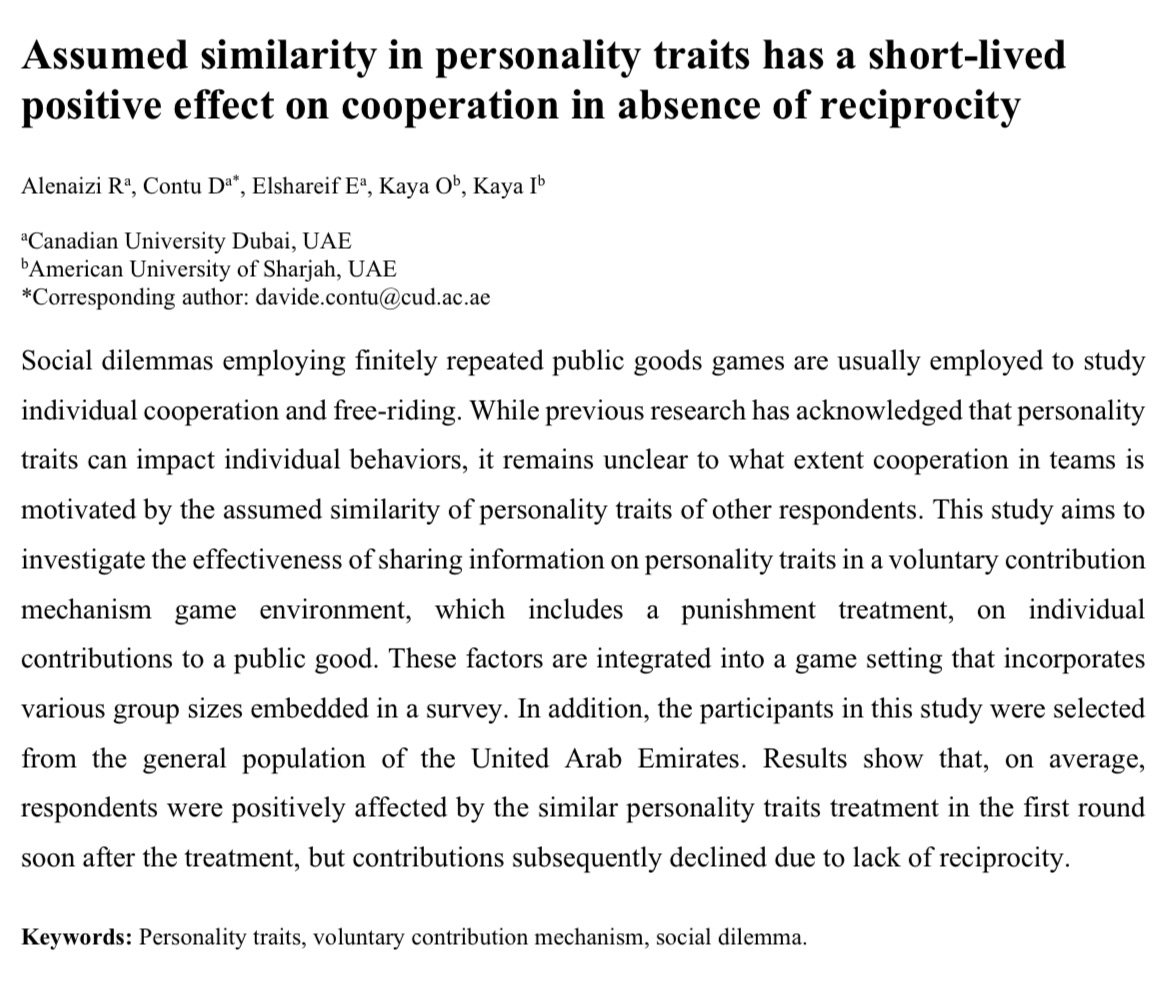
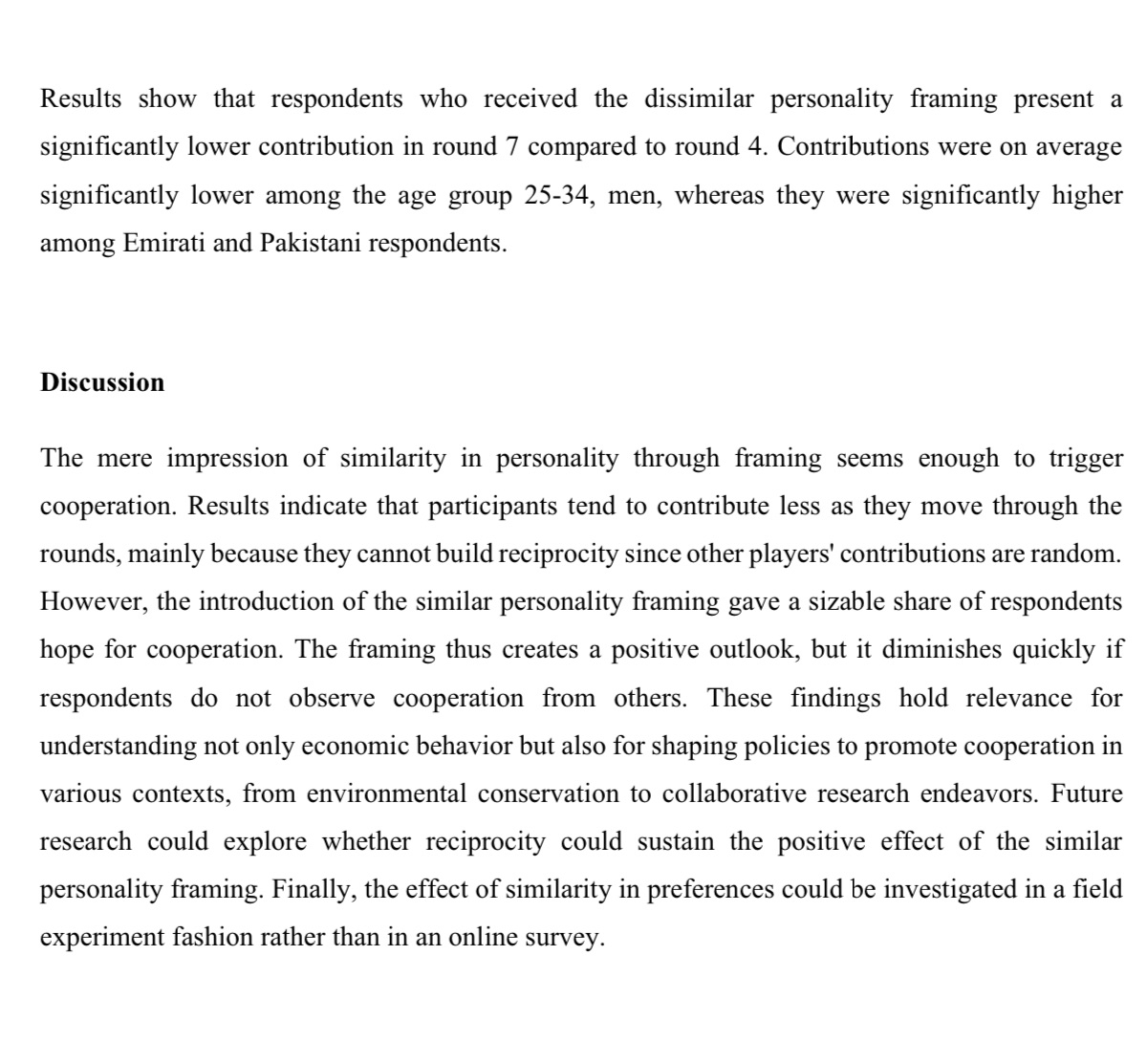
Assumed similarity in personality traits has a short-lived positive effect on cooperation in absence of reciprocity Alenaizi R?, Contu D*", Elshareif E*, Kaya O, Kaya I \"Canadian University Dubai, UAE American University of Sharjah, UAE *Corresponding author: davide.contu@cud.ac.ae Social dilemmas employing finitely repeated public goods games are usually employed to study individual cooperation and free-riding. While previous research has acknowledged that personality traits can impact individual behaviors, it remains unclear to what extent cooperation in teams is motivated by the assumed similarity of personality traits of other respondents. This study aims to investigate the effectiveness of sharing information on personality traits in a voluntary contribution mechanism game environment, which includes a punishment treatment, on individual contributions to a public good. These factors are integrated into a game setting that incorporates various group sizes embedded in a survey. In addition, the participants in this study were selected from the general population of the United Arab Emirates. Results show that, on average, respondents were positively affected by the similar personality traits treatment in the first round soon after the treatment, but contributions subsequently declined due to lack of reciprocity. Keywords: Personality traits, voluntary contribution mechanism, social dilemma. Results show that respondents who received the dissimilar personality framing present a significantly lower contribution in round 7 compared to round 4. Contributions were on average significantly lower among the age group 25-34, men, whereas they were significantly higher among Emirati and Pakistani respondents. Discussion The mere impression of similarity in personality through framing seems enough to trigger cooperation. Results indicate that participants tend to contribute less as they move through the rounds, mainly because they cannot build reciprocity since other players' contributions are random. However, the introduction of the similar personality framing gave a sizable share of respondents hope for cooperation. The framing thus creates a positive outlook, but it diminishes quickly if respondents do not observe cooperation from others. These findings hold relevance for understanding not only economic behavior but also for shaping policies to promote cooperation in various contexts, from environmental conservation to collaborative research endeavors. Future research could explore whether reciprocity could sustain the positive effect of the similar personality framing. Finally, the effect of similarity in preferences could be investigated in a field experiment fashion rather than in an online survey
Step by Step Solution
There are 3 Steps involved in it

Get step-by-step solutions from verified subject matter experts
 Study Help