







Question: I created this code but how do I change the input to ask for each X coordinate instead of only inputting one coordinate for this
I created this code but how do I change the input to ask for each "X" coordinate instead of only inputting one coordinate for this question.
# Use list comprehension to create the board board = [[0] * 20 for i in range(20)]
# Ask the user for the initial live cell's coordinates coordinates = input("Enter the initial live cell's coordinates (X Y), grid starts at (1,1): ").split() x, y = int(coordinates[0]) - 1, int(coordinates[1]) - 1
# Set the initial live cells board[y][x] = 1 board[y][x+1] = 1 board[y][x-1] = 1
def printBoard(new_board): while True: # Print the board for row in new_board: for cell in row: # Use a ternary operator to print "X" if the cell contains a live creature, or "." if it's empty print("X" if cell == 1 else ".", end=" ") print()
# Create a new board to store the next generation of creatures next_board = [[0] * 20 for i in range(20)]
# Update each cell in the new board based on the rules of the Game of Life for y in range(20): for x in range(20): # Count the number of live neighbors count = 0 for dy in [-1, 0, 1]: for dx in [-1, 0, 1]: # Ignore the current cell if dx == 0 and dy == 0: continue # Ignore cells outside the board if x+dx = 20 or y+dy = 20: continue # Count live neighbors if new_board[y+dy][x+dx] == 1: count += 1
# Apply the rules of the Game of Life if new_board[y][x] == 1: if count == 2 or count == 3: next_board[y][x] = 1 else: if count == 3: next_board[y][x] = 1
# Check if all cells are dead if sum(sum(row) for row in next_board) == 0: print("All cells are dead") break
# Ask the user if they want to continue user = input("Do you want to continue? (y): ") if user == "n": break
# Update the board for the next iteration new_board = next_board
# Start the game printBoard(board) 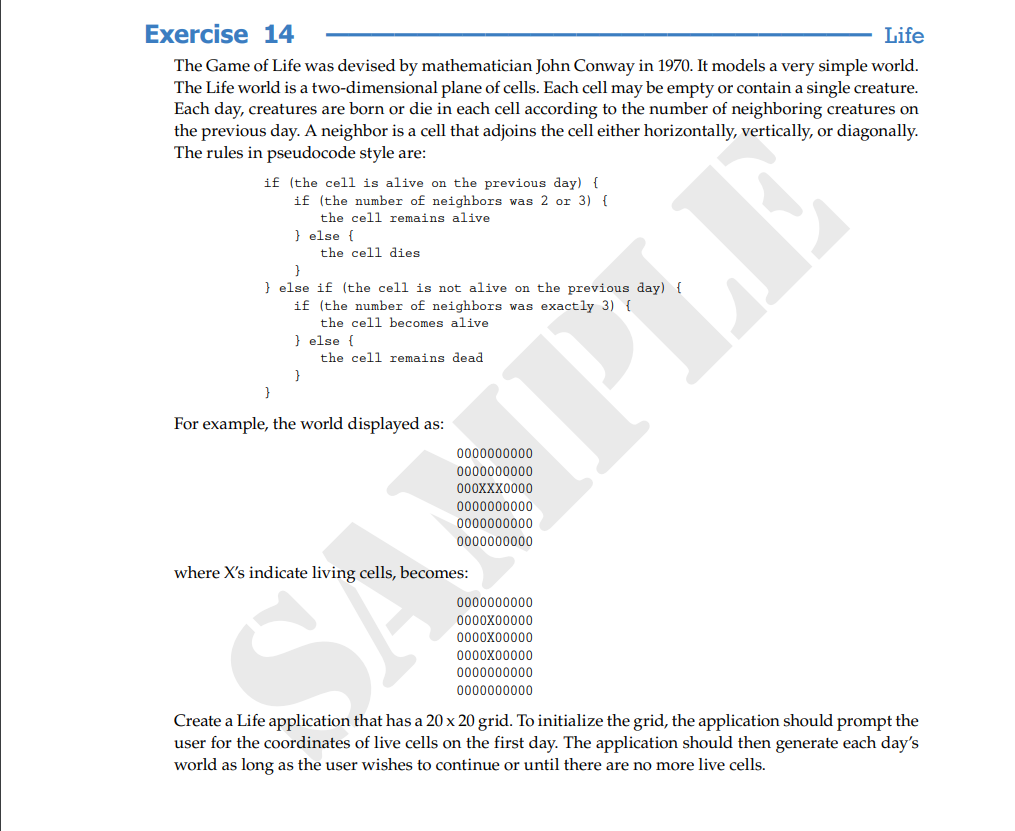
The Game of Life was devised by mathematician John Conway in 1970. It models a very simple world. The Life world is a two-dimensional plane of cells. Each cell may be empty or contain a single creature. Each day, creatures are born or die in each cell according to the number of neighboring creatures on the previous day. A neighbor is a cell that adjoins the cell either horizontally, vertically, or diagonally. The rules in pseudocode style are: if (the cell is alive on the previous day) \{ if (the number of neighbors was 2 or 3 ) \{ the cell remains alive \} else \{ the cell dies \} } else if (the cell is not alive on the previous day) \{ if (the number of neighbors was exactly 3 ) \{ the cell becomes alive t else \{ the cell remains dead For example, the world displayed as: 0000000000 0000000000 000XXX0000 0000000000 0000000000 0000000000 where X's indicate living cells, becomes: 000000000000000000000000000000000000000000000000000000000 Create a Life application that has a 2020 grid. To initialize the grid, the application should prompt the user for the coordinates of live cells on the first day. The application should then generate each day's world as long as the user wishes to continue or until there are no more live cells
Step by Step Solution
There are 3 Steps involved in it

Get step-by-step solutions from verified subject matter experts
 Study Help