







Question: I do know how to do derivatives, but have totally no idea on questions like this, can you walk me through the steps? thx 7.
I do know how to do derivatives, but have totally no idea on questions like this, can you walk me through the steps? thx
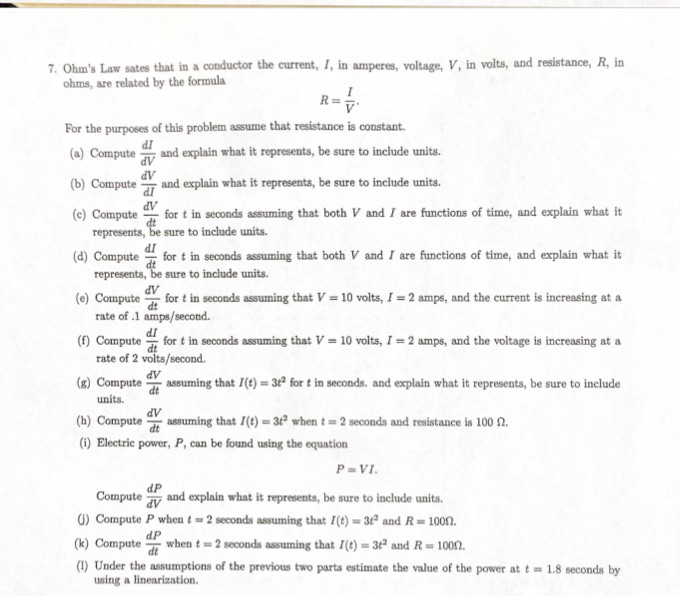
7. Ohm's Law sates that in a conductor the current, I, in amperes, voltage, V, in volts, and resistance, R, in ohms, are related by the formula RE For the purposes of this problem assume that resistance is constant. (a) Compute av and explain what it represents, be sure to include units. (b) Compute and explain what it represents, be sure to include units. (c) Compute dV dt for t in seconds assuming that both V and / are functions of time, and explain what it represents, be sure to include units. (d) Compute - for t in seconds assuming that both V and / are functions of time, and explain what it de represents, be sure to include units. (e) Compute - for t in seconds assuming that V = 10 volts, I = 2 amps, and the current is increasing at a rate of .1 amps/second. (f) Compute - for t in seconds assuming that V = 10 volts, I = 2 amps, and the voltage is increasing at a rate of 2 volts/second. (g) Compute - assuming that I(t) = 3t for t in seconds. and explain what it represents, be sure to include units. (h) Compute - assuming that I(t) = 3t' when t = 2 seconds and resistance is 100 0. (i) Electric power, P, can be found using the equation P - VI. dP Compute y and explain what it represents, be sure to include units. (j) Compute P when t = 2 seconds assuming that I(t) = 343 and R = 1000. (k) Compute - when t = 2 seconds assuming that I(t) = 362 and R = 1000. (1) Under the assumptions of the previous two parts estimate the value of the power at t = 1.8 seconds by using a linearization
Step by Step Solution
There are 3 Steps involved in it

Get step-by-step solutions from verified subject matter experts
 Study Help