







Question: I don't know how to approach these task, which topic should I convey? Project Description Power Optimisation in Wireless Sensor Networks: Wireless sensor networks (WSNs)
I don't know how to approach these task, which topic should I convey?
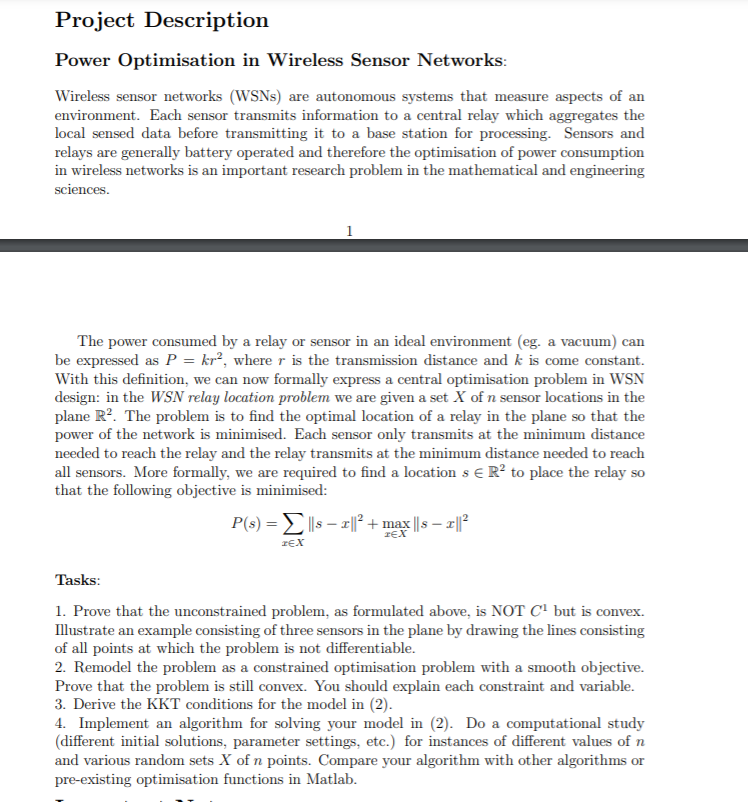
Project Description Power Optimisation in Wireless Sensor Networks: Wireless sensor networks (WSNs) are autonomous systems that measure aspects of an environment. Each sensor transmits information to a central relay which aggregates the local sensed data before transmitting it to a base station for processing. Sensors and relays are generally battery operated and therefore the optimisation of power consumption in wireless networks is an important research problem in the mathematical and engineering sciences. The power consumed by a relay or sensor in an ideal environment (eg. a vacuum) can be expressed as P = kr', where r is the transmission distance and & is come constant. With this definition, we can now formally express a central optimisation problem in WSN design: in the WSN relay location problem we are given a set X of n sensor locations in the plane R'. The problem is to find the optimal location of a relay in the plane so that the power of the network is minimised. Each sensor only transmits at the minimum distance needed to reach the relay and the relay transmits at the minimum distance needed to reach all sensors. More formally, we are required to find a location s E R" to place the relay so that the following objective is minimised: P(s) = >||s - x|2 + max ||s - z|2 IEX Tasks: 1. Prove that the unconstrained problem, as formulated above, is NOT C' but is convex. Illustrate an example consisting of three sensors in the plane by drawing the lines consisting of all points at which the problem is not differentiable. 2. Remodel the problem as a constrained optimisation problem with a smooth objective. Prove that the problem is still convex. You should explain each constraint and variable. 3. Derive the KKT conditions for the model in (2). 4. Implement an algorithm for solving your model in (2). Do a computational study (different initial solutions, parameter settings, etc.) for instances of different values of n and various random sets X of n points. Compare your algorithm with other algorithms or pre-existing optimisation functions in Matlab
Step by Step Solution
There are 3 Steps involved in it

Get step-by-step solutions from verified subject matter experts
 Study Help